

The wait is finally over for McLaren’s first golf clubs. The supercar maker and F1 racing team officially kicked off its new venture Wednesday evening at a launch party tied to this week’s Cadillac Championship and concurrent Miami Grand Prix by announcing its first two sets of golf clubs: the McLaren Golf Series 1 and Series 3 irons.
“We’ve been working toward this moment for some time and there’s a real sense of anticipation in seeing it all come to life,” McLaren Golf CEO Neil Howie said in a release. “Behind the scenes, we challenged every part of the process — from materials to construction — to uphold the exacting standards and constant pursuit of excellence that define McLaren. To now introduce these irons to the world and see them in the hands of golfers is incredibly exciting.”
Justin Rose, McLaren’s first global ambassador and investor, will debut the irons this week at the Cadillac Championship.
What’s actually new with McLaren Golf Series 1 and 3 Irons — and why you should care
All in on MIM
To deliver on its precision-first approach, the company’s inaugural iron designs are built entirely around Metal Injection Moulding (MIM). MIMing has gained traction in golf-equipment manufacturing over the past decade, allowing designers to create more complex internal geometries and achieve tighter tolerances than traditional forging or casting.
In the past, other companies have used the technology — which, as the name describes, involves injecting powdered metal into a mould to create a structure — in putters, wedges and interchangeable weights. It also enables the use of a proprietary steel developed from a blended powdered material.
“We were focused on creating a material that was soft and felt really good, while still meeting our performance targets—and I think we hit the mark,” Ryan Badgero, McLaren’s director of engineering
That material debuts in McLaren’s first two models: the Series 1 and Series 3 irons.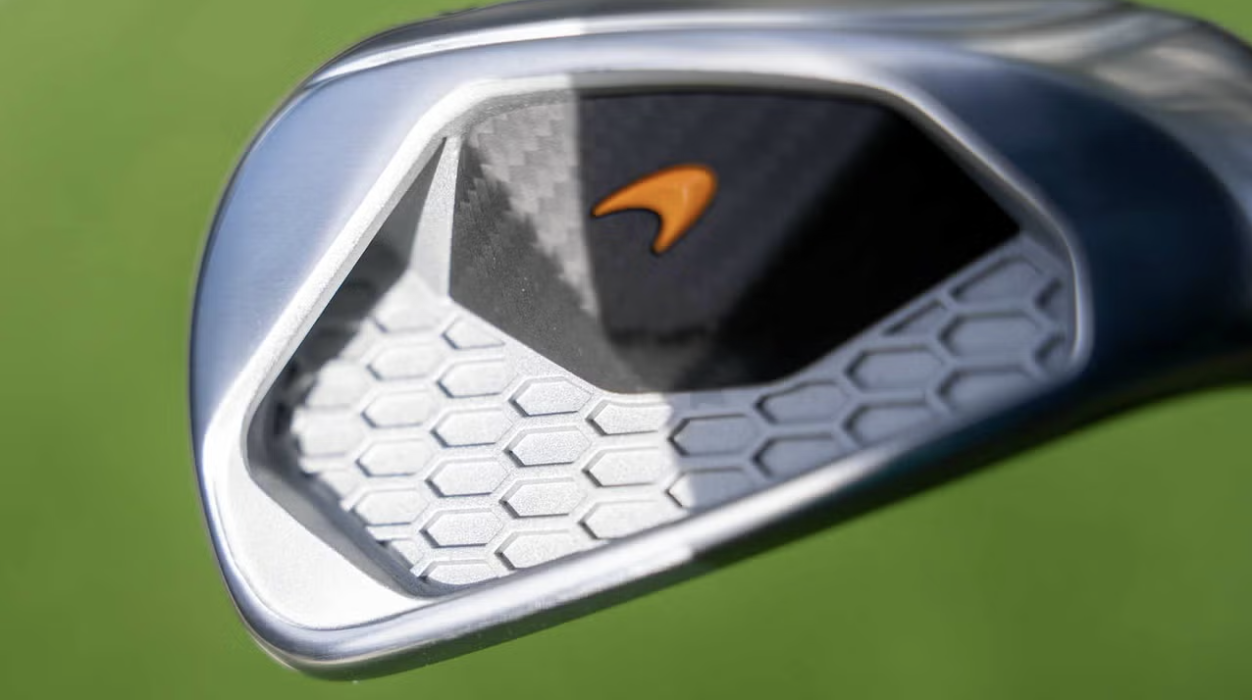
Both feature a structural mesh on the back of each clubhead, adding support while trimming roughly 2–3 grams of mass. That may not sound like much, but in club design, every gram counts. The mesh is also a callback to McLaren’s roots in car design, as the pattern mimics similar structures on McLaren Automotive’s supercars like the GTS and 750S.
“We’re able to MIM this mesh directly into the head, then redistribute that saved weight to tune CG and increase MOI,” Badgero said. “At the same time, it provides structural support, allowing us to go thinner in certain areas while maintaining integrity. It’s really a two-in-one feature.”
That discretionary mass is reallocated into tungsten weighting to create a progressive vertical CG — helping long irons launch higher while making short irons easier to flight.
A playable blade
The Series 1 takes on a traditional muscle-back profile aimed at better players and tour pros. With weight savings from the mesh, the club incorporates a silicone dampening system to enhance feel, as well as tungsten weighting. Tungsten placement shifts the CG progressively from low to high through the set, and also from heel to toe. Paired with a progressive offset package, the long irons are designed to guard against a right miss, while the short irons remain neutral.

The specs show the offset jumping nearly a full millimetre between the 8- and 7-irons, and then jumps another 1.2 mm from the 6-iron to the 5-iron. Everywhere else, the progression is roughly .1 to .2 mm. This was done based on direct feedback from working with Rose.
“One of the key pieces of feedback was that players hate seeing that right miss in the long irons,” said JP Harrington, McLaren’s senior design manager for irons and wedges. “CG placement and offset work together to help square the face more easily and prevent that leak.” A flat sole promotes versatility and shot-shaping for more skilled players.
Supercharging players distance
The larger, more forgiving Series 3 fits into the performance cavity-back category. Here, the mesh and tungsten remain, but the mass is concentrated more centrally. That’s achieved through a carbon-fibre bonnet housing a tungsten weight, along with a smaller toe weight.
The central piece doubles as a calibration weight, allowing McLaren to fine-tune head weights to extremely tight tolerances while also offering a lighter head option.
“Because it’s stacked on the centre of gravity — we designed it to hit specific CG coordinates — adding weight there doesn’t shift it,” Harrington said. “So from the lighter B head to the standard A head, the CG remains constant.”
The Series 3 sole features added camber and pronounced heel relief to improve turf interaction and forgiveness. With a more traditional offset progression—similar to the Series 1 in the long irons—the Series 3 could also serve as a long-iron replacement within a blended set. In fact, both the 3- and 4-irons feature the same loft and offset as the Series 1, while the Series 3 5-iron has the strong loft but matching offset. A 5-iron bent weak to match the Series 1 lofts would actually have less offset. Justin Rose plans to at use a Series 3 4-iron in competition and potentially a Series 3 5-iron as well.
The McLaren Golf iron lineup
Series 1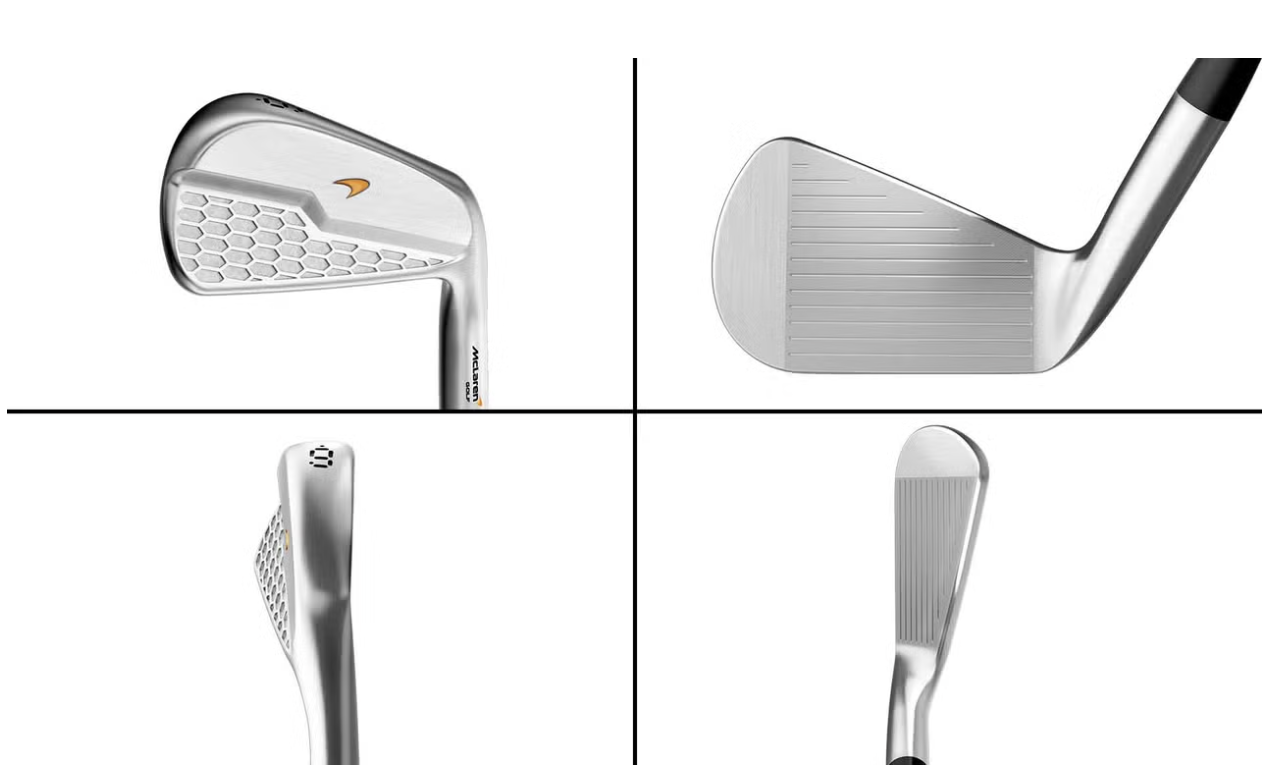
What is it: A traditional muscle-back shaping with a flat sole for ease of shot shaping. The iron has been enhanced through progressive CG moving from low-to-high and heel-to-centre from the long irons to the short irons, and a progressive offset package to help mitigate right misses with long irons.
Who it’s for: High precision ball strikers who want more speed and stability than a traditional forged muscle-back.
Series 3
McLaren Golf Series 3 iron
What is it: McLaren calls this iron a “performance cavity-back” in the players’ distance category. The Series 3 features utilise an internal toe weight, and another enclosed in a central carbon fibre bonet to centre the CG within the head and allow for an A and B weight head.
Who it’s for: A wide range of player abilities, from mid-level ball strikers looking to gain more speed or better players looking for a long iron replacement.
Our Take: Golf clubs engineered by a racing team
If you had asked me to picture the irons a supercar or F1 team would produce, they would look a lot like these. These are golf clubs you specifically get if you’re looking to get maximum performance, just like the McLaren F1 team demands from their cars on a race day. It shouldn’t be surprising that the R&D and leadership teams of McLaren could translate their expertise and design golf clubs in a way that they haven’t before.
Thanks to the MIM construction process, both the Series 1 and Series 3 irons take a trend we’ve started to see in the equipment space by making irons that play like the category above them. For instance, the Series 1 irons are playable to the point where more than just traditional blade players might be able to game them, and the Series 3 irons are going to have the forgiveness and speed of something in the players’ distance category while looking more like a traditional cavity back.
As you’d expect from a supercar company, neither of these irons is shy of speed. Rose’s fingerprints are all over the Series 1 with the progressive CG and offset to help reduce his right-miss tendency. Series 3 is something that really intrigues me, and I could see landing in my bag.
McLaren is making a big statement in the golf space, bringing new ideas and innovation. The obvious next step would be Series 2 irons, but, as Rose teased earlier this week, there will eventually be a whole bag of McLaren clubs from which to choose.
Price, Specs and Availability
McLaren Golf’s new Series 1 and Series 3 irons will be available in Europe through select custom-fitting retailers beginning April 30. Clubs will cost €375 per head.
Stock loft specs of each set are below.
Series 1: (3i) 20, 22, 26, 30, (7i) 34, 38, 42, (PW) 46
Series 3: (3i) 20, 22, 24, 27, (7i) 31, 35, 39, (PW) 44, (GW) 49