
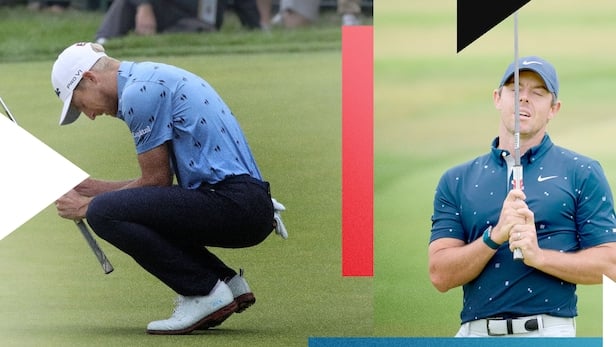
Think about how often this happens: you’re playing a match and the hole is over, but just for fun, you mindlessly roll a six-footer straight into the cup.
Now think about how often this happens: you face an even shorter putt during a big moment in a round, and now the hole feels as small as a thimble.
RELATED: Rory McIlroy reveals key skill for managing on-course nerves
This is why the most challenging golf conditions are not the kind featuring wind or rain, but self-doubt and panic. The presence of stress on its own isn’t the issue for golfers. The real trouble starts when we interpret it to mean something is wrong.
“Some people get stressed about the idea of being stressed,” said Dr Jeremy Jamieson, a professor of psychology at the University of Rochester and a leading authority on stress. “Like that the only way I can do well is if I get rid of this stress. And so now you’re spending time, you’re spending energy, spending resources on just trying to get rid of your stress response when you don’t need to. It’s something that’s there to help you.”
Two similar golf shots triggering vastly different reactions is a reflection of our intricate stress systems, which we explore in our most recent “Mind Games” video [below]. This is where nerves come from, but golfers commonly interpret the sensation as misplaced. We can accept the need for a “fight or flight” response – racing heart, sweaty palms – when being chased by a bear. But why do we feel the same thing when simply trying to save par?
As Jamieson says, the reaction traces to an earlier era, when a heightened sense of danger primed our bodies to protect against threats. ”We’re kind of catching up still in the evolution,” he said. Maybe golf isn’t about survival, yet our brains still recognise something important is at stake.
“Our greatest need as humans is to be loved and accepted, and we have an ego that’s always threatened, always comparing, never satisfied,” said Jim Murphy, a performance coach and author who works with a number of tour players. “The fear is that if I miss this putt, if I perform poorly and get a bad score, then I’m gonna get rejected, which is our greatest fear.”
It’s only when golfers understand why this anxiety surfaces that they can develop strategies on how to respond, the most important being accepting nerves versus trying to suppress them. The temptation is to want those unpleasant feelings to disappear. But when we resist against a core human instinct, we tend to make things worse, because the signal we’re sending our bodies is we’re overmatched.
“Your stress response is about taking care of that thing that could harm you,” Jamieson says. “But if we feel like we’re worried about something, like, ‘I can’t handle this,’ or ‘I don’t have the ability to take on this challenge,’ we’re just telling our bodies like, ‘Hey, I don’t have the resources to address this demand.’”