
The fleetingness of life has no greater monument than a headstone. Beneath it lies a person — someone with a mother and a father, someone who loved and hated, someone who spent their years doing the best they could with whatever tools they’d been born with. Maybe they’d had children of their own. Maybe they’d had a home — not a house, but a home, where they felt in place. Maybe they had friends. If they were lucky, they’d felt happiness. Inevitably, they’d felt sadness. They had wept. They had been a person — flesh and blood, and all of it long since gone. That unique life, unlike any other before or since, reduced to a stone marker: their name, the day they were born, and the day they died. Maybe an epitaph. And that’s it. Their whole life: decades of love, hate, sadness, joy, family, friends — and nothing from it left above ground except a name and two dates chiseled onto a slab of rock that strangers wander past for the rest of time, with no idea of what happened in between the two dates carved thereon.
Henry Duff, a postman who died in 1922. Lieutenant Corporal Peter Gordon, either 21 or 22 years old, killed by Germans in northern France in 1917. Janet MacKay, born 1886, died 1890. Margaret MacKay Taylor, born 1896 with no electricity, died 1981, less than three months before MTV premiered.
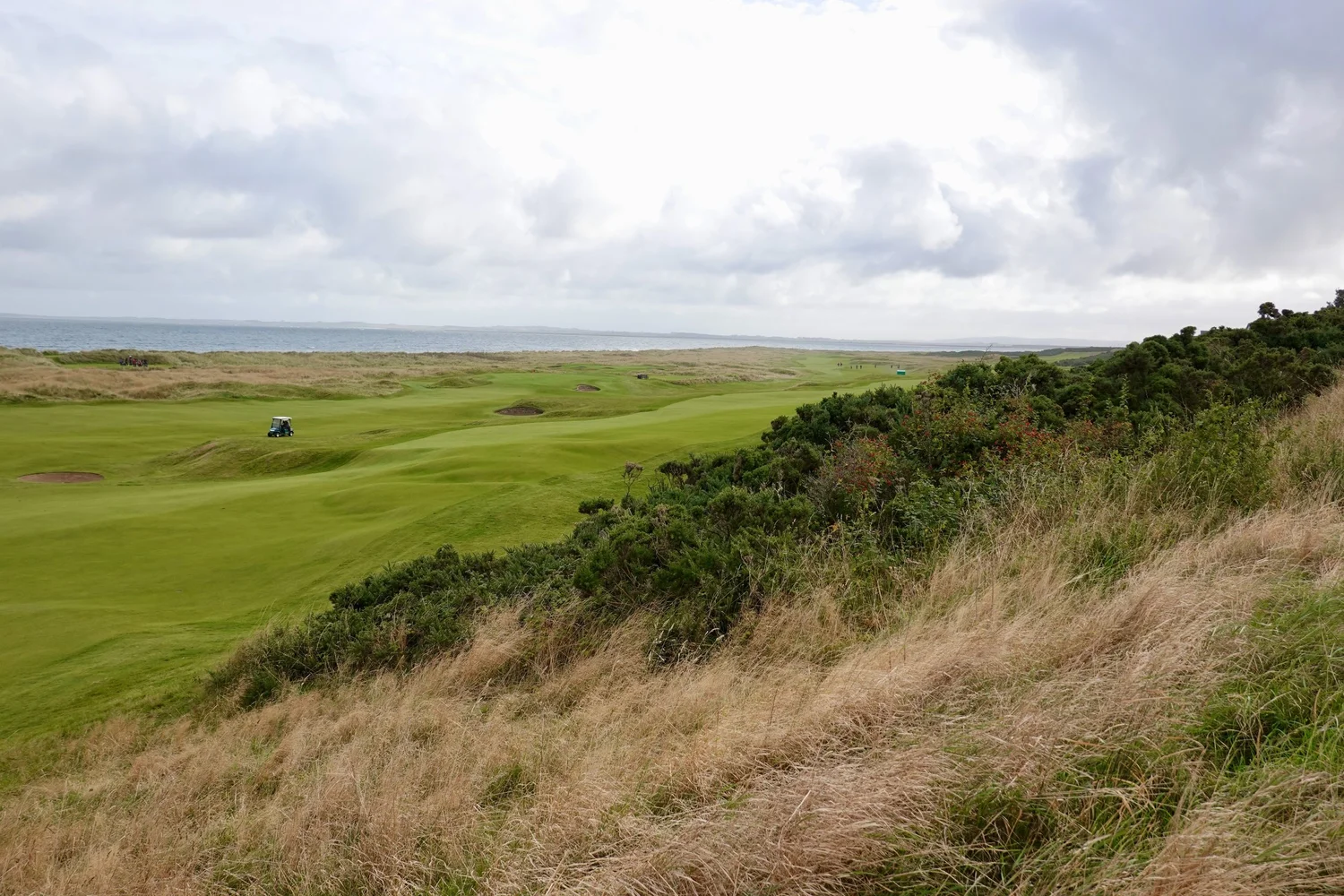
Before them all, there had been Royal Dornoch. After, too. One day, it’ll be us, and Royal Dornoch will still stand. There is comfort in that, but also disappointment — Royal Dornoch will still be there, but just out of our reach forever.
. . .
“What makes the sun set in the west
And birds fly in the sky?
And what makes a woman beat her breast
When her children start to cry?”
– Lyle Lovett, “Baltimore”
If you wandered onto Royal Dornoch’s first tee by accident, you wouldn’t guess that one of the planet’s greatest golf courses lies ahead of you. It is an unassuming place: a straightforward par-4 (331 yards from the tips, 301 yards from the yellow tees) with a mostly flat green, and just enough fairway bunkering on the left to introduce players to risk-reward. The second hole is a memorable par-3 (184 yards from the tips, 167 yards from the yellow tees), with steep fallaways left, back, and right, and two sand traps ready to swallow anything short. But even there, the setting is reserved and earthly.