
I’ve been stuck in high-handicap hell for some time now, constantly questioning whether the work I am putting into my game is actually helping me to improve as an amateur golfer.
However, after embarking on a winter golf rebuild, that has been running since December 1st, I am starting to see drastic improvements.
You may like
My Golf Performance Data vs 20-Handicapper Average Benchmark
As I head into the second half of my winter golf rebuild, I’ve got some very clear goals in mind for the 2026 season.
My (very) ambitious target is to break 80, using some of the data-informed tips outlined in the video above, but my realistic goal is to get my handicap down to 18 (or less).
This pursuit would be futile without recognising where my game is currently at, so that I know how to make the necessary progress to where I want it to be this season.
So, I decided to benchmark myself against the average 20-handicapper (according to Shot Scope data) and share the table to give you the chance to compare your performance for a better understanding of your game.
Swipe to scroll horizontallyRow 0 – Cell 0
Average 20-Handicap Benchmark
Baz’s Performance Data (Last 5 Rounds)
Average Score v Par
23.18
24
Fairway hit %
45%
38%
Greens in regulation %
19%
14%
Up & down %
31%
39%
Avg. Putts per GIR
2.16
2
The measures listed include average score against par, fairways hit, greens hit (based on regulation for my handicap index), up and down percentage (to measure short game) and putting average per green in regulation.
You may like
Overall, across my last five measured rounds, I’m playing at around 0.8 shots worse than a 20-handicapper – which consider my official index is 22 makes for good reading.
Below, I’ve broken my performance data down to directly compare to the benchmarks, in the hope that it highlights which areas I need to work on moving forwards.
You can do the same with a pad of paper and a pen, or a laptop for those more technically minded, then let me know in the comments section below how you fare against this data.
Average Score vs Par
My score vs par is +24, which places me slightly on the wrong side of the average.
Due to the horrendous weather conditions we have experienced here in the UK this winter, some of those rounds have been recorded on a nine-hole course, so I’d be interested to see how this number moves when courses fully re-open and I have the additional benefit of months of winter golf rebuild progress under my belt.
Fairways Hit %
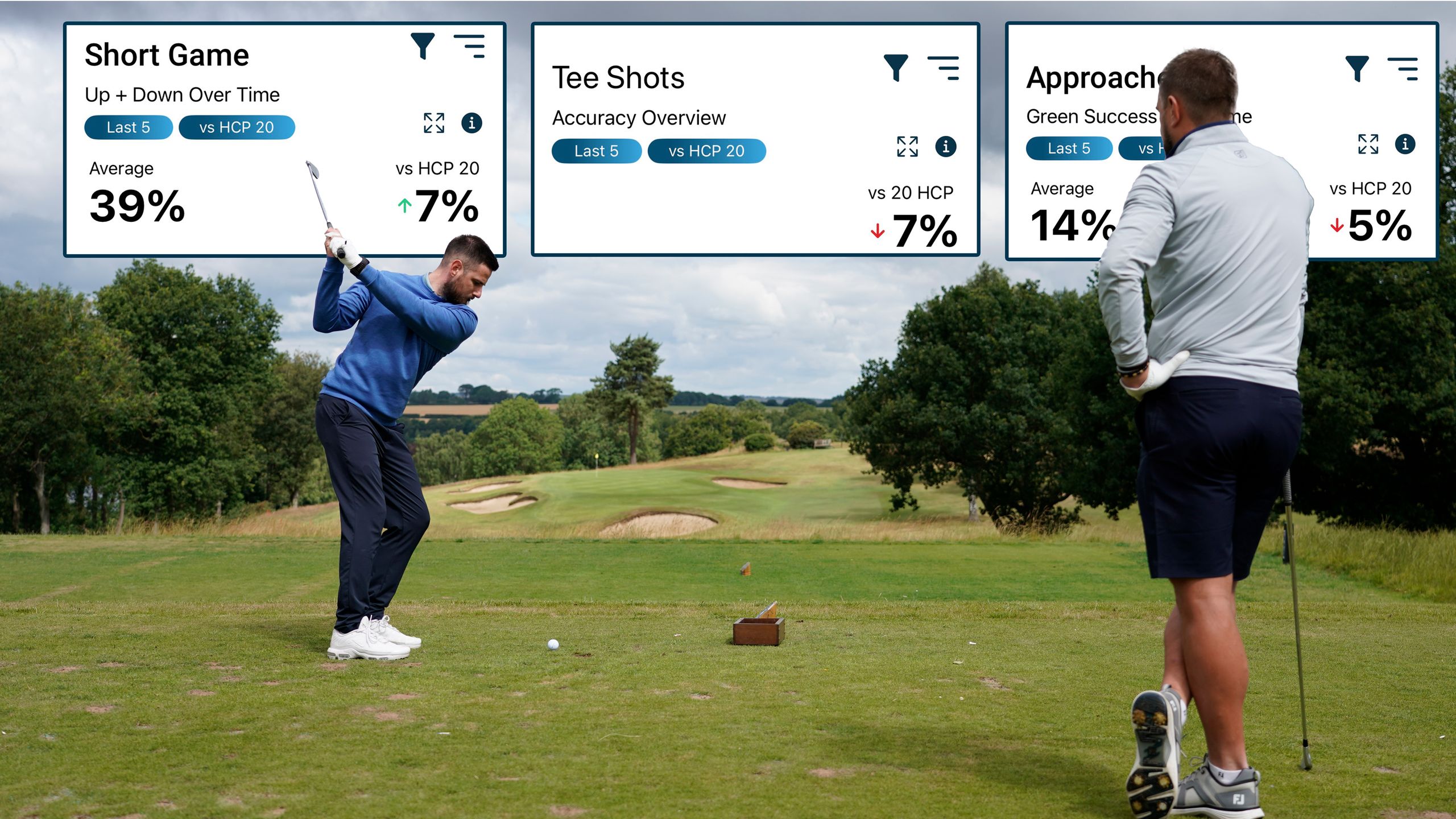
My fairway hit percentage over the past five measured rounds is 38%, leaving me 7% shy of the benchmark average for a 20-handicapper.
I’m sure much of that will be down to a tendency to miss right, which is a problem that plagues many amateur golfers, with 44% of my tee shots finding the right rough.
For reference, the average for a 15-handicapper is just higher at 47% – so one or two more fairways could make all the difference to my game.
I am currently working on setting the correct position in the backswing and allowing my lower body to work more effectively as I start the downswing, with a better weight transfer, so watch this space for a reduction in the dreaded slice.

My performance data suggests that I hit 7% less fairways than a 20-handicap benchmark average – but it also evidenced my right miss tendency
(Image credit: Mark Newcombe)
Greens Hit %
Over the last five rounds I hit 14% of greens in regulation (for my handicap) which is 5% down on the average benchmark.
Again, I am comparing myself to the average 20-handicapper – so expect to be a little lower based on the fact I am two shots off that particular index currently.
My miss is more left when approaching the green, as opposed to right off the tee, but only marginally. I miss left 8% of the time and right 5% of the time, while my particular issue tends to be missing short (66%).
To combat this I have worked on improving my clubhead speed, ways to ensure a centred strike with irons and creating a good pre-shot routine (including club selection).
Up And Down %
This is without doubt my strongest area statistically. Over the past five rounds I have achieved an up and down average of 39%, meaning I am able to get the ball into the hole from around the green in two shots around four out of ten times.
The average 20-handicapper has a 31% up and down success rate – so things are looking good in the short game department.
That number is drastically helped by my most recent measured round, where I achieved an up and down average of 54%. That’s actually in line with the numbers of a scratch golfer, and while it’s only one solitary round it at least highlights improvement and potential.
I had an on-course lesson not long ago with Ged Walters, a PGA Pro and Top 50 Coach, who helped me with a transformational short game shot that I never knew I needed – so I’d advise anyone looking to improve around the greens to start right there.

Short game appears to be a strong point at the moment, according to the data, so I’ll weight practice more heavily in favour of the areas that I am lacking in
(Image credit: Mark Newcombe)
Putting Average Per GIR
We’ve reached the final measure and once again I am seeing how my performance at the business end of the golf course is slightly better (or more consistent) than my endeavours off the tee and on approach to the green.
My putting average per GIR is 2.0, based on my five most recent rounds, which is marginally better than the average 20-handicap benchmark of 2.16 per GIR.
The whole point of this exercise was to determine where I needed to focus my attention as I head into the start of the 2026 golf season, and based on this data I can be pretty high on my chances of reaching my target handicap – providing I can tidy up my tee shots and iron play in time for competitive golf to return.