
WELLFLEET — After more than two decades of planning and a five-year approval process, reconstruction of the Chequessett Club golf course began on Jan. 5 with the arrival of heavy equipment. Low-lying tees, fairways, greens, roughs, and sand traps on five of the course’s nine holes, perennially subject to flooding, will be raised in anticipation of increased tidal flow from the Herring River Restoration Project, which would further inundate the course.
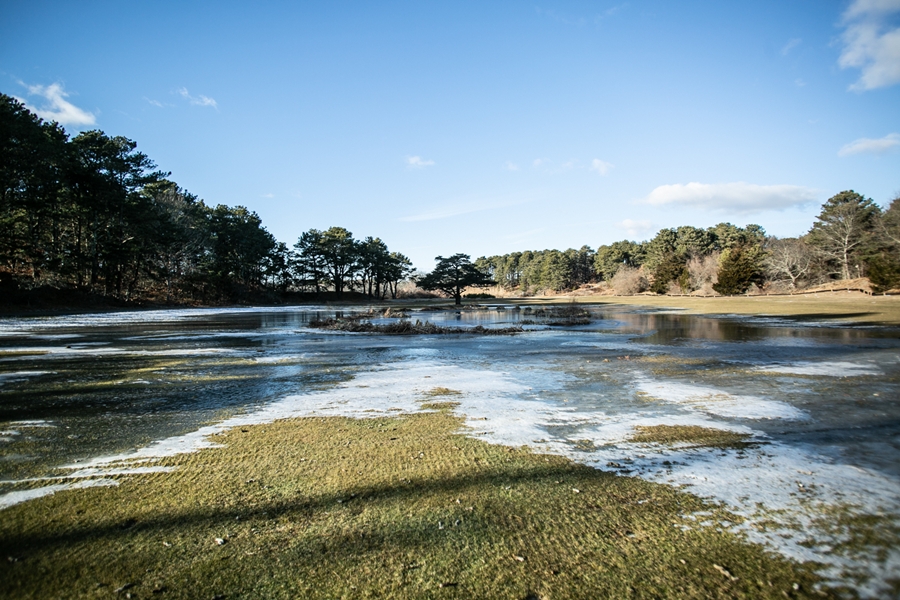 Low-lying tees, fairways, greens, rough, and sand traps on five holes at the Chequessett Club will be raised 6.7 feet to prevent flooding. (Photos by Agata Storer)
The construction, which will shut down play at the club until spring 2028, will happen in two phases: mitigation, which will raise the five holes by 6.7 feet, and restoration, in which the course will be replanted with grass, trees, and shrubs, said the club’s general manager, Barry McLaughlin.
The plan was created by New Hampshire architect Howard Maurer, who designed the Miacomet Golf Course on Nantucket. It includes some tree removal and installation of an irrigation pond as well as revegetation. The tree clearing is “not a wholesale clearing of the property,” said McLaughlin. “It’s to establish new feature areas and remove trees in areas where water is going to be.”
The loss of revenue from golf will be partly offset by the club’s other offerings, including tennis, pickleball, and summer camps. It’s also a venue for weddings and private events, McLaughlin said. There are more than 200 members who are “supporting the club staying viable during the closure,” he added.
Golf-related jobs will necessarily be fewer over the next two years, but most of them are seasonal with high year-to-year turnover. McLaughlin hopes that the renovated course — which will have a new driving range as well as remodeled holes — will attract new players and provide more opportunities for employment.
Changes at the golf course were first proposed more than 25 years ago following the initial planning of the Herring River restoration. The course was built in 1929, 20 years after the Chequessett Neck Road dike restricting the river’s tidal flow was put in place. Holes 1, 6, 7, 8, and 9, the ones to be raised, have long experienced significant flooding from high tides, rainwater buildup, and inadequate drainage.
The cost of the golf course work is about $10.5 million, according to a Nov. 3 presentation at the club. Of that total, $6.815 million will come from state and federal grants secured by the town of Wellfleet and will pay only for mitigation. The remaining $3.6 million for restoration will come from the club, which sold a chunk of its land in 2021 “to support any major capital work,” said McLaughlin. The club’s membership voted to use the money for the project at the November meeting.
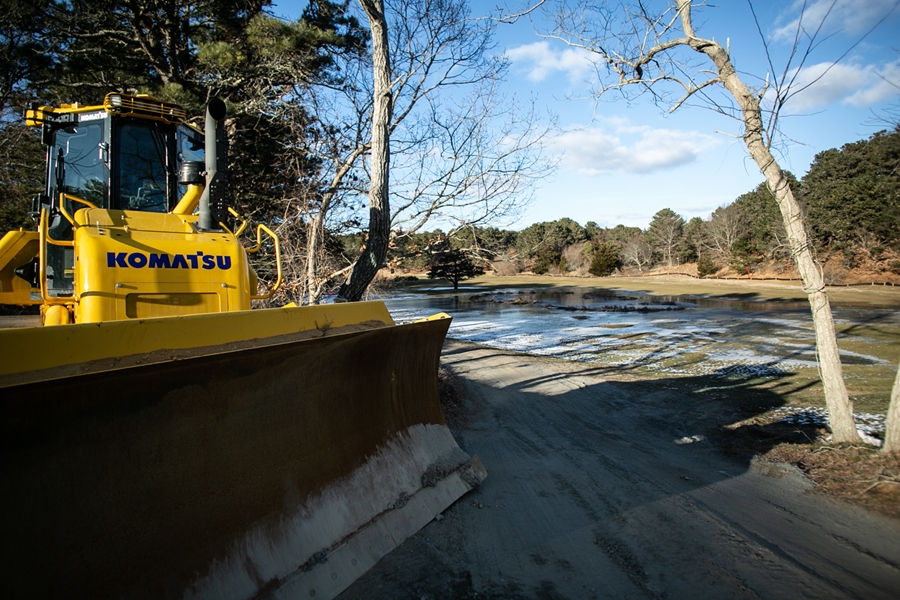 Construction teams began bringing in equipment last month.
The initial mitigation phase is slated to take about six months, according to McLaughlin. Construction teams from Turco Golf in New Jersey arrived last month with an initial crew of 10. That number is expected to expand to 40, with some additional local workers.
Following the establishment of erosion control measures like silt socks and fences (mesh barriers to prevent runoff), the next milestone is clearing trees and obtaining 220,000 cubic yards of earth from a “borrow pit” on the course, which will act as the sole material used to raise the holes, McLaughlin said. The site of the borrow pit will eventually be turned into the new driving range.
The restoration phase this summer will begin with constructing new holes on the elevated grounds, then seeding and revegetating the course. The work was supposed to have been finished by now, but “intricate” legal matters held up the timeline, said McLaughlin. The government grants will expire this summer, he said, so it’s imperative that the work be done now.
“There wasn’t really an option not to do something,” he said. “It was really about coming up with the right strategy and the right plan that the membership could get behind.”
Grants secured by the nonprofit Friends of Herring River covered “environmental assessments, engineering design, and permitting” for the golf course mitigation, said Carole Ridley, the coordinator of the Herring River Restoration Project.
Wellfleet will provide oversight for construction on the golf course, according to Christa Drew, executive director of Friends of Herring River. The town will verify that the work is done in accordance with design specifications.
The three government agencies funding the golf course project are the U.S. Dept. of Agriculture Natural Resources Conservation Service (NRCS), the Mass. Div. of Ecological Restoration, and the National Oceanic and Atmospheric Administration (NOAA).
NOAA and NRCS are two of the federal agencies that were targeted by the Trump administration’s Dept. of Government Efficiency last year. Both agencies’ budgets are projected to be significantly reduced. But both Drew and Ridley said the Herring River project was never in significant danger of losing funding.