
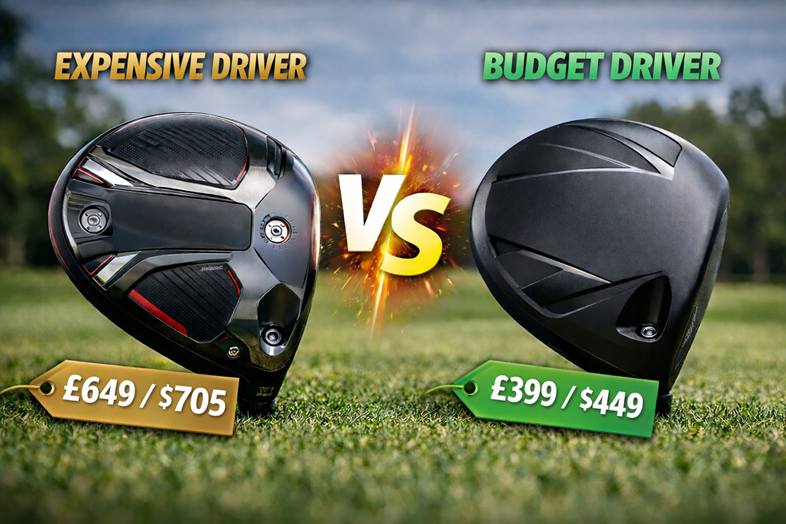
We put the cheapest and most expensive drivers of 2026 up against each other on a launch monitor to find out whether premium price tags actually deliver premium performance.
Every year we test all the latest drivers on a launch monitor to crown the best driver of the season. That process allows us to identify the longest driver, the most forgiving, the best low-spin model, and everything in between.
What we don’t factor into those rankings is the price tag.
That’s deliberate. Value for money is incredibly subjective. Some golfers want the absolute best performance available, regardless of cost. Others simply want something that works well without destroying their bank balance. Our job is to focus on performance first and let you decide where price sits in your buying decision.
There’s a big difference in the price point of drivers in 2026.
At the very top end, you’ve got models like the Callaway Quantum Triple Diamond and Ping G440 K, both sitting well north of £600 in the UK and around $700 in the US. At the other end of the spectrum is the Vice VGD01+, which undercuts the big brands by a considerable margin. Depending on where you’re shopping, the Ping and Callaway are roughly 40–60% more expensive than the Vice.
So the obvious question is: does the performance justify the premium, or are you paying for the brand name, tour presence, and the huge investment big manufacturers make in R&D?
To find out, we pulled the numbers from our full driver test and compared the cheapest driver of 2026 with the most expensive.
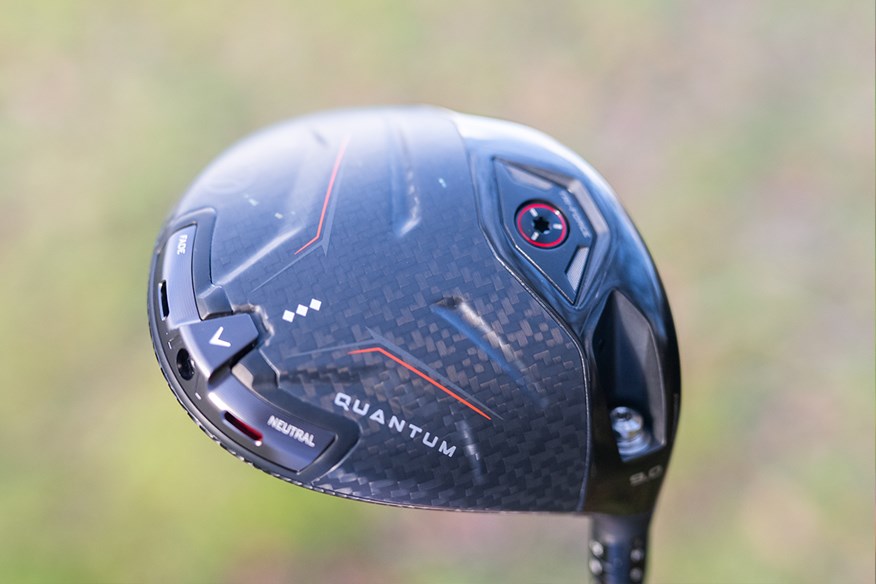 The drivers tested – and their prices
Vice VGD01+ | £399 / $449
Ping G440 K | £630 / $705
Callaway Quantum Triple Diamond | £649 / $699.99
The Ping is included as the most expensive driver in the US, while the Callaway is in as the priciest model in the UK. The Vice is the cheapest on both sides of the Atlantic.
All testing was carried out on a launch monitor under controlled conditions, using the same tester and premium golf ball.
Speed and distance – where you get what you pay for
If you’re spending big money on a driver, distance is usually high on the wish list. This is one area where the premium models do begin to separate themselves.
The Callaway Quantum Triple Diamond was one of the standout drivers for raw speed and distance.
It produced a ball speed of 162.8mph – which only the Quantum Max beat out of every driver tested – and an average carry of 286.3 yards, which was the fifth highest in the test. That’s elite-level output and exactly what better players expect from a low-spin, tour-inspired driver.
The Ping G440 K ranked well for ball speed at 161.8mph, but only mid-pack for carry distance at 277.7 yards. That gap is largely explained by higher spin and a steeper descent angle, which we’ll come onto shortly. Unlike the Callaway and Vice, the Ping is unapologetically a forgiving, high-MOI driver, prioritising stability and consistency over outright distance.
The Vice VGD01+ was the slowest and shortest of the three, averaging 271.3 yards of carry with a ball speed of 159.2mph – both a little below test average. Like the Callaway, the Vice is designed as a low-spin driver engineered to deliver maximum distance, but it doesn’t quite deliver the same level of speed efficiency.
From Vice to Callaway, the gap was around 15 yards of carry. That’s significant, but it only makes the Callaway around 5.5% longer. If you’re a slower swinger carrying your driver 230 yards, that percentage difference might translate to closer to 10 yards. That’s still not to be sniffed at, but it does bring the percentage price difference into question: is 4-5% more distance worth 40-60% higher price?
DriverBall Speed (mph)Carry Distance (yds)Callaway Quantum Triple Diamond162.8286.3Ping G440 K161.8277.7Vice VGD01+159.2271.3Test average161.3278.4 Launch, height and spin – different philosophies at play
Spin is where the personalities of these drivers really start to show.
The Callaway Quantum Triple Diamond lived up to its low-spin billing, producing just 1,992rpm of backspin. Launch angle was relatively low at 11.9°, and peak height topped out at 30 yards. That’s ideal for faster swingers who want a piercing flight and maximum roll-out, but it may be a struggle for players lacking swing speed or those who don’t naturally generate much spin.
The Ping G440 K was much more neutral. Spin climbed to 2,532rpm, launch sat at 11.4°, and peak height increased to 33.3 yards. This is classic Ping: a forgiving, high-MOI driver designed to keep the ball in the air and minimize distance loss on off-center strikes, even if that comes at the expense of outright length.
The Vice VGD01+ launched the highest at 12.9° and peaked at 38.1 yards, but it also spun the most at 2,661rpm. While it’s still marketed as a low-spin option, it’s clearly more forgiving than the Callaway in this regard, making it easier to hit and a good option for players who struggle to get sufficient launch – albeit at the cost of distance for faster swingers.
Descent angle followed a similar pattern. The Vice came in steepest at 41.4°, the Ping at 39.1°, and the Callaway flattest at 34.7°, reinforcing the different characteristics of each driver.
DriverLaunch Angle (°)Spin Rate (rpm)Descent Angle (°)Callaway Quantum Triple Diamond11.9199234.7Ping G440 K11.4253239.1Vice VGD01+12.9266141.4Test average12.1239538.4Forgiveness and dispersion – money can’t buy you fairways
Here’s where things get interesting.
You might expect the most expensive driver to be the straightest and the cheapest to be the most wayward. In reality, that wasn’t the case.
The Callaway Quantum Triple Diamond was the tightest overall, with an average left-to-right dispersion of 12.3 yards. That’s excellent, but it also reflects the fact it suits consistent ball-strikers best.
The surprise came from the Vice VGD01+, which recorded 14.3 yards of dispersion. That’s only marginally wider than the Callaway and noticeably better than the Ping.
The Ping G440 K, despite its ultra-forgiving reputation, produced the widest dispersion at 18.5 yards in this test. That doesn’t mean it’s inaccurate, but it does underline how individual delivery, spin profile, and launch conditions can influence results just as much as forgiveness tech or price.
DriverLeft-to-right dispersion (yds)Callaway Quantum Triple Diamond12.3Ping G440 K18.5Vice VGD01+14.3Test average15.0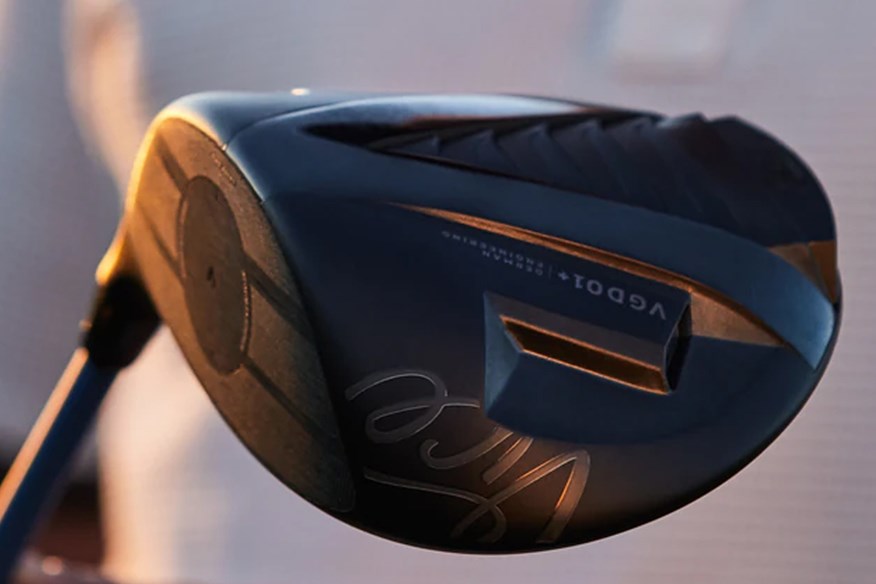 So… is a premium driver worth it?
In all honesty, the answer depends entirely on what you value most.
If you want maximum distance, the Callaway Quantum Triple Diamond absolutely justifies its price. It was the fastest, longest, and most efficient driver in this comparison, and for the right golfer, it will outperform cheaper options.
If you prioritise stability and forgiveness, the Ping G440 K still makes a strong case, even if the numbers don’t scream “value” on paper.
But if you’re looking at pure performance per pound or dollar, the Vice VGD01+ is seriously impressive. It gives up distance, yes, but not nearly as much as the price difference might suggest. In terms of forgiveness and playability, it hangs far closer to the premium models than expected.
Would I personally spend a couple of hundred more for 10-15 extra yards? If I’m playing competitive golf and swinging fast, probably. If I’m an everyday club golfer just looking for solid performance and value for money, I’d think long and hard before parting with the extra cash. There’s no need to upgrade your driver every year, of course, so spreading that extra cost across three or five seasons probably makes it feel like a more reasonable difference.
But the takeaway is simple: expensive drivers are better – just not by as much as you might think.