
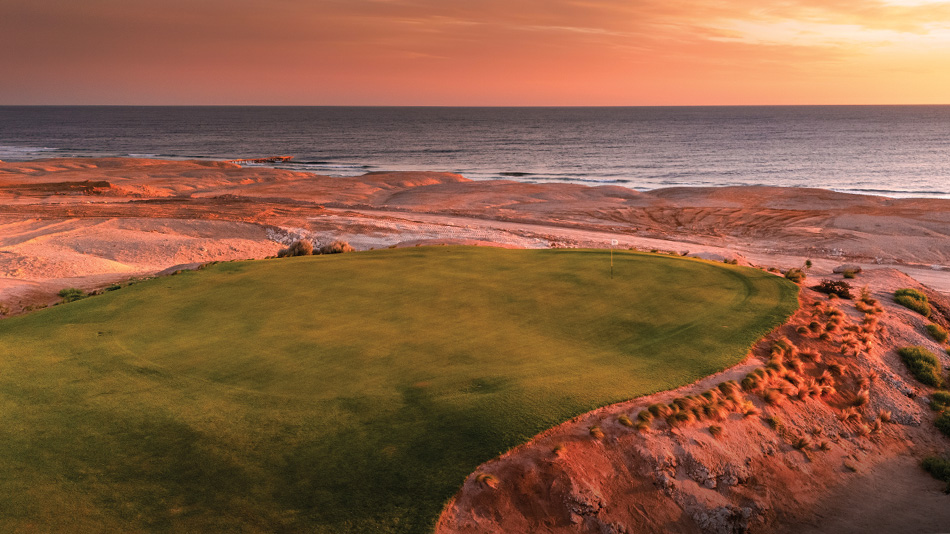
Nine holes of a Lobb + Partners layout on Egypt’s Red Sea coast are now open. Richard Humphreys paid a visit
Bandon Dunes developer Mike Keiser’s philosophy is that one course is a curiosity, while two is a destination. By that logic, Somabay on Egypt’s Red Sea coast has taken 27 years to become a destination.
A Gary Player course at Somabay Golf opened in 1998. Now, it is joined by Hidden Coves, a new layout designed by Tim Lobb of Lobb + Partners. Holes ten to eighteen are now officially open, with the front nine playable by late 2026.
The new course comes at a time of great transformation in the region, with significant investment into public infrastructure projects and private tourism developments, catering not just for golfers but those who come to the area to enjoy year-round sunshine, beaches, snorkelling among coral reefs and various other sports in the turquoise waters. This has included the expansion of Egypt’s national road network, the addition of a second terminal at Hurghada airport (around 30 miles north of the resort) and the development of a second marina at Somabay.
The resort is a hive of activity with Abu Soma Development Company expanding its residential areas with over 2,000 units, multiple hotels and various commercial areas in the next two years.
The existing course at Somabay Golf is popular with German visitors, who currently account for 45 per cent of tee times, with golfers from Sweden, Belgium and Switzerland making up most of the rest. Ahmed ‘Billy’ Belkasem, Somabay’s associate destination marketing director, says that this will change, as they are intent on attracting more international tourists from places like the UK, Finland, Italy, Poland, Austria and the Czech Republic.
“Our recent efforts include tour operator partnerships, hosting high-profile golf events and media personalities, a greater focus on golf groups comprising beginners and women, and marketing Somabay so we showcase our location’s golf, sun, sea and beyond,” he says.
Hidden Coves, named after the inlets that lie beneath the cliffs of the coastline holes, has been in the works for more than 10 years. It would have been completed quicker, but Covid tempered momentum. “We have been working on the project for a fair while and Egypt itself has seen many changes over the past decade or so,” says Lobb. “The routing was fixed in 2017, and we have not changed it since then. It primarily occupies the central portion of the peninsula that Somabay is located on, with holes twelve to fifteen playing towards and close to the Red Sea.”
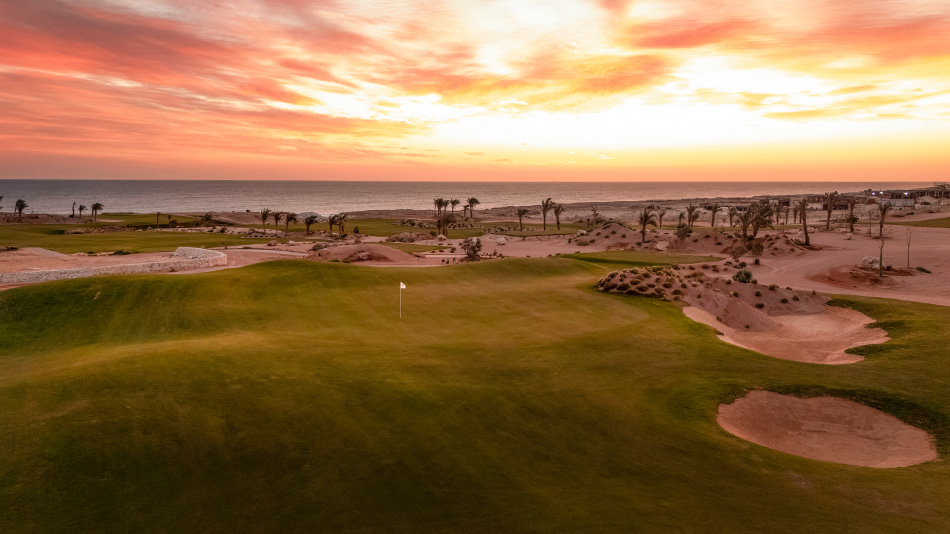
Holes on the windswept site are separated by the desert landscape, which features native plants and palms (Photo: Kevin Murray)
Lobb’s routing revolves around two holes that he identified as ‘must-haves’ – thirteen and fourteen – playing nearest the coast. Although the land would make for prime real estate, Lobb convinced the owners that reserving this area for golf would elevate the playing experience and enhance the overall appeal of the resort.
The thirteenth is a par four that begins with a drive to a fairway flanked on the left by a native area of sand and palms, that cuts in and out of the fairway. A large dune dominates the line of play for the approach shot, to a green with a spectacular sea backdrop.
Hole fourteen is the most dramatic on the property, a par three that sits among the sand and rock landscape above the coastline and is fully exposed to the wind. The green, which looks deceptively slim from the tee, falls away on all sides, with a miss leaving pot luck among the native landscape. Playing to the front of the green is the safest option, especially when the wind is up and a back pin is particularly treacherous.
“When I first visited the site, it was very apparent that the wind was a feature and that maintaining bunkers would always be a challenge,” says Lobb. “It comes from a similar direction most days, so we wanted to use the wind when determining the golf strategy. A few of the par fours can be driveable when the wind is blowing, which creates great excitement. The short par-three fourteenth, right up against the Red Sea, can be super challenging – even though it has no bunkers and is only 125 yards.”
There are only eight formal bunkers on the entire course – which would at first seem to diverge from what Lobb describes as his usual approach of using bunkers as a strategic element. But he has instead incorporated the sandy landscape of the site into the design, both to separate holes and as a hazard around greens and encroaching into fairways. On hole eleven, for example, there are great swathes of sand slicing into the fairway. Similarly to his other Egyptian design, at Newgiza in Cairo, the sandscapes feature native planting, which adds both character and jeopardy.
“I was determined to design a course that looked different to the existing Gary Player layout but also had different hazards and design strategies,” says Lobb. “We have incorporated abrupt mounding – using building rubble – to create distinctive landscape features that play into the golfing strategy.” Sandy mounds on the par-four fifteenth do exactly that, splitting the fairway and providing golfers with the option of going long over the mounds to leave a short pitch into the green, or playing right and away from the hazards, resulting in a longer approach to the green.
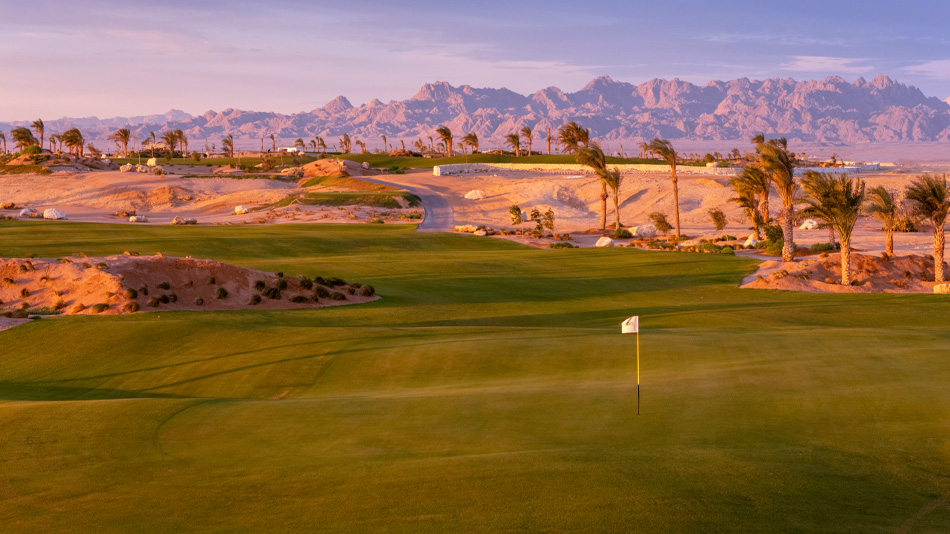
Lobb has used material from construction to create dunes, as seen here cutting into the approach area of the par-four thirteenth (Photo: Kevin Murray)
A key tenet of Lobb’s design is to create a family-friendly course suitable for people playing on their holiday. This means a focus on enjoyment; it’s generally easy to find your ball, even when a little wayward, and there are opportunities for birdie. The par-four eighteenth gives players a chance to finish their round in style. Big hitters can go for the green by hitting over a lake (the only water hazard on the back nine, but there will be more on the front), while the shorter hitter has ample room to play it safe.
The focus on playability doesn’t mean it is a complete birdie-fest. The seventeenth, for example, is likely to be more about damage limitation. It is the longest par four on the course and will usually play into the wind, and require a wood into the green.
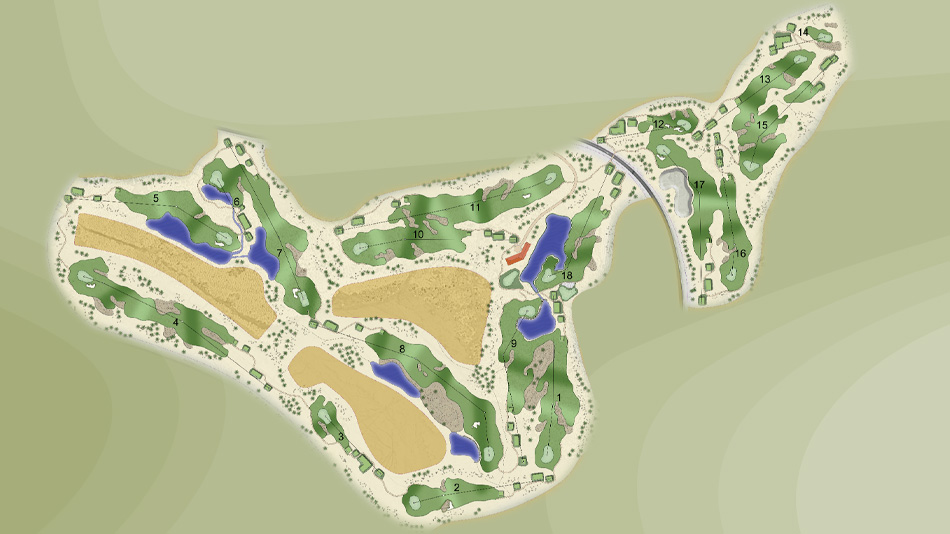
The front nine will see water in play on five holes (Image: Lobb + Partners)
In Somabay’s windy, coastal desert environment, turf performance and water management have been critical to how the course plays.
“We have been working hard with course superintendent Andrew Hughes to ensure that the Pure Dynasty turf can be mown down tight,” says Lobb. The paspalum turf has been used on all playing surfaces following its successful performance on tees and greens on the Gary Player course, originally supplied by Atlas Turf International and Pure Seed. Hughes has guided the grow-in of the Pure Dynasty turf on the Hidden Coves course.
“Pure Dynasty is perfectly suited to our environment and gives us the flexibility to maintain a true wall-to-wall paspalum surface with varied heights of cut,” says Hughes. “It also supports the design intent of allowing golfers to putt from 20-30 yards out if they would like, making the course more playable and enjoyable for all levels. One of the advantages of paspalum is its ability to reduce water requirements once mature, supporting our long-term sustainability goals.
“The Toro Lynx system also gives us precise control over irrigation and allows for individual sprinkler adjustments depending on wind direction and micro-conditions. We’ve installed Infinity heads on greens for ease of maintenance and Flex heads across the rest of the course for consistent performance and the results so far have been great.”
Lobb and his team’s thoughts are now focused on the front, which is currently under construction. “It is played mainly in the central land parcel of Somabay but will still have long views of the Red Sea,” says Lobb. “Like the back nine, the front will have a number of teeing locations to cater for all levels and interestingly shaped greens complexes. There will be a few more lakes to bring the water element into the golfing strategy, too.”
There are several excellent additional golf facilities at the resort, which allow visitors to complement an eighteen-hole round with a more casual golfing experience. For those wanting more variety over a longer stay, the Madinat Makadi course, designed by John Sanford, is just up the coast and there are two more (El Gouna and Ancient Sands), north of Hurghada.
Read more: Somabay’s array of golf facilities include a short-game area by James Edwards, a redesigned par-three course, double-sided driving range an island-green for holin-one contests.
It may have taken a while, but Somabay’s status as a golf destination is now secured.