
It hit me right in the feels when we got to the entrance sign on 17-Mile Drive.
Cypress Point Club
Members Only
“Get ready for one of the best days of your life,” smiled Jason Bruno, my friend and media colleague, sitting in the driver’s seat. “We here, baby.”
How I came to be part of a foursome at Cypress Point on a pristine Monterey Peninsula morning alongside Bruno, California-based golf course architect Jay Blasi and Kevin Frisch of KFPR Communications in early December will have to stay — as Cypress Point is — private. What I can tell you is I owe a debt of gratitude to some people that I’ll never be able to repay.
Covering the game and golf industry for 43 years, my craziest fantasy never included standing on the first tee of Cypress Point. If I’m being honest, Dr. Alister MacKenzie’s “Sistine Chapel” wasn’t even on my bucket list. It just didn’t seem realistic.
Courses such as Royal Melbourne, Royal Dornoch, the Old Course at St Andrews and Royal County Down — all at or near the top of my list — are accessible through various channels, which means there’s always hope I’ll cross those off one day. Even Augusta National provides media covering the Masters each year with a chance to play the course through its annual Monday lottery.
Cypress Point? Unless you’re invited by one of 250 club members you can’t get on.
What was surprising when we arrived was the absence of opulence or pretentiousness. The club might one of the world’s most exclusive and its golf course ranked somewhere between one and three on most global lists, but you’d never know it.
Dwarfed by Cypress trees, the Spanish Colonial designed clubhouse, pro shop and men’s locker room are elegantly understated with a dark cedar roof and simple white exterior. Pro shop staff were as nice as could be and more than welcoming.
Inside the locker room framed black and white photos are a veritable time portal back to the club’s early days. Two stood out for me: one of Cypress Point founder Marion Hollins in a classic swing finish and the other of a sitting MacKenzie — whom Hollins commissioned to design Cypress after the untimely passing of original architect Seth Raynor — gazing across to the famous 16th green.
Hollins, the club’s visionary and matriarch, is immortalized in multiple places at Cypress but nowhere more profoundly than the club’s red brick back patio. Aptly named Hollins Terrace, the view overlooks the 16th hole and 17th tee box and it is spectacular. Legend has it that Hollins had some of her ashes spread across the 16th green, a hole she in fact designed with MacKenzie’s blessing.
Cypress Point does have some rules. Dress code is slacks and collared shirt (golf hoodies are acceptable). Changing shoes anywhere other than the locker room is a no-no and phones stay in your golf bag except when used for taking pictures. Being a walking-only course, caddies are mandatory. The cost for a caddie is $200 and with no yardage markers, they’re worth every penny.
Approaching our tee time, everyone’s anticipation level was high. Caddie Paul took the obligatory first tee group picture and we were ready to go.
Cypress Point’s opening tee shot is sublime. Over a hedge and across 17-Mile Drive, the hole works its way into a valley backdropped by the Santa Lucia Mountains and Pacific Ocean. Making a 15-foot putt for par on No. 1 was a dream start.
Having a few weeks’ notice to prepare for this once-in-a-lifetime game, I had re-read Mark Frost’s brilliant book, The Match.
Chronicling the historic January 10, 1956, match at Cypress Point pitting professionals Ben Hogan and Byron Nelson against young amateur sensations Ken Venturi and Harvey Ward, it offers a lot of detail about the golf course. Having met Nelson at the 1987 Ryder Cup, and interviewed Venturi at the 1988 Canadian Open at Glen Abbey) and Ward in 1985 at the Pinecrest Inn in North Carolina, it was fun to revisit that epic encounter.
Re-watching last year’s Walker Cup at Cypres Point was also time well spent. Gaining that visual perspective probably didn’t help me play any better, but it made me appreciate what awaited in prospect.
I could spend a couple thousand words on a blow-by-blow round description, but I don’t do those. Instead, I jotted down some notes while playing and added a few thoughts to hopefully give you a sense of what Cypress Point is like.
– We played the middle tees, which measure 6,294 yards. The goal was to enjoy the views, design and experience so we didn’t bother with a scorecard. The championship tees are 6,552 yards and forward tees are 5,715. The par is 72.
– The golf course has three distinct areas: Holes 1 to 6 run through a pine forest, 6 to 12 are in the dunes and 13 to 18 are the famous ocean holes. The brilliant design and routing makes the transitions seamless.
– There are three par 5s on the outward nine: The second, fifth and sixth.
– MacKenzie’s bunkering on the first five holes should be mandatory study for any aspiring golf course architect. They are the best I’ve ever seen.
– The greens are diabolical. Small for the most part, they’re fast (around 11 on the Stimpmeter), feature subtle undulations, fall-offs and specific quadrants you need to get approach shots to.
– I made birdie at the fourth from 15 feet, but my front nine highlight came at the short par-4 ninth hole. Caddie Paul handed me pitching wedge for the uphill shot and pointed out a line at least 20 yards left of the flag. Just like he drew it up, my shot finished a foot from the hole.
– MacKenzie’s use of the terrain and the dunes’ sandy outcroppings are pure land art.
– The 250-year-old Octopus tree on the 14th hole is arguably the greatest tree in golf.
– The short par-3 15th hole is just as good as the famous l6th hole.
– Some consider the 18th hole to be a letdown, but I didn’t see it that way. The inland uphill par 4 requires two great shots to reach the green before you putt out and shake hands.
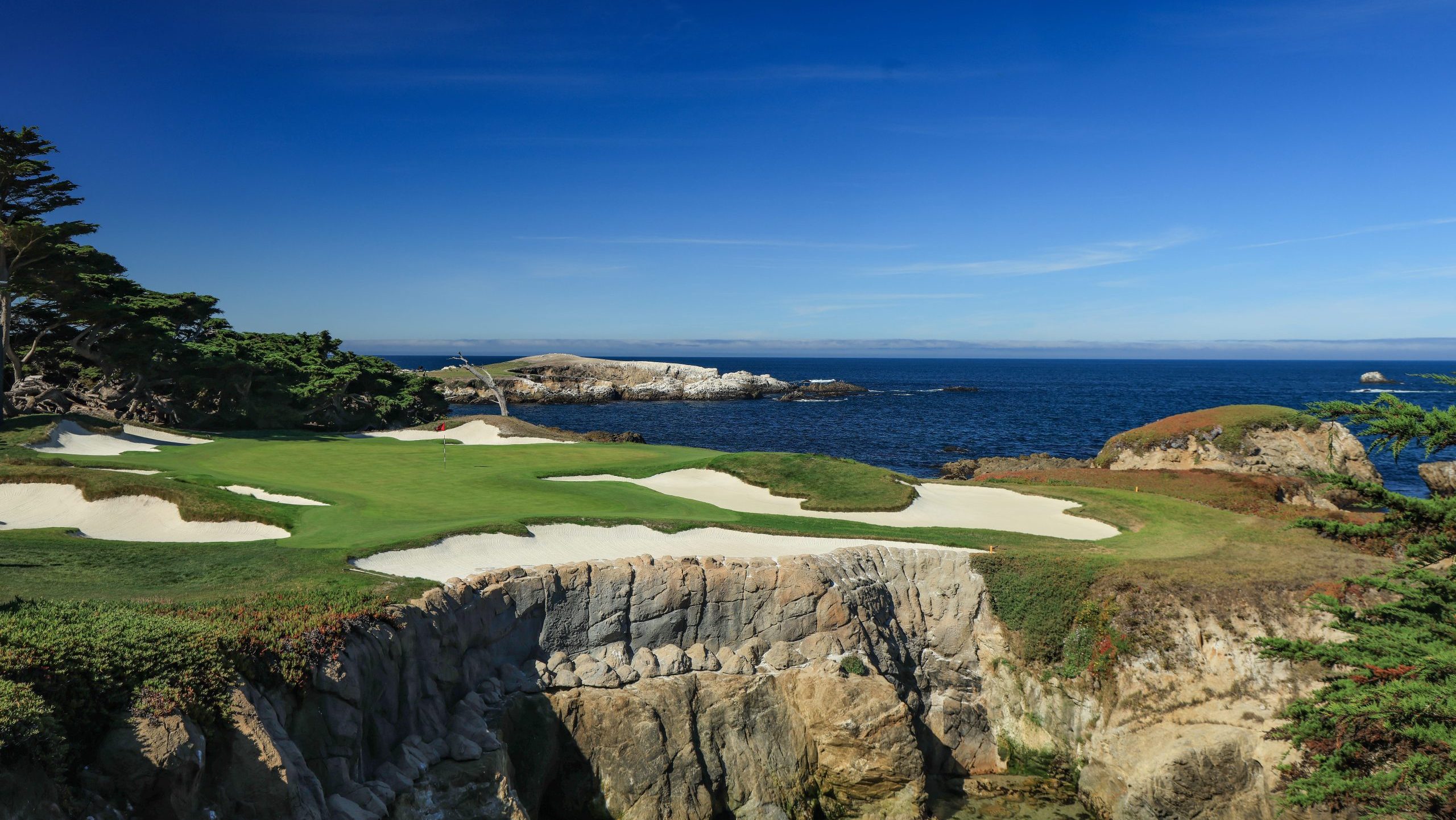
The walk from 15 green to 16 tee is the greatest stroll in golf. And it’s not close. As the 16th green starts coming into view, the sound of waves crashing up against the craggy Monterey Bay shoreline is amplified and you appreciate there isn’t a more special place anywhere on earth.
This is where I honored my dad.
He passed in late October and coming to grips with that has been difficult. Credit to Jason Bruno for the idea of hitting a shot for him on 16. For that, I rummaged through his golf bag before the trip and found a sleeve of Callaway Chrome Soft Truvis Shamrock golf balls I gifted him for Father’s Day a couple years ago. In my hotel room the night before we played, I used a black Sharpie to carefully inscribe the following:
Lloyd Young 1933-2025
After hitting their tee shots on the famed 223-yard par 3, Bruno, Blasi and Frisch gave me the tee and a lot of encouragement. I needed it. With tears in my eyes, I somehow managed to hit a high solid shot but wasn’t sure if it had cleared the Pacific. Halfway to the green, Blasi confirmed it. My ceremonial shot for Dad finished 12 feet right of the hole.
A birdie would have been nice, but my putt burned the right side. In the moment I thought about keeping the ball, but it didn’t feel right. So I grabbed that same Sharpie, wrote some words, then flipped the ball into the Pacific.
It read: “Grateful to be here.”
So was his son.