
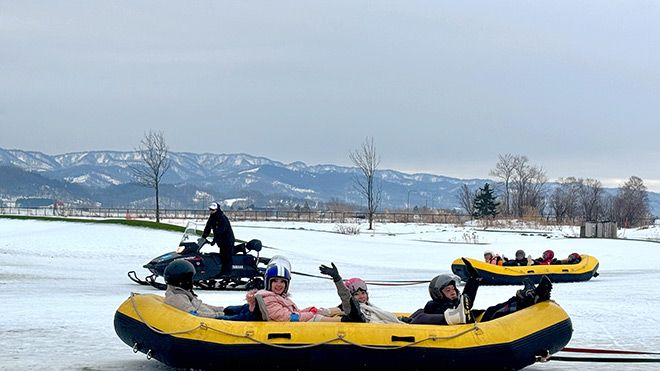
BIBAI, Hokkaido—A golf resort here has used its off-season—and the accompanying heavy snowfalls–to turn around its business and perhaps save this depopulated city from financial ruin.
Bibai city had previously flourished as one of the nation’s most famous coal-producing areas.
But the closure of its leading coal mine decades ago led to a drastic population decline.
The main Bibai Station in the municipality was sparsely used in summer. And even the magnificent natural surroundings and the city’s rich history could not draw visitors from around Japan and overseas.
The Golf5 Country Bibai Course on the outskirts of the city also suffered prolonged financial hardships.
However, Takashi Komizu, manager of the golf course, found a way out of the financial hazard.
Using the once-dreaded snowfalls that isolated Bibai from surrounding areas, he turned the sprawling 27-hole golf course into a winter paradise, particularly for foreign tourists who have never experienced snow.
Nowadays, after the arrival of the snowy season, up to a hundred people exit a single train at Bibai Station. Conversations in foreign languages often echo through the station.
These sightseers usually head en masse for the leisure complex Alpen Snowland Bibai, the winter name of the Golf5 Country Bibai Course.
The visitor influx has led to a deployment of winter-only interpreters and security guards.
SNOW BUSINESS
Bibai, with about 18,000 residents, is located 35 minutes by express train from JR Sapporo Station.
Alpen Snowland Bibai covers 1.25 million square meters, the equivalent of 27 Tokyo Domes, and is surrounded by snow-capped mountains.
It offers visitors a range of rides and experiences, such as snowmobiles, hovercrafts and hot air balloons. Sledding is also available for customers who want to take full advantage of the undulating terrain.
Alpen Snowland Bibai reported just 800 visitors in its first year in 2017. The figure has since risen steadily, excluding the COVID-19 pandemic period, and reached a record 20,000 last season, a more than 2.8-fold year-on-year increase.
Around 90 percent of visitors come from abroad, mainly in regions with little or no snowfall.
A representative from Apple Vacations, a Malaysian travel agency that has been organizing tours to Hokkaido since the inauguration of Alpen Snowland Bibai, stressed that simply touching snow is an extraordinary experience for Malaysians.
The winter resort also offers easy and enjoyable activities for beginner skiers, the representative said, adding that the feature has led to a high level of customer satisfaction.
An Australian couple described their visit to Alpen Snowland Bibai as the most thrilling experience of their lives. It was the first time they had experienced snow, and simply walking across a vast snowy field was a great deal of fun.
A Filipino woman was pleased that her children kept laughing after they arrived at the resort. She was also happy that the place was not as crowded as other spots in Japan.
BONDS FUEL SUCCESS
“Our golfing business had been plagued by a tough corporate environment from its opening in 1995, but our Snowland department has recently logged significant growth,” Komizu said.
When the Golf5 Country Bibai Course closed for winter, employees were sent to work at ski slopes and other facilities around Japan run by Alpen Co., the Nagoya-based sporting gear company that operates the golf course. This forced them to live away from their families in Bibai for several months.
Some staff members looked for new employers or left Bibai for more stable work.
Komizu believed that the best way to keep talented workers was to have them work year-round in Bibai.
He learned that another golf resort near New Chitose Airport in Hokkaido was drawing considerable attention by offering visitors the experience of playing in snow.
After Komizu requested advice, the Chitose operator shared its know-how to “invigorate Hokkaido together,” noting that the two businesses were sufficiently far apart.
But Komizu also had to convince his own corporate management of the winter plan for the money-losing golf course.
Expecting a harsh response, Komizu prepared his negotiation cards.
He suggested “using the Japan Tourism Agency’s subsidy system to rein in our out-of-pocket spending.”
He also leveraged the golf course’s relationship with local partner Bijiko Kanko Bus.
“The connections that Bijiko Kanko Bus has with a leading Malaysian travel agent will get it to include our facility in its tours from the first year,” Komizu emphasized.
He aggressively highlighted the positive visitor estimates and bright prospects for his plan–and ended up winning approval.
Komizu was also fortunate enough to acquire a secondhand snow groomer that was due to be replaced at a ski resort of the Alpen Group.
The vehicle is essential for maintaining the vast snowfield in Bibai.
After opening, Alpen Snowland Bibai mainly targeted tourists in snow-free regions of Southeast Asia.
Bibai, located midway between famous tourist destinations like Sapporo, Asahikawa and Furano, encouraged visitors to “casually stop by” the comprehensive snow resort.
“Our success was also buoyed by the recent tendency among tourists to prefer local destinations over already renowned spots,” Komizu said.
Bibai may have stood out last season when the city received abundant snow while snowfalls were lighter elsewhere across Hokkaido.
HIDDEN GEM
The public and private sectors are closely cooperating to spread the flow of visitors in Bibai to the surrounding area. The move comes as tourists have shifted from group tours to individual packages.
Hokkaido Railway Co. (JR Hokkaido) has improved the convenience of Bibai Station via its updated train schedule and other measures.
The Bibai Tourism and Products Association co-hosted a specialized “market” at the station to sell regional specialties to passengers waiting for their trains.
The city government has also set up a free public wi-fi network around the station and plans to provide information about nearby shops and stores in multiple languages.
In addition, it is considering establishing “kamakura” snow huts and holding an illumination event so that visitors will stay longer in Bibai and visit more places in the area.
Bibai Mayor Hisashi Sakurai has promoted the municipality at international travel fairs as part of his top-level sales endeavor.
He said snow has been transformed from a “nuisance for residents” into a “fantastic resource” that can provide the city with valuable assets and values from a global perspective.
“We will go all out to prevent this feat from fading as a passing fad and convert it into a fresh chance,” the mayor said. “To achieve this, we, as part of the city government, are determined to commit ourselves to realizing a framework that transcends organizational boundaries under the all-Bibai umbrella.”
The accomplishment of Alpen Snowland Bibai, a private facility, has provided a ray of hope for the surrounding region.
Komizu, however, remains humble.
“The most important factor behind the breakthrough is the talent of our staff, while the Hokkaido brand name and our prime location also contributed significantly,” Komizu said. “In fact, the overwhelming majority of comments about our establishment on review sites mention our staff’s kindness and friendliness.”
Komizu said the resort will continue to use the satisfaction of both customers and employees as a top priority indicator.
Now equipped with accommodation facilities, Alpen Snowland Bibai aims to break its visitor record this season.
It also plans to offer consultation services to spread its expertise to other areas and energize all of Hokkaido.