
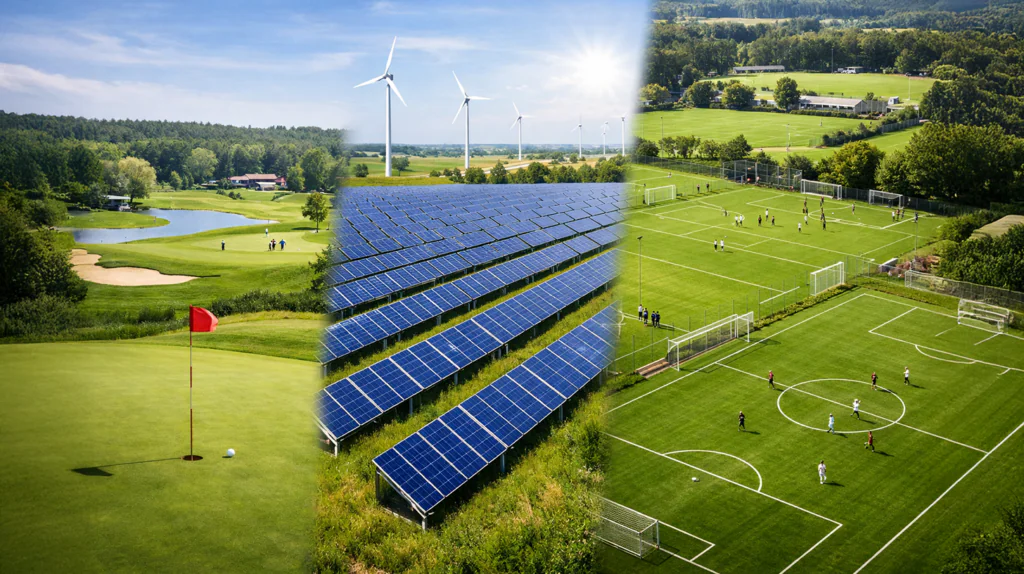
Comparison of areas: Golf courses vs. solar parks
More important than the sheer number of sites, however, is the land use. The average golf course is significantly larger than a single solar park. A typical 18-hole golf course occupies between 40 and 80 hectares, depending on the terrain and facilities, and sometimes even more if driving ranges, practice facilities, and ancillary areas are included. This puts the area of a large golf course on a similar scale to larger solar parks, which often occupy 10 to 50 hectares.
The approximately 700 to 1,000 golf courses in Germany occupy roughly 20,000 to 50,000 hectares of land. This is roughly the same scale as the area covered by ground-mounted photovoltaic (PV) systems in Germany. According to current studies and government figures, approximately 45,000 to 46,000 hectares will be used for PV systems by the end of 2024, including arable land, grassland, and verges along roads and railways.
The land use by golf courses and solar parks is therefore of the same order of magnitude, namely in the range of several tens of thousands of hectares. The figures can vary slightly depending on the definition and calculation method, but overall, solar parks currently cover a comparable – and in some estimates even slightly larger – area than golf courses in Germany.
How many football fields are there in Germany?
In Germany, football pitches are generally referred to as “football fields” or “playing venues.” According to estimates and sports statistics from the German Football Association (DFB) and sports science studies, there are approximately 40,000 to 50,000 official football pitches in Germany. This number includes both club pitches and municipal facilities used for organized matches.
The area of a standard football pitch is approximately 0.7 to 0.8 hectares, depending on the size of the pitch and its surroundings. Therefore, when calculating sports field areas in individual German states, a conversion factor is often used, expressing a specific total area in “football fields.” For example, at the end of 2022, the sports field area in North Rhine-Westphalia was approximately 56.3 square kilometers, which corresponds to about 8,000 football fields.
Multiplying the approximate average area of a football pitch by the estimated total of 40,000 to 50,000 pitches yields a total area of all football fields in Germany of approximately 30,000 to 40,000 hectares. This puts the land use by football fields close to that occupied by golf courses and solar parks – meaning that football fields alone occupy significantly more land than individual solar parks, but are of the same order of magnitude as the combined area of all solar parks.
Number of locations: more football fields than solar parks?
If one considers the sheer number of sites, not the area, the number of football fields far exceeds the number of solar parks. While there are roughly 7,000 to 8,000 ground-mounted photovoltaic systems in Germany, the number of football fields is estimated at 40,000 to 50,000. This means that there are currently significantly more football fields than solar parks in Germany – both in terms of the number of installations and the area they cover.
The comparison with golf courses is also interesting: In terms of the number of locations, football pitches are also significantly more numerous than golf courses. While golf courses in Germany comprise “several hundred” to almost 1,000 locations, the number of football pitches is in the tens of thousands.
Land use in the overall context
To properly understand the statements “There are more golf courses than solar parks” and “more football fields than solar parks,” it’s important to know whether the statement refers to the number of locations or the total area. The number of golf courses is smaller than the number of solar parks, while the number of football fields is significantly larger than the number of solar parks.
In terms of area, all three uses – golf courses, solar parks, and football fields – fall within a range of approximately 30,000 to 50,000 hectares. This means that the land consumption of solar parks is roughly equivalent to that of golf courses and football fields, but football fields clearly dominate in terms of the number of locations.
Interpretation and political discussion
The question of whether there are “more golf courses than solar parks” frequently arises in political debates concerning land use for renewable energy. The figures show that the land use for solar parks in Germany is roughly the same as that for large sports facilities and golf courses combined – and thus represents only a fraction of the total agricultural or settlement area in Germany.
Many studies also emphasize that solar parks are increasingly being built on already used land such as arable land with lower productivity, roadside verges, or brownfield sites. This allows them to use the same area multiple times, for example through agri-PV, where agriculture and solar power are generated in parallel.
How should this claim be evaluated?
The statement “There are more golf courses than solar parks in Germany” is incorrect – at least in terms of the number of locations. There are currently more solar parks than golf courses, and the area of the solar parks is roughly comparable to the area of all golf courses combined.
The claim that there are “(even) more football fields than solar parks” is accurate, both in terms of the number of locations and the total area. Football fields are significantly more numerous in Germany than solar parks and cover a total area roughly the same size as all solar parks combined.
This allows us to answer the original question with a clear, nuanced result: The number of golf courses is lower than the number of solar parks, whereas the number of football fields is significantly higher than the number of solar parks. In terms of land use, all three uses – golf courses, solar parks, and football fields – are comparable, although they represent only a small portion of Germany’s total land use.