
— February 2026 —
Black History Month began in 1926 as “Negro History Week,” founded by historian Carter G. Woodson, and was expanded to a full month in 1976 by President Gerald Ford. As such, this year’s theme “A Century of Black History Commemorations” invites reflection on the diverse leaders who have shaped our shared past, including the golfers and pioneers who helped shape golf’s history in Massachusetts.
Our state’s golf history is rich with such legacies. We see it in the meticulous mind of Dr. George Franklin Grant, the Harvard dentist who patented the wooden golf tee. We see it in the forethought of Robert Hawkins’ Mapledale Country Club (now Stow Acres), which provided a stage for the first nationwide tournament for Black golfers. There was the brilliant powerful swing of former tennis star Althea Gibson, who once set a course record at Pleasant Valley, as well as the early brilliance of a teenage Tiger Woods, whose 1992 U.S. Junior Amateur victory at Wollaston hinted at the greatness the world would soon come to know. Then there’s community leaders such as George Lyons, Archie Williams, and groups like the Men’s Inner Club and Fairway Ladies who fought to maintain and improve conditions at Franklin Park, home to the second oldest municipal course in the U.S.
These stories continue to rise to the surface, not because of the time of year, but because they speak to something deeper. They remind us that when a community comes together for the greater good, it moves the game to a better place.
This month, Mass Golf is proud to present a series of entries celebrating the legacies of pioneers who not only mastered the sport but also dedicated their lives to ensuring that the walk down the fairway is one everyone can enjoy.
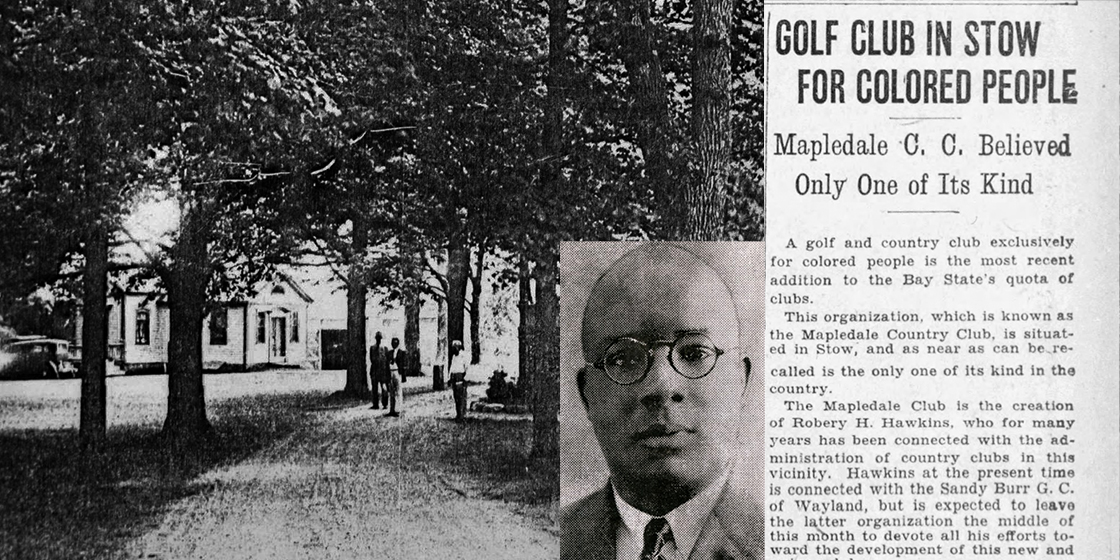
100 years ago: Robert H. Hawkins Purchases Land To Create Mapledale Country Club, Now Known As Stow Acres
In February 1926, winter lingered at the Randall Estate in Stow, Massachusetts, a town not far from where the first shots of the American Revolution were fired. From the windows of its twenty-room mansion, the surrounding acreage, 196 in total, lay undisturbed.
That same month, the property was purchased by Robert H. Hawkins, a successful Black businessman, chef, and passionate golfer. At a time when segregation excluded Black golfers from nearly every course in the country, Hawkins envisioned a resort and golf club where Black men and women could play freely and be welcomed as a community.
He called it Mapledale Country Club. Opened later that year, it would become one of the first Black-owned and operated golf courses in the United States.
Hawkins’ journey to his creation began in Adams, Massachusetts, where he was born and learned the game as a young caddie at Forest Park Country Club, playing in the shadow of the imposing Mount Greylock, the highest peak in the Commonwealth. Before founding Mapledale, Hawkins surely drew inspiration in serving as manager of the new Sandy Burr Country Club in nearby Wayland, earning him the distinction of being the first African-American man to hold that position at a club in New England.
Mapledale opened later that year, and in September 1926 hosted an event that likely outlived Hawkins’ wildest imagination: the “Negro National” championship, a two-day, 72-hole tournament open to any player who could pay the modest $4 entry fee. It was a landmark in American sports history, offering Black golfers a chance to compete in a generation when the PGA of America’s “Caucasian-only” clause (1934-1961) excluded them from nearly all professional play.
It later transformed into the United Golfers’ Association championship, played through to 1976. The organization was reactivated in 2000 to continue the legacy of diversifying the golfing world.
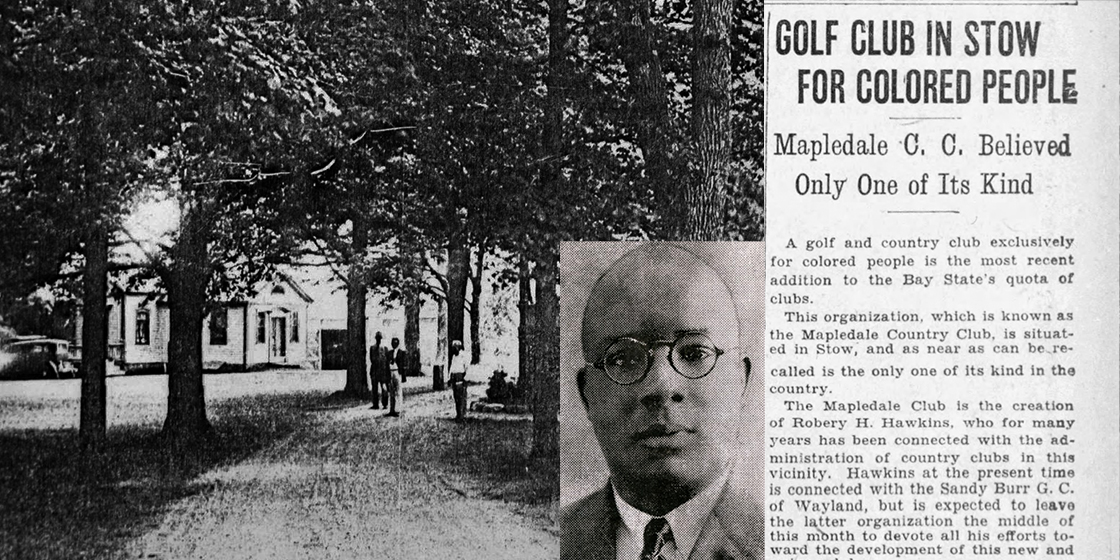
Mapledale was a place of competition and community, of leisure and legacy. It attracted Black professionals, doctors, and entrepreneurs from across the Northeast, offering golf alongside horseback riding, tennis, croquet, and clubhouse amenities, such as a billiards room and lounge. Over the next two years, Mapledale hosted the national tournament again, drawing trailblazers like Harry Jackson, Pat Ball, and John Shippen, who was the first Black golfer to play in the U.S. Open. These events helped establish what would eventually become the United Golfers Association (UGA), a vital institution Hawkins co-founded in 1925 to provide opportunities for Black golfers nationwide.
“He is heavily built; has a round dark brown face; impresses one by his smiles as of an amiable nature,” the New Pittsburgh Courier described Hawkins in a 1927 article about Mapledale. “His club is located 25 miles from Boston in the faith that it would meet a need of his own group. The club is an attractive spacious colonial building of 18 rooms, and the meals are well cooked. The season of 1927 finds his club provided with a golf course of nine holes, tennis, croquet and a bridle path. He looks forward to an expansion that would provide trap and gallery shooting and winter sports.”
However, like many great dreams of the era, Mapledale was short-lived. The Great Depression forced Hawkins to sell the property in 1929. It would later become Stow Acres Country Club, continuing as a public course, though Hawkins’ name and legacy slowly faded from view. When he passed in 1973, his obituary made no mention of the groundbreaking course he once built or the championship he helped launch.
Over the past four years, a dedicated group of Stow residents has worked to ensure that Robert H. Hawkins’ legacy is not forgotten. Their effort, Rediscover Mapledale, is a grassroots initiative committed to honoring Hawkins’ vision and protecting the land where it first took shape. Through educational programming, historic signage, and the creation of a traveling exhibition, the group is reintroducing Mapledale’s remarkable story, not just to Stow, but to communities across Massachusetts.
As part of this year’s centennial celebration, Rediscover Mapledale will host a series of events designed to bring that legacy to life. On Saturday, February 7, acclaimed historian Sean Osborne will lead a storytelling session at Stow Acres Country Club at 3:00 p.m., connecting Hawkins’ work to the broader arc of Black history in New England.
Later this year, on August 29, the club will host the 3rd Annual Robert H. Hawkins Memorial Golf Tournament, followed by the “100 Years of Golf” Gala that evening. The event will also mark the debut of the exhibition Mapledale: 100 Years Thanks to Hawkins, which will travel to schools, museums, libraries, and community spaces throughout the Commonwealth—bringing this long-overlooked story into classrooms and public forums across the state.
While Hawkins’ legacy is being rediscovered, the landscape itself continues to evolve. The South Course, which includes much of the original Mapledale footprint, is now protected by a 151-acre conservation restriction, preserving it for recreational use and shielding it from development.
Ownership of the property has also changed hands. In December, the club was sold to the Walden Group, the company that also owns Black Swan Country Club and recently acquired Blackstone National Golf Club. The North Course, however, has a more fragmented future: the front nine holes were sold to developer Mark O’Hagan, with plans to construct approximately 189 housing units, while the back nine was purchased by the Town of Stow for recreational purposes. A previous agreement allowed the course’s former owner to continue using the land for golf if it was properly maintained, but the terms of that arrangement under new ownership remain unclear.
Still, in a decision that seems to echo Hawkins’ resilience, the club has kept its driving range open to the public all winter, despite more than a foot of snow blanketing the turf. Even as the landscape changes, that spirit of access, community, and perseverance continues to live on.