
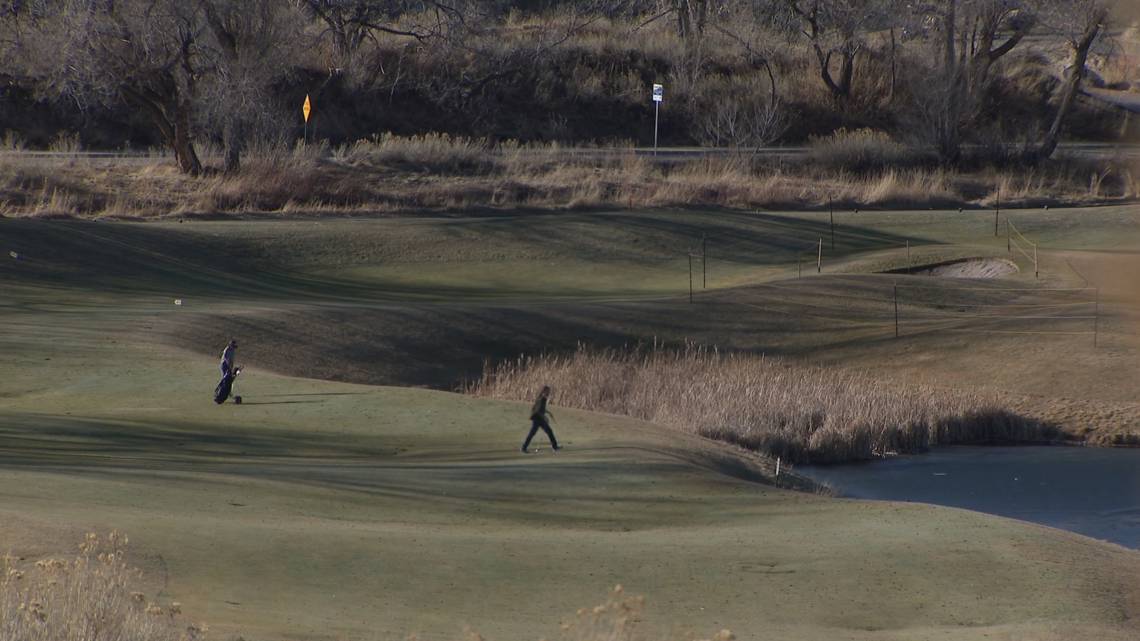
February tee sheets are already packed, yet turf managers warn that grass deprived of winter rest and moisture may face lasting stress.
DENVER — Unseasonably warm, dry winter weather has reshaped Colorado’s outdoor economy in uneven ways: while ski areas contend with thin snowpack, golf courses along the Front Range are experiencing a surge more typical of spring.
At Fossil Trace Golf Club in Golden, Adam Finch, the head golf professional, said the season has stretched well beyond its usual boundaries.
“For the first time in our golf course’s history, we were open every day in November with the exception of the Thanksgiving holiday,” he said, adding that “Our golf season certainly feels like it’s expanding.”
Finch, who has worked at the course for 19 years, described February conditions that would normally be unlikely.
“We’ve got golfers booked each and every day for this next coming week,” he said. “It’s been a few years since we’ve been open any days in February.”
Players arrived in shorts, T-shirts, and tank tops, a sight he called “wild” for this time of year.
The lack of snow has allowed courses to remain open, but the same conditions are complicating course management.
Winter snow typically acts as insulation, Finch explained, “What we actually like to see is snow on the golf course to insulate the turf grass… just to get us to those spring warm, growing months.”
Finch said the increased play is causing additional wear and tear on the course during a time when the grass is usually on a break. But now, staff are now preparing the course daily, something he says typically isn’t done this time of year.
Across the municipal system operated by Denver Golf, the pattern is similar. Pam Smith, the system’s director of agronomy, said winter is usually a period of downtime.
“To have some downtime in the middle of winter where we don’t have golf carts, we don’t have golfers, we’ll have snow cover for prolonged periods of time,” she said, is the norm. “This year is extraordinarily different. We’ve seen no weather pattern bringing us snow.”
Smith said activity has surged, citing data from Kennedy Golf Course showing that offseason play from November through this first week of February is up about 70% in rounds and roughly 90% in cart use.
She noted that while winter play is usually “kind of a bonus,” but now “we’re filling the house.”
To protect turf, Denver Golf announced that all courses would shift to walking only seven days a week starting Feb. 10, citing “extreme drought conditions” and “severe wear and tear on golf course traffic areas.”
The concern is that dormant grass cannot repair itself.
Scott Ellis, superintendent at Wellshire Golf Course, acknowledged that conditions are “great for the golfers and… the customers,” but he said it raises questions “about the future, and specifically the future of this season.”
Water management is another variable. Smith said that if dry conditions persist and water supplies tighten, the system has a staged plan. She said that if water use had to be reduced, crews would rely more on hand watering and place limits on how much irrigation certain courses receive. Maintenance would focus on keeping key playing areas like greens, tees and fairways alive, while less critical areas such as the rough would receive little to no water until supplies improved.
She emphasized that greens require relatively little water.
“If this weather pattern continues, I do believe we have sufficient resources to keep the greens green. The greens actually take a real, nominal amount of water compared to the rest of the golf course.”
The broader question, she said, is long-term supply.
“I think it’s the long term,” she said. “Like, how does this impact it when it comes to if there’s Denver Water restrictions and we all start having to conserve?”
For now, managers are still looking skyward.
“We might get an actual winter with a lot of snow, and things will bounce back and go back to normal. We’re hoping for that,” Smith said.
Ellis echoed that sentiment.
“Just like the ski industry is hoping for snow, we’re hoping for snow to recharge the reservoirs and make sure we have adequate water for the season,” he said.