
The National Golf Foundation (NGF) found that on-course participation in 2025 reached its highest level since the Tiger Woods–aided peak era of the late 1990s and early 2000s. Overall participation again surpassed record highs, driven by the popularity of tech-driven off-course options.
The NGF’s recently released The Graffis Report, its annual golf industry review, found that green-grass golf participation in the U.S. surpassed 29 million in 2025, short of the all-time record of 30.6 million in 2003 but marked an eighth consecutive year of growth and a net increase of roughly one million golfers year-over-year. Over the past eight years, on-course participation has risen by more than 5 million.
The NGF believes the growth further confirms that the sport’s recent momentum is “not a short-term COVID bump but a broader, lifestyle-driven shift toward experiences that deliver social connection, time outdoors, and physical, mental and emotional well-being.”
The organization also added, “There is a renewed appreciation for the holistic benefits of the green-grass game, and tens of millions of Americans now recognize golf’s public health benefit as one of the ultimate wellness activities — combining exercise, stress relief, challenge, self-improvement and community in a uniquely accessible outdoor setting.”
Total golf participation (on-course and off-course, using a real club and ball with a full swing) is up 50 percent over the past decade to more than 48 million, an all-time high, fueled by both traditional play and the continued expansion of technology-enabled ranges, simulators and entertainment venues.
NGF said, “These off-course formats are proving to be powerful entry points that complement, rather than replace, the green-grass game.”

Other findings from the study include:
National rounds played reached another record, the fourth time in five years, achieved with roughly 2,000 fewer facilities than existed during the previous participation peak two decades ago.
More than 8 million women and girls are now playing on course, an all-time high. This represents a 46 percent increase in participation compared to 2019, before the COVID-19 pandemic.
Record levels of diversity across golf’s participation base, with unprecedented on-course representation among females (28 percent) and people of color (26 percent).
Roughly two-thirds of “green-grass” beginners enter the game with “off-course” experience.
With approximately 16,000 golf courses at nearly 14,000 facilities, the U.S. maintains its position as the world’s largest golf market.
Continued strength in demand and facility utilization supports healthier economics and golf course spending on infrastructure and supplies, with nearly 70 percent of operators rating their financial condition as “good” or “excellent”.
There has been a normalization of public pricing power, with the average 18-hole fee up about 29 percent since 2019—a change broadly in line with the cumulative rate of U.S. inflation over the same period.
The NGF concluded, “Overall, today’s golf economy is broader, more inclusive and more resilient than at any time in the modern era, supported by a multi-channel ecosystem that introduces millions to the game while reinforcing the central role of the golf course as the industry’s front door.”
Golf Datatech Sees U.S. Golf Rounds Climb for Third Straight Year
The NGF’s report comes as Golf Datatech recently reported golf rounds played in the U.S. rose 1.2 percent in 2025, reaching a new record for the fourth time in five years.
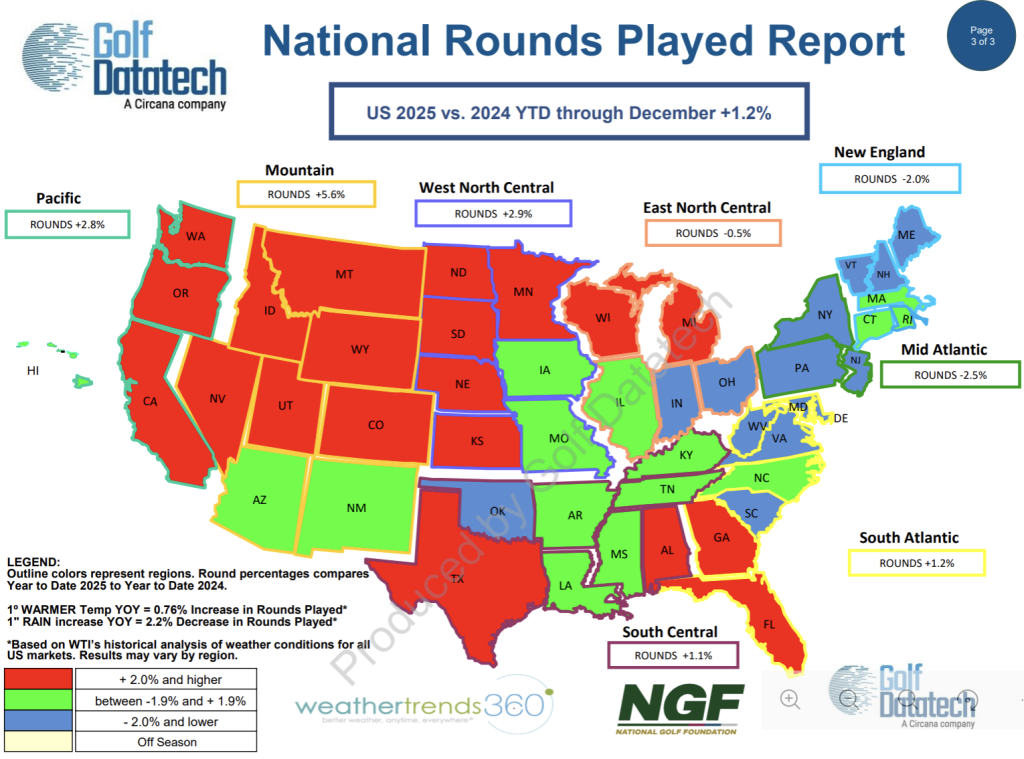
Golf rounds increased by 2.2 percent in 2024 and by 4.2 percent in 2023, but declined by 3.7 percent in 2022, largely due to inclement weather and tough comparisons with the surge in play during the pandemic. U.S. golf rounds jumped 5.5 percent in 2021 and 13.9 percent in 2020.
In 2025, five of eight geographic regions covered by Golf Datatech showed increases in rounds played, with the Southeast and several Western states benefiting from favorable weather.
Mountain led the gains in rounds played, up 5.6 percent, followed by West North Central, 2.9 percent; Pacific, 2.8 percent; South Atlantic, 1.2 percent; and South Central, 1.1 percent. The regions declining in rounds played were Mid Atlantic, down 2.5 percent; New England, off 2.0 percent; and East North Central, off 0.5 percent.
Images courtesy Pinehurst Resort, NGF and Golf Datatech