
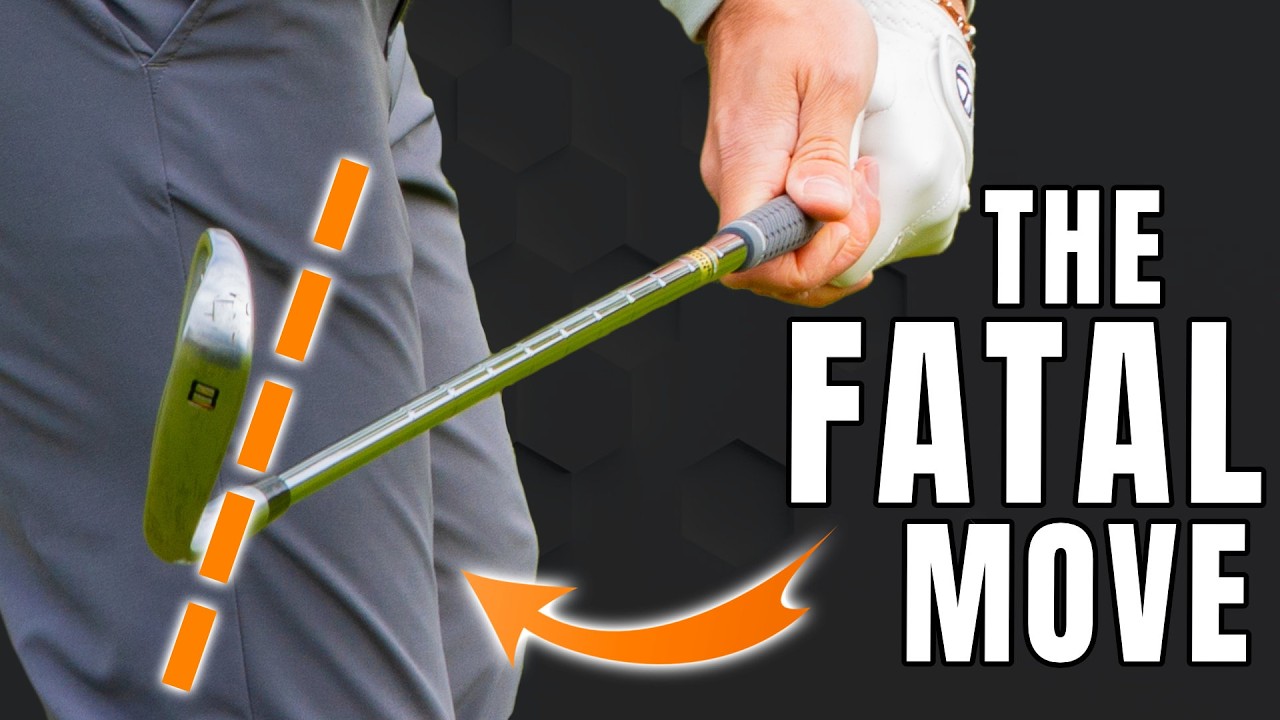
This Hidden Flaw Explains 90% of Amateur Swing Problems
If you’ve ever wondered why your swing feels smooth in practice but completely falls apart with the ball… this video is for you.
In this lesson, I break down the real reason so many golfers struggle with consistency, ball striking, and those frustrating swing faults that just won’t go away. Spoiler: it’s not your grip, takeaway, or even your tempo — it’s a deep flaw in how the downswing is naturally performed by most amateurs.
I’ll show you why this issue is so common, how it affects nearly everything in your swing, and — more importantly — how to fix it with simple, effective drills you can take straight to the range.
✅ Understand the root cause
✅ Learn what the pros do differently
✅ Finally make your swing work when it matters
Don’t let this hidden flaw hold you back any longer.
📲 The Chris Ryan Golf Academy App
The all-in-one coaching platform designed to help you train smarter, practice better, and play your best golf! 🎯
✅ Structured training plans
✅ Fun & effective practice games
✅ Exclusive content not on YouTube
Start your 7-day free trial today! ⬇️
🔗 https://www.chrisryangolf.com/chris-ryan-golf-academy-app/
⛳ Want to Play Better Golf?
Join me on the journey to lower scores and more enjoyment on the course! Don’t forget to LIKE, COMMENT & SUBSCRIBE for weekly golf coaching videos.
💬 Got a question? Drop a comment below – I read them all!
📩 Want to work with me? Email: chris@chrisryangolf.com
🌍 Visit My Website: www.chrisryangolf.com
🎥 Want Personal Online Coaching?
If you’re serious about improving, I offer personalised online coaching to help you reach your goals faster.
🔗 https://www.chrisryangolf.com/online-coaching/
🤝 My Trusted Partners
🔥 TaylorMade Golf – https://www.taylormadegolf.eu
🏌️♂️ Clubhouse Golf – https://www.clubhousegolf.co.uk
🎯 Hack Motion – https://www.hackmotion.com/chrisryan
📡 FullSwing – https://www.fullswinggolf.com
🎯 PuttOut Golf – https://www.puttout.golf
👟 Adidas Golf
🔧 Mapei – https://www.mapei.com/GB-EN/
00:00 Introduction
00:37 Why A Natural Swing is Flawed
03:10 What Squares The Face?
07:44 Drill – How to Square The Face
37 Comments
I agree this is the cause of most slices, but the average golfer will not be able to get the wrist timing accurate enough to be consistent with this approach. I tried for a long time to rotate the wrists at impact, but in the end, what worked for me was understanding that the forearms were easier to control and time than the wrists. My golf coach explained it to me like this. He said the feeling was like that of putting top spin on a tennis shot. Your swing comes from inside to out with the right forearm applying the topspin. That was the eureka for me and i no longer felt i was trying to time the wrists. Wishing everyone luck with their own eureka moment 😊
The secret to timing clubface rotation is to make it something that happens, not something you do. The center of mass for the clubhead is above the shaft will help rotate the clubhead counterclockwise through the impact zone if you load and the fully release the club with freedom. You have let it go.
At 07:43 “What we actually want to be doing is: a twist of the (lead) wrist and a release of the forearm”, in what appears to be a single plane swing, ie the club shaft is in the same tilted plane as the arm rotation (Lela’s arm which is left arm in this video), with shoulder rotation driven by core/hips/legs. Understanding the physics of torque would be helpful. What happens if we modify the plane of the club shaft so that it is not in the same plane as the arm rotation. Jim Furyk was constantly criticized by ‘knowledgeable’ golf commentators and professionals for having a ‘hitch’ at the top of his swing, where he allows the head of the golf club to drop below the rotational plane of his arms (as driven by shoulders/core/hips/legs). The mass of the club head then wants to align with the plane of arm rotation, but can only do this as a torque, which naturally produces the “twist of the wrist and release of the forearm”. The club face squares at impact without the muscular effort and coordination suggested in this video. This additional torque (not accessible in a single plane swing – sorry Bryson DeChambeau and Moe Norman) yields something like 20% additional club head speed with the same speed of arm rotation. The trailing forearm goes from supination to pronation. The lead forearm goes from pronation to supination – all a consequence of the out of plane swing.
What grip are you using 2:26
BRAVO! I think this is the best of the best by Chris Ryan. I distinctly remember going through an entire bucket of balls at one point trying to figure out how I could leave my hands in the tree chop position without hitting a slice. Even holding the club in a massively counter clockwise position and hitting the ball forward of the left foot won't work, and this video perfectly explains why and HOW to fix it.
Chris, here's an idea for your next video. I have managed to hurt the medial meniscus of my right knee (I'm right handed), and as long as I follow through perfectly onto my left side I'm okay, but if I bounce backward onto my right as part of my follow through it hurts like hell. Can you please suggest some drills for always coming to that perfect posture at finish with chest to target, weight on the left foot, and right toe to the ground EVERY TIME!
A weak grip causes the need for this timing/rotating the wrists thru impact as well as bowing of the wrists. What Chis is describing takes many hours on the range to timing your body. Check out Mike Malaska/Shawn Clement and save your time and wrists from damage (ala Speith and Kepka)
Great explanation, now I know why my wedges go 2 miles high….open face…. tried this in the garden, now to try it on the course
Do you mean bow? You say arch
simple and clear and can be practiced anywhere, thumbs up and a sub, thanks for posting, this is a game changer (pun intended) 🙂
I think the reason the natural swing to hit something rotates the wrist is that we learn that the stringing seems to be more powerful and less hurtful on the wrist if we have our thumb on the opposite side of the impact (like using a hammer). in martial arts weapons class, that is a must. but, apparently in golf it goofs things up. I'm going to get an orange pipe cleaner and tie that on my club now 🙂
The intro was great. Another analogy is the baseball swing, which is essentially what you were doing. The reason this does not become a problem in baseball is because (as we all know) the bat is round. As such, as long as you are making good barrel contact with the ball, it matters not whether you "square" the bat. This can make it hard for baseball players learning golf, as it adds an element they are not used to.
I've been taught for the last 5 years not to do this, with disastrous results. Thank you so much for focusing on how the clubface is actually squared. My game has been destroyed by trying not to rotate my forearms and hands on the downswing.
Very well explained.
This advice will absolutely RUIN so many golfer's swing! Too many moving parts. Complete Garbage!!!
Great video as always Chris. One thing, I sometimes feel that tension in the golf swing is another reason that is amateurs don’t release that club, do you feel that? Poor online coaching has definitely fed in to that holding on to club head problem for sure!
I use zip ties on my clubs. It looks like the device you use may be able to use interchangeably on different clubs. Would you please share a link for that device please?😊
Great vids! But I have the same comment as a couple of others, but you didnt reply…why not just start with a 45° closed club face??
Hi Chris. This looks great but I am wondering about the strong grip vs weak grip into all of this. I am confused by that. To me more now it seems to be all about the club face? Any thoughts you can share?
You pointed this out in a previous video as well, I believe, when describing the lead arm twisting. This explanation is very well expressed. A fresh "twist" on supination as described by none other than Ben Hogan. Well done, sir! Keep 'em coming. Love it!
The whole thumbs up drill is so mind opening.
Untrue. You are taking only one aspect of the swing in your original analysis. What you describe in your drills is what happens in just a basic swing.
Most people and coaches say you have an open club face if you slice. This is the best example of “what to do” in order to close the club face!
Eureka!
Just brilliant Chris
45 degrees
Lots of fluff, as usual. This could be half as long.
The reason beginners pronated lead hand which swings the club too far inside is that is the REFLEXIVE BRAIN solution for staying in balance DURING THAT PHASE of the swing but it’s not the ideal position for the club head MASS on be in to POWER AND STEER the LEAD ARM MASS that is what ACCUMULATES most of the KINETIC ENERGY that gets transmitted and amplified by the lever arm of the club shaft separately form the KE generated in the clubhead mass when it whips down around the hands and the last part of the down swing and what most people don’t realize powers, the lifting of the arms in the Takeaway and back swing if the club had mass is in the correct position when it forces their wrist to cock because it can’t be extended backwards any further why you don’t want to swing the club inside you want to swing it in the widest arc possible closest to the target line on the way back to extension because that generates the greatest amount of kinetic energy in the lead arm and the clubhead to power the lift to the top of the arms effortlessly effortlessly and efficiently
Your teaching videos are amazing! Thank you for posting. 👍🙏❤️
The club face squares up automatically. There is very little weight in the grip end and the weight is in the centre, not off set like a metal head. Just swing the club, there is no need to try to square the face.
Also, with the hitting the tree… you don’t hold your left arm straight on the backswing, you get more power bending it. Wonder if there is something to that?
Great advice!!!
Bowing or flattening the left wrist is key, I don’t think you have to think about ”releasing” the club with a forearm roll. That should happen naturally just like it happens naturally in the back swing when you get to a certain point. Bowing or flattening the left wrist also makes it hard (impossible?) to swing steep from the outside so it do affekt the swing path. Good video!
Why not just have a stronger left hand grip. In other words start your grip like it was when you hit the tree. Then no need to rotate your arms and you are square at impact
The best drill for overcoming this issue is (imho) .. the old Henry Cotton drill.. smacking irons into old used tires. After a time of the club head twisting in your hands upon impact.. you train your forearms and wrists to time the club head square upon impact. This is a much better natural way to achieve square impact than trying to “think” it so. There are impact bags now for sale on various sites or you can make your own out of a heavily made duffel or hockey type bag.. packed with rags or towels etc..or find an old bean bag chair at the local dump. Bash the hell out-of it until the seams unwind and the beans spill out! Use an old club as well in case you break the head.
Why is it necessary to rotate the forearms at all during the take away? Set the trail wrist (extension) and fold the trail arm (flexion) during the back swing, and reverse it during the downswing. Face stays square to the swing plane the entire time and by using hinge joints (wrist, elbow) the action is much more repeatable. For me, timing forearm rotation is very difficult without consistent hours of practice and I've become a much more consistent ball striker without it.
Regardless, using a visual aid to represent club face, such as the one in this video, is a great way to help golfers gain awareness of how they prefer to square the club face.
Is he speaking English?
It’s called a natural golf swing.