
Low barriers and urban locations are turning park golf into senior welfare resource
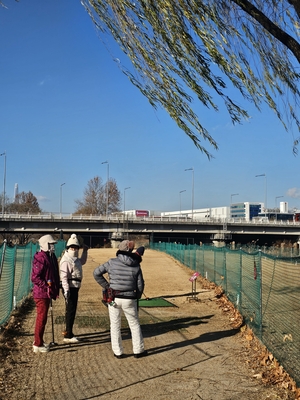
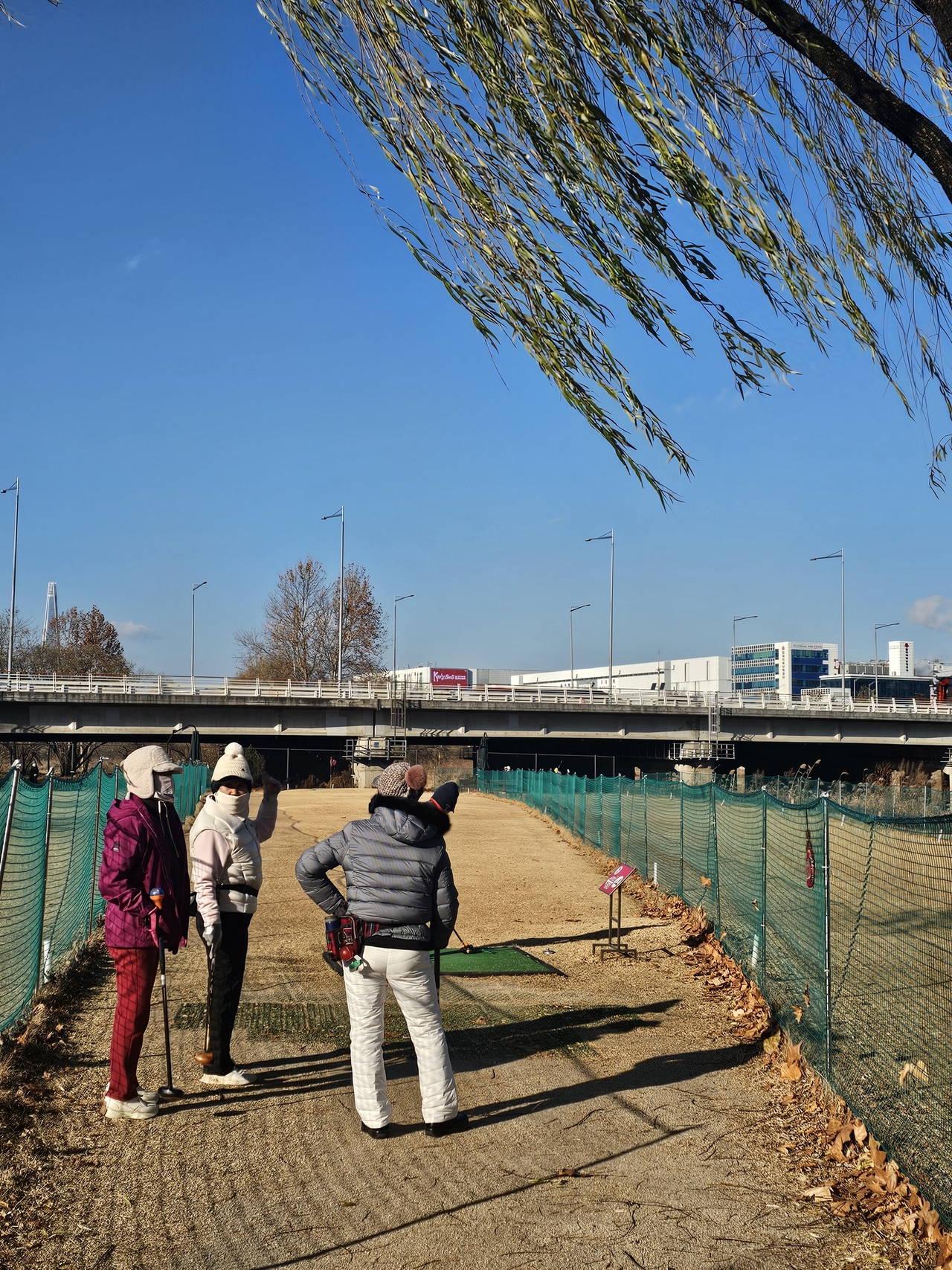 Yoon and three other women in their 60s wait for their turn to hit a ball at a public park golf course near the Tancheon Stream in Segok-dong, Gangnam-gu, Seoul, Dec. 3. (Choi Jae-hee / The Korea Herald)
On a Wednesday afternoon when Seoul’s temperature plunged to minus 10 degrees Celsius, dozens of seniors gathered on a field near a stream in Gangnam-gu.
Bundled up in padded jackets, hats and gloves, groups of three or four roamed the area with golf clubs in hand, hitting the balls off the ground as they wandered from place to place.
Soft cheers rose whenever a ball rolled cleanly toward the flagstick, followed by lighthearted groans when it slipped past the hole, turning the quiet streamside into a lively outdoor arena.
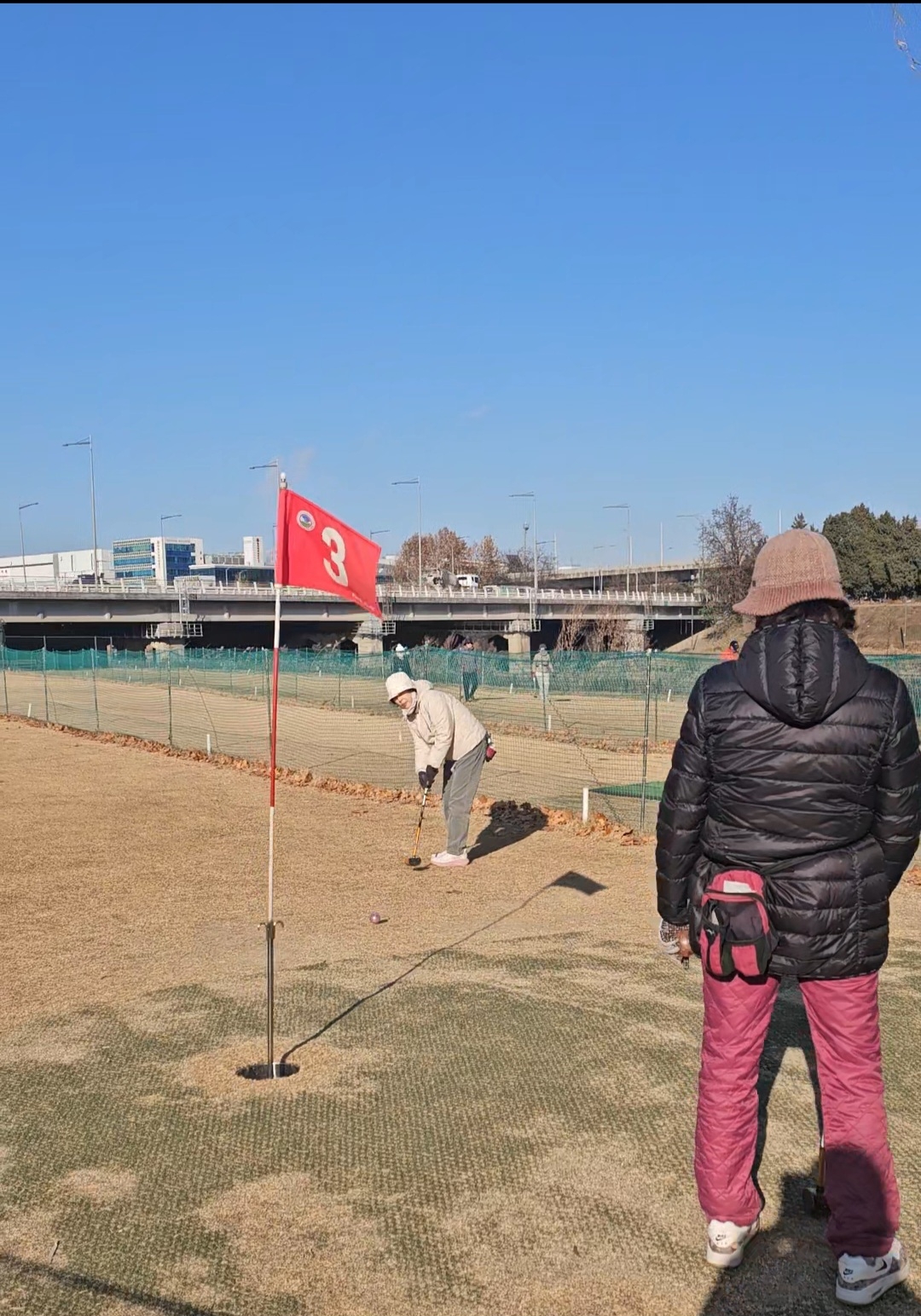 A woman hits a ball toward a flagstick. (Choi Jae-hee / The Korea Herald)
What they were fully immersed in, despite the biting cold, was “park golf,” a kind of long-course putting usually played with a heavier club and a lighter, larger ball, which has emerged as a popular pastime among Koreans in their 50s and 60s.
The number of members registered with the Korea Parkgolf Association more than tripled from 64,000 in 2021 to 200,000 in 2024, a KPA official told The Korea Herald.
“Local park golf clubs usually register with the association as groups, and most are made up of people in their 50s or older. We organize casual matches and use the gatherings to socialize, much like running crews for younger people,” the official said.
 A row of large racks where visitors hang their backpacks and other belongings (Choi Jae-hee / The Korea Herald)
When The Korea Herald visited the public park golf course on a 24,552-square-meter lawn near the Tancheon Stream in Segok-dong, Seoul, more than 30 senior players in groups of three to four were playing the sport for about two hours.
The Tancheon course is the largest of the 25 park golf courses operated by district offices across the city, including those in Gangdong-gu, Geumcheon-gu, Dongdaemun-gu, Gangseo-gu, Yangcheon-gu, Mapo-gu, Songpa-gu and Nowon-gu.
Since its opening in June 2024, the site has recorded nearly 40,000 visits as of November, according to the Gangnam-gu Office.
“Monthly reservations open online a month in advance, and they’re so popular that the slots are usually filled within about 30 minutes,” said the course manager.
Gentle on joints, easy on budgets — and more
With a relatively lower risk of injury than standard golf, park golf remains one of the few outdoor team sports accessible to older adults.
Unlike standard golf, park golf requires no powerful rotational swings, as the distance from the tee to the hole ranges only from 40 to 150 meters. This means far less strain on the wrists, back and knees.
Its shorter playing time also makes park golf an easy, accessible leisure option. A typical round of park golf consists of four nine-hole courses, each taking about 30 minutes, for a total of 36 holes in around two hours.
Yoon Tae-jin, 64, who lives in Wirye, Gyeonggi Province, and visits the park golf course at least once a week, said, “If you can manage an hour of walking, you can handle two or three hours of park golf easily. You don’t even feel the time go by when you’re chatting and swinging with other people.”
She added that standard golf typically takes four to five hours to play 18 holes, and since most courses are located outside the city, the long travel time by car or public transportation makes it even more exhausting.
Also, the 6-centimeter plastic park golf ball doesn’t travel far or fast like a standard golf ball, lowering the risk of older players being struck.
Affordability is another major draw for middle-aged and older adults, especially retirees.
A 30-minute nine-hole game costs only 3,000 to 4,000 won at most public park golf courses in Seoul, whereas a standard golf session of the same length typically costs over 100,000 won, with cart and caddie fees pushing the total even higher.
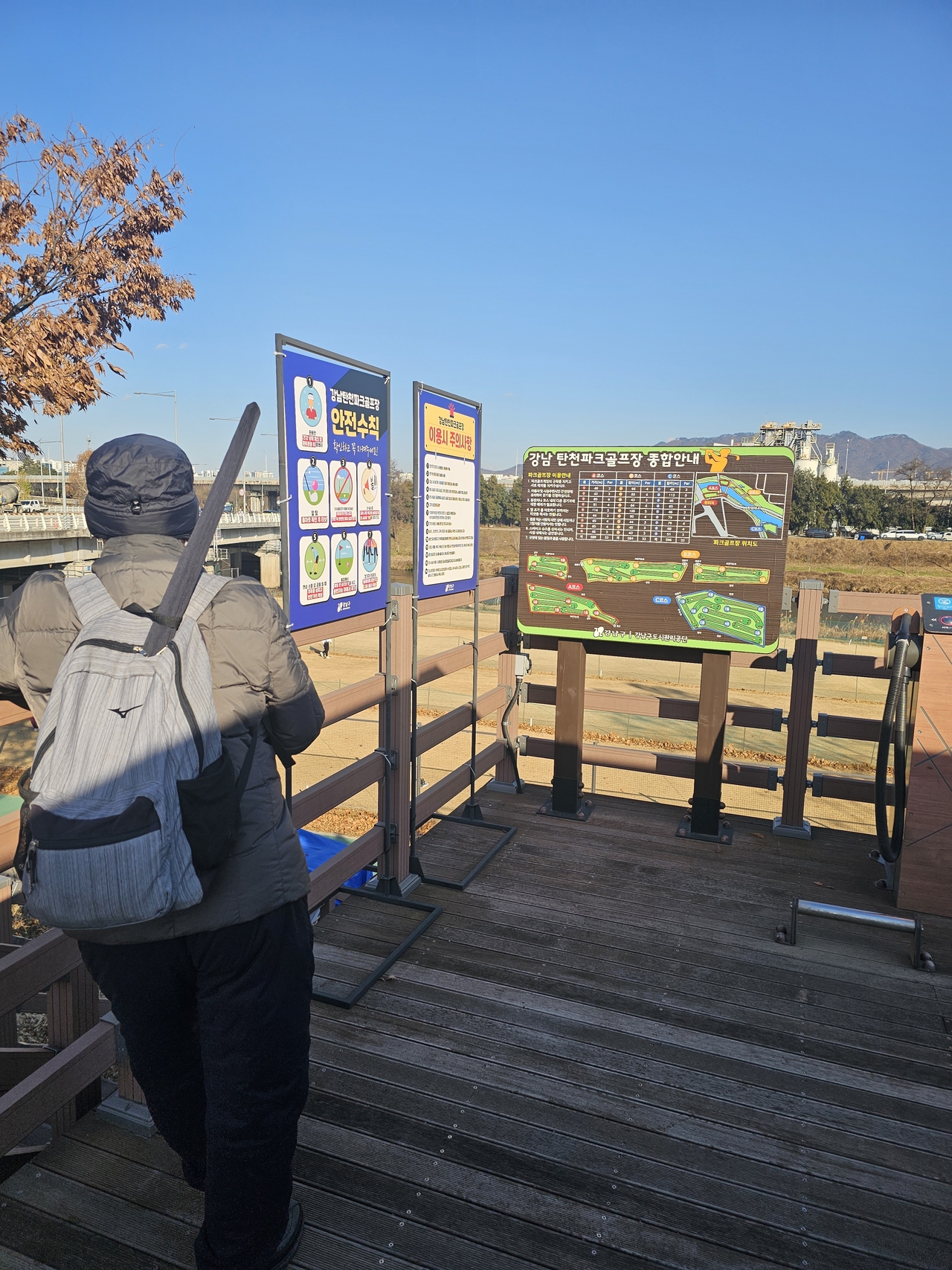 Yoo waits to enter the park golf field in Segok-dong, Gangnam-gu. (Choi Jae-hee / The Korea Herald)
“Golf costs a lot of money, and when your shots don’t go well, it can be pretty stressful. But park golf doesn’t bring that kind of stress. It’s affordable and something seniors can keep doing consistently,” said Yoo Won-sik, 73, who lives in Yongin, Gyeonggi Province.
Since park golf is typically played in groups of 3 or 4, it often doubles as a sport and a key source of social connection.
“At the senior lounge in my apartment complex, I usually spend time with people my age, but at the park golf course, I get to meet seniors of different age groups. Just sharing the same hobby makes it much easier to strike up conversations,” said Kim Hong-geun, 74, a Songpa-gu resident who began playing park golf with his wife three years ago.
“In some cases, people who first meet at the course even end up going out for a meal together afterward,” he added.
Yang Kyung-hee, a woman in her 60s in Cheonan, South Chungcheong Province, whose husband passed away seven years ago, said the sport helps her ease feelings of isolation.
“When the ball drops into the hole, I feel like I really accomplished something, and when my score falls behind others in the group, it makes me want to win. For seniors like me who spend much of their time alone, these feelings bring more energy into our daily lives,” she said.
Why park golf makes sense for aging Korea
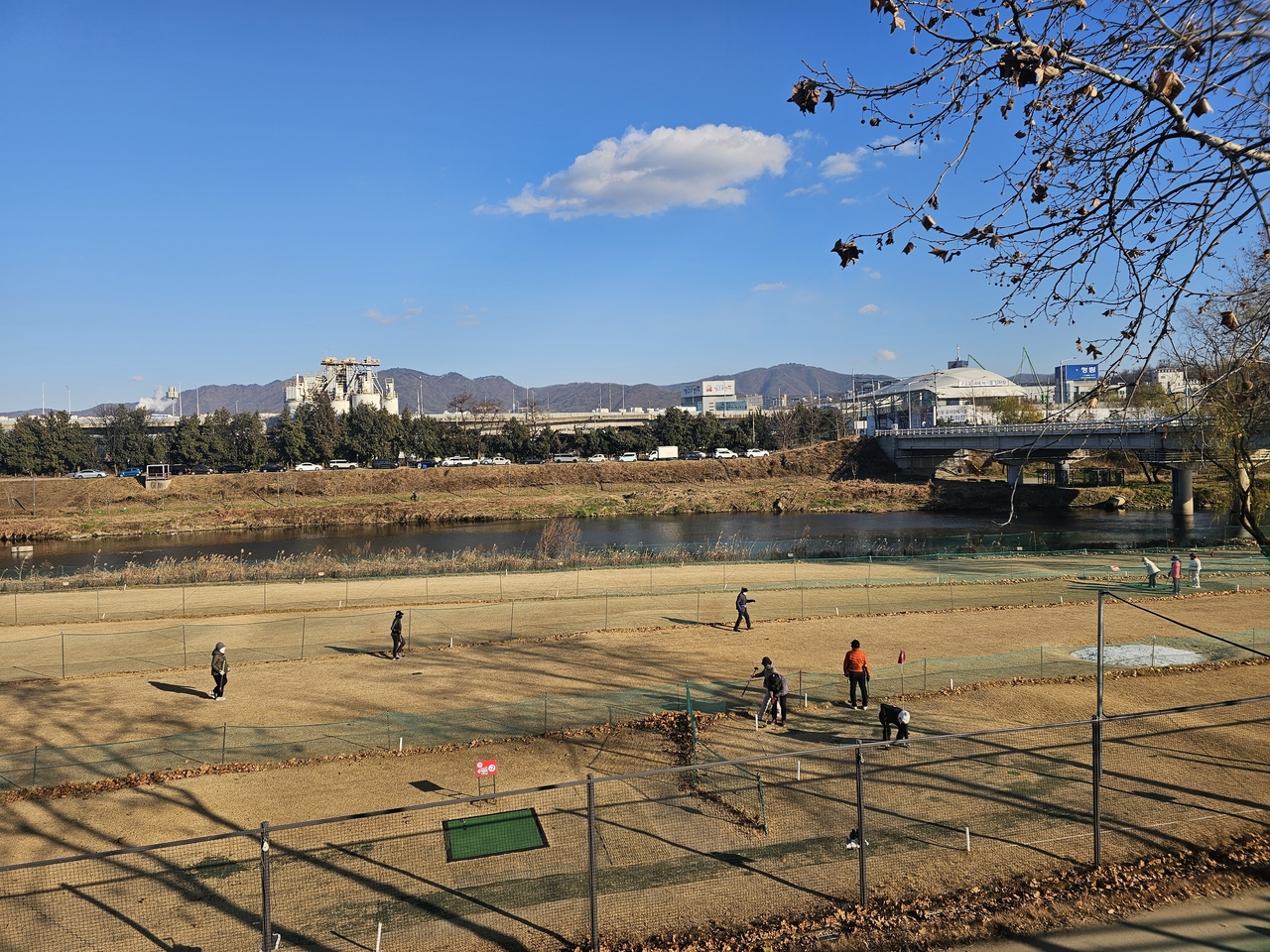 A distant view of the park golf course in Segok-dong, Gangnam-gu. (Choi Jae-hee / The Korea Herald)
South Korea became a superaged society last year, with 10.24 million people aged 65 or older accounting for 20 percent of the country’s total population. And local governments nationwide have been ramping up efforts to build more park courses, as part of their senior welfare programs.
The Gangnam-gu Office announced earlier this year that it plans to build an 18-hole park golf course near Daemosan.
South Chungcheong Province is set to break ground next March on a 108-hole provincial park golf course in Cheongyang-gun, which would become the largest in the country, while Daegu is moving forward with the construction of a 180-hole natural grass course in Gunwi-gun.
Indoor park golf centers have also been on the rise, providing seniors with accessible alternatives during periods of extreme weather, from heat waves to cold snaps.
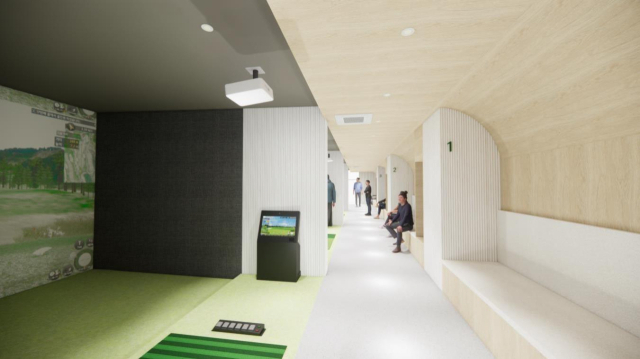 An indoor park golf center set to open in February at Samgakji Station on Seoul Subway Line No. 6. (Yongsan-gu Office)
In February, Seoul’s Yongsan-gu plans to open an indoor park golf center in a vacant commercial space at Samgakji Station on Subway Line No. 6 — the first of its kind in the city. The 258.2-square-meter facility will feature five screen-park golf bays and a rest area.
“Rather than a mere expansion of sports infrastructure, these projects are being pursued as part of senior welfare initiatives, which pretty much reflects how quickly Korea’s population is aging,” said an official at the Yongsan-gu Office.
Behind local governments’ zeal to expand park golf courses, however, lies a practical reason: their comparatively low development costs.
An 18-hole park golf course can be built on 10,000 to 30,000 square meters of land, while a standard 18-hole golf course typically requires 660,000 to 1 million square meters, according to the KPA
This smaller footprint allows local governments to repurpose already developed public land or leftover spaces, including parks, riverbanks and flat areas.
The park golf course in Segok-dong sits on a wide stretch of grassy land that had remained unused beside the stream, with metal fences and netting installed to separate each course.
Construction of the park golf course near Daemosan will utilize a 25,000-square-meter plot that had been farmland before it was designated as a city park in July 1977.
So the practice of repurposing existing land allows park golf courses to be developed at relatively modest costs — as low as 100 to 200 million won for basic facilities and up to 1 to 2 billion won when additional amenities such as changing rooms or a small cafe are included, officials said.
In contrast, private golf courses in Korea often require investments of hundreds of billions of won, as developers undertake large-scale construction projects that cut into mountains or fill natural valleys, given the country’s scarcity of flat land. The country is overwhelmingly mountainous, with flat land accounting for under 30 percent of its territory.
“With limited budgets and growing demand for senior-friendly leisure spaces, park golf courses offer local governments an option that is both affordable and socially beneficial,” said Park Kyung-rae, a professor in the Department of Well-being and Welfare Convergence at Mokpo Science University and president of the Jeonnam Park Golf Association.
“Park golf courses have relatively low maintenance costs even after they are built, making them a cost-efficient public project in the long run. Unlike conventional golf courses that require several types of turf, park golf courses use only one and occupy far less space, so they need fewer workers to manage.”
cjh@heraldcorp.com