
👉 Grab your copy of Systematic Core Training For Kettlebells here. https://salutis.kartra.com/page/systematic-core-training
____________
REFERENCES:
[1] Malai S, Pichaiyongwongdee S, Sakulsriprasert P. Immediate effect of hold-relax stretching of iliopsoas muscle on transversus abdominis activation in chronic NSLBP with hyper-lordosis. J Med Assoc Thai 2015;98
[2] Kim B, Yim J. Core stability and hip muscle stretching improve physical function in NSLBP: RCT. Tohoku J Exp Med 2020;251:193-206.
[3] Arjmand N, Shirazi-Adl A. Role of intra-abdominal pressure in the unloading and stabilization of the human spine during static lifting tasks. Eur Spine J. 2006 Aug;15(8):1265-75. doi: 10.1007/s00586-005-0012-9. Epub 2005 Dec 7. PMID: 16333683; PMCID: PMC3233951.
[4] Campbell A, Kemp-Smith K, O’Sullivan P, Straker L. Abdominal Bracing Increases Ground Reaction Forces and Reduces Knee and Hip Flexion During Landing. J Orthop Sports Phys Ther. 2016 Apr;46(4):286-92. doi: 10.2519/jospt.2016.5774. Epub 2016 Mar 8. PMID: 26954271.
[5] Hodges PW, Richardson CA. Inefficient muscular stabilization of the lumbar spine associated with low back pain. A motor control evaluation of transversus abdominis. Spine (Phila Pa 1976). 1996 Nov 15;21(22):2640-50. doi: 10.1097/00007632-199611150-00014. PMID: 8961451.
[6] Byeong-Gwon Yun, Seung-Joo Lee, Hyun-Jeong So, and Won-Seob Shin. Changes in muscle activity of the abdominal muscles according to exercise method and speed during dead bug exercise. Physical Therapy Rehabilitation Science 2017;6:1-6.
______________
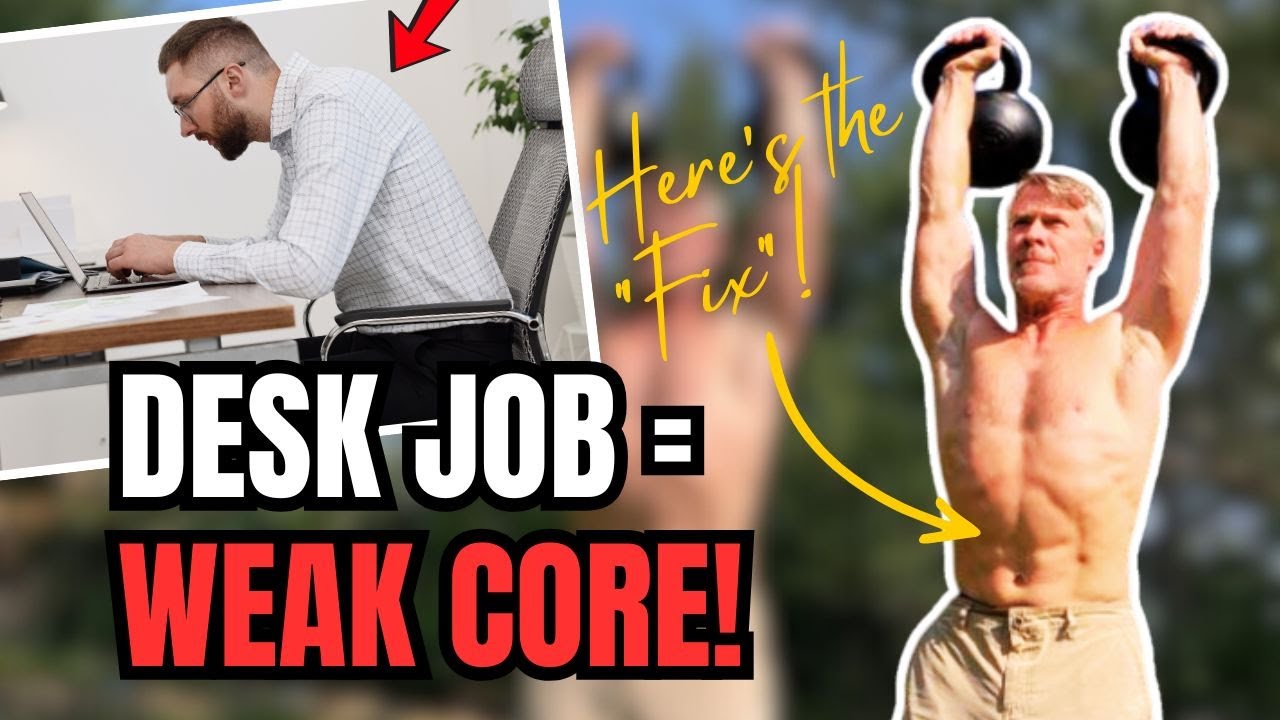
Desk jobs — or any chair surfing — are a necessary evil of modern life.
Upside: we can focus for long periods and earn in comfort.
Downside: sitting wrecks posture.
We end up with:
Forward head → reduced breathing & core stability (diaphragm inhibition).
Slumped shoulders → limited overhead mobility, higher shoulder injury risk.
Tight hips → weak glutes, shear forces on lumbar spine, back pain.
So on Swings, instead of hips powering the movement, the lower back overworks.
A common “fix” for tight hips is stretching hip flexors. When I first discovered this in 2001/2, it felt great—until it didn’t. The looseness never stuck. Research shows hip flexor stretching briefly boosts deep abdominal activity, but it fades when training ends. Sitting then reinforces tightness, creating a loop.
At the same time, I relied on abdominal bracing for core stability. Which worked—until it didn’t. A hard brace increases hip joint forces. Research shows strong bracing reduces shear at the lumbar spine but spikes hip compression by 8–12%. It also reduces hip-knee flexion and raises ground reaction forces, shifting stress to hips instead of glutes.
Combine tight hip flexors, weak glutes, and max bracing, and you get aching backs and damaged hips. That’s how I tore both labrums after years of stretching and bracing.
The Fix: Restore Anticipatory Control
In a healthy body, the deep core activates milliseconds before moving an arm, leg, or kettlebell. This feed-forward activation, or anticipatory postural adjustment, is also called reflexive stabilization.
Studies show the Transverse Abdominis and Multifidus fire early in pain-free lifters but late in those with back pain. Conscious bracing can’t substitute—once the bell moves, you’ve only got milliseconds. If the reflex is off, shear forces hit when load peaks, often causing that “lightning shock” in the lower back.
So, how do we restore it? With specialized stability drills that re-train feed-forward activation.
One of the best is the Dead Bug, proven to restore anticipatory control. We use this and others in the Stability phase of the SSP Model (Stability–Strength–Power) from Systematic Core Training for Kettlebells.
The prescription:
5 minutes of stability training before KB sessions.
10 minutes after.
Then progress to Strength and Power.
This resets the deep abdominals, re-strengthens them with the pelvic floor and diaphragm, and restores the ability to create intra-abdominal pressure (IAP) to protect the spine in Swings, Cleans, Squats, and Snatches.
Should You Ever Brace?
Yes—on heavy, slow lifts like Deadlifts, Squats, and Presses. But bracing should layer on top of reflexive stability, not replace it.
Stay Strong,
Geoff
Hey, what’s going on my friend? It’s Jeff Nert from chasingstrength.com. And in today’s video, we are answering the question, is your desk job stealing your strength. In case you didn’t know, desk jobs or any chair surfing is a what I call a necessary evil in our modern lifestyle. Okay, so on the upside, we now have the ability to concentrate for long periods of time and bring home the bacon and relative comfort without sweating in the fields or the foundaries. Right? Now, on the downside, all that sitting tightens you up and destroys our posture. So, we end up with what we call a forward head position like this, slump shoulders like this, and tight hips. These are three major recipes for disaster when hoisting your kettle bells over your head. Okay? So, why? Well, a forward head position that decreases your breathing ability and therefore creates a loss of core stabilization or core stability through what we call diaphragm or diaphragmatic inhibition. Slump shoulders, well, that causes the inability for you to put fully put your arms over your head, increasing the risk of injury to your shoulders during your presses or your snatches. And tight hips, well, they cause excessive stress and sheer forces on your lumbar spine, which is your lower back, right? from tight hip flexors and the resulting weak glutes. Okay. Now, as a result, you may not be able to use your hips on swings. So, you feel your lower back overworking instead. Everybody’s favorite injury, right? So, one of the common fixes, right, and I say fixes, I use air quotes fixes like we like to use on this channel for tight hips is stretching your hip flexors, which is the front of your hips. Now, when I first discovered this back in 2001,220, I was amazed at how awesome I felt until I didn’t. See, even though my hip flexors loosened up, they didn’t stay that way. They didn’t stay loose. The new ranges of motion I had suddenly unlocked, well, it never stuck around. Now, why is that, right? Why didn’t they stay or why didn’t it the range of motion stay? Well, the research shows that while hip flexor stretching temporarily increases your deep abdominal transversus abdominis activity, right? That’s one of the deep abdominal stabilizers, transversus abdominis or transverse abdominis, excuse me. It doesn’t stay that way. It returns to muted, right? Put air quotes around that. Muted, right? When your training is over. Now, furthermore, the sitting continually reinforces the tightness you feel in the front of your hips, the tightness you get in the front of your hips, and that creates a negative feedback loop. That’s not all. Here’s what else. At the same time I was stretching my hip flexors, I was using a core stabilization strategy called abdominal bracing. Now, that too worked great until it didn’t. Now, why not? Well, it turns out that a hard abdominal brace actually increases the forces your hip joints have to absorb. These are called ground reaction forces, and that means they actually have to work harder than normal. Furthermore, the research shows that cranking up the brace dial, right? Think of it as a knob, right? Remember that old beat box that we used to have, boom box, excuse me, man, I’m showing my age. The boom boxes we used to have, and they had all the knobs and dials on there. Think about turning that brace dial as a knob all the way up, right? That shifts part of the load that’s meant to spare your spine, your lumbar spine. It shifts it forward straight into your hip sockets. Okay? And I got to tell you, I was a master at the hard brace. Okay. So, why is this a problem? Well, the research also shows there’s a research called finite element modeling. It shows that a hard brace although it does increase intraabdominal pressure, which is the purpose of the brace, right? And it also drops the sheer forces at the L4, L5, right, joints in your spine or your lower back. It actually spikes the hip joint compression by about 8 to 12%. And that, let’s just say you do about 10 to 12 reps there. Well, you’ve increased that compression on your hip joints by about 100%. Now, keep doing that over the course of time. Okay? And then you have some pretty severe problems or at least you have the potential for some pretty severe problems. Now, another study called the landing study shows that bracing, that hard abdominal brace, cuts your hip knee flexion or the bending that occurs simultaneously at your hips and your knees and jacks up or increases your ground reaction forces. So now your hip joints take that hit, right, of that force instead of your glutes, right? That’s what your glutes are designed for. They’re designed to absorb that force. So add those extra pounds of force to hips that are already glued short by a chair. And the recipe for disaster looks like this. Or at least the recipe for potential disaster looks like this. Tight hip flexors plus sleepy glutes that don’t work plus a max brace equals your back still aches and your hips start to bark at you or even pinch right there in the front of the hip joint. And I am 99.99% sure that’s exactly what happened to me and my hips and how I tore both hip labrooms. My right one in January of 2005 and my left one in September of 2005. Even after four hard years of obsessive multiple times a day hip flexor stretching and hard heavy bracing on practically every lift that I did. So, you might be wondering, that’s great, Jeff. Thanks for giving us that background. But what is the fix here? How do I fix this? Now, it’s pretty simple, kind of simple, and that is we need to restore what’s called anticipatory control. What is that in plain English, please? Okay, I’m getting there. So, look, before a healthy body moves an arm, leg, or kettle bell, the deep core musculature is designed to fire reflexively first, about 30 to 50 milliseconds early. Okay, researchers call that tiny head start feed forward activation or anticipatory postural control, right? Or anticipatory postural adjustment. Okay, rehab folks call it reflexive stabilization or reflexive stability. It’s the same thing. It’s just using a different label. Okay, there’s a classic study done. I’ll leave the link below in the video description. And it showed that the transverse abdominis and the multipetus, the multipetus is also another deep core stabilizer, those two muscles fired before the shoulder, what’s called the deltoid, right, in pain-free lifters, but it fired late in people who had lower back pain. Now, you you might be wondering, yeah, but I can lock in that brace. And sure, you can lock in the brace before the first rep, but once your kettle bell is flying, you’ve only got milliseconds at each hinge in each catch, right? in order to create that deep abdominal stabilization. So if your deep core reflexes are on snooze, right, then conscious bracing, right, that hard brace can’t rearm the core stabilization mechanism fast enough. So sheer forces creep back in just when the forces peak. Okay? And that is why some people hurt their backs on the top of the swing, right? Or at the very bottom of the back swing. that anticipatory control isn’t there to protect the shear forces on the lumbar spine in either one of those end ranges. So, as a result, the spine can move when it’s not designed to, and you get that lightning shock. If you’ve had that, that’s really exciting, isn’t it? I have. Super awesome. Or that sharp pinch right there in the lower back, right? Usually that sharp pinch is right in the middle or on either side of the spine. I’ve had all of them. They’re exciting. I love them. Now, fortunately, I haven’t had them using kettle bells, but using barbells. Okay, so you might be wondering, how do we restore that anticipatory control? Well, great question. The first thing we’re going to do is we’re going to reinstall that feed forward activation through specialized stability exercises. Now, if you watched the last video, and we’ll leave a link in the video description below, you’ll know that I recommend starting with diaphragmatic breathing. From there, one of my favorites, all right, is called the dead bug. Research shows that it’s one of the top exercises for restoring anticipatory control. There are several others we use in the stability section of what I call the SSP model. SSP stands for stability, strength, and power. And that’s found inside systematic core training. Okay? And what you’re going to do is you simply perform 5 minutes of stability training before each cattle bell session. And then 10 to 15 minutes if you like, at least 10 minutes after your kettle bell training session is over. And then once you have right completed all the stability exercises and checked all those boxes in the stability portion of the program, then you’re going to move on to the strength portion and do the same thing there. And then from there, you’re going to move on to the power portion. Okay? Now, I’ve outlined in detail inside systematic core training for kettle bells this entire process if you’re interested in it. And it includes videos demonstrating how to perform each exercise. I’ll leave a link to the entire program in the video description below this video if you’re interested in getting rid of your tight hip flexors for good and turning up the power on your swings, snatches, cleans, and presses and so on. Incidentally, you might also be wondering, does this mean I should never brace my abs? And the answer is no. That is not the case. Okay, you can brace your abs when you’re doing a heavy slow lift like a deadlift or something that requires a little bit more balance like the single leg contrateral kettle bell deadlift or something heavier like the squat or the press. But you should layer it, right? Layer, right? We’re going to use those air quotes again. You layer it on after your deep abdominals are back online from restoring your anticipatory control. Okay, so again, restore anticipatory control. Make sure that’s working. and then put a brace on top of that. Hope that makes sense. If you found this video helpful, click the like button, smash the subscribe button, share with a friend you know who’s got tight hip flexors and can’t get rid of them or wants to get rid of them. Okay? And then leave me a comment in the comment section below. What have you done for your tight hip flexors? All right? What have you found the most beneficial? Until next time, my friend, stay strong. [Music]
Thanks for the replies to my e-mails Geoff. I'll wait for the RKC kettlebells to get back in stock and then do my move with one of your programs.
P.S.
I can buy the StrongFirst kettlebells but i have a feeling that the embossed writing would be uncomfortable on the forearms.
Hey Geoff! Bought SCFKT in the spring. Played with it but didn't stick with it (life happened). Just got myself back into the training habit two weeks ago. Working slowly back to where I was in April with Humane Burpee Complex and … on my 5th Stability session. Doing all each breathing and nodding exercises in Level 2 or 3. I can already tell my body is more confident in doing the work. I will stick with it. At 60, I don't have much more time to get this right, so between Resets, SCFKT and working from the Humane Burpee to The Rite of Passage, to KSK to Giant to maximize myself to get as much out of my aging body while I can and prepare for the 70's and 80's.
static deep squats seemed to help on my hips quite a bit. Adding weight, not so much. Swings are much better, or reduced ROM squats, being someone who enjoys the ability to walk. Better core stability without blowing a gasket sounds like a good idea. Maybe one day my rumpus will again feel that sweet dew of the lawn with firmly planted heels. Thanks for the wisdoms and inspiration.
Bought your SCT and it has been a blessing for me, no more soreness the next, I’m working toward the Giant X1 goal. But I have a question though, I split the position between 3 days, Monday Supine, Wed Side Lying… After warming up I will do the breathing for 30reps in a few mins then start training, is that enough or should I do the full Inner & Hidden to fill the 10 mins mark, then start training, and do them again?
I’ve just invested in this.
I can’t wait to get started on this aspect.
Thanks Geoff
Holding a deep body weight squat helps me. The SCTFK has been great too!
👍👍👍👍👍