
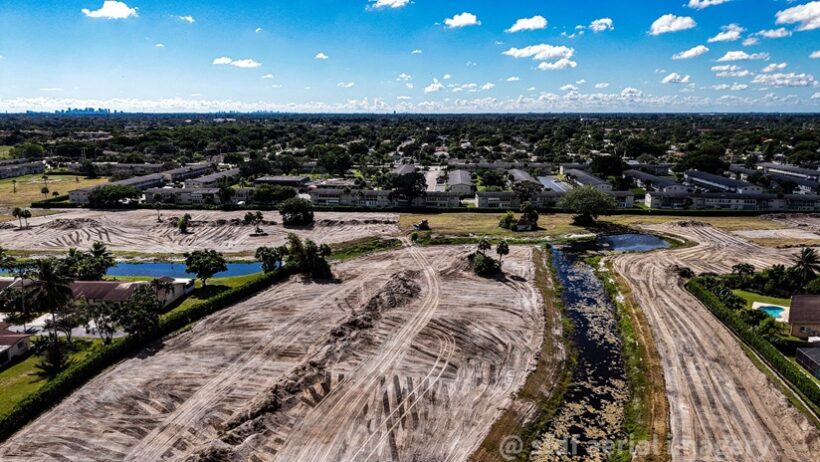
Plans to redevelop Margate’s former Carolina Golf Club into housing
are facing resistance from nearby residents who claim that ground toxins during
excavation may become air born and make families sick. A resident in the throws
of golf course redevelopment across town describes just that.
“My husband is sick as a dog with double pneumonia in the
hospital. Several of the other neighbors are complaining of getting sick and
their children getting sick and I don’t even want to talk about the dogs and
cats that are walking around, coughing and sneezing,” Oriole resident, Stacia
Day, shared in an email. “This is a complete and utter nightmare,” she said of
redevelopment on the former Executive Golf Course on Margate Blvd.
_______________
Resident, John Demming of the Carolinas, cites a Declaration of Restrictive Covenant
on the golf course issued by the Broward County Environmental Protection
Department (EPD) in 2008. The document, recorded in county records, restricts
use of the property’s maintenance
facility area for other uses due to confirmed soil and
groundwater contamination from arsenic and other toxic substances.
The document requires the contaminated soil to remain sealed
under asphalt or capped with clean fill and states that the restrictions “shall
continue in perpetuity unless otherwise modified in writing” by both the
property owner and the county.
Contamination, states the declaration, has resulted from
years of pesticide and herbicide use in the equipment wash-down and chemical
mixing areas of the former maintenance site. Soil tests conducted in 1999 and
2000 found arsenic concentrations exceeding state cleanup target levels.
Groundwater testing confirmed contamination above Florida’s regulatory
thresholds. The EPD therefore imposed permanent land-use restrictions
prohibiting groundwater withdrawal, soil removal, or any residential,
educational, or recreational development within the contaminated area.
Residents argue that any plan to construct townhomes on or
near that section of the property would violate those restrictions and could
endanger public health. Plans to redevelop the 148-acre property include 540
townhouses, 30,000 square feet of neighborhood-scale retail, and more than 65
acres of park land and lakes. Over the years, golf courses in and around Margate have been targeted for redevelopment. Next door, a portion of the former Heron Bay Golf Course in Parkland was rezoned for million-dollar homes.
Though the declaration at the Carolinas confines the contamination to the
maintenance area, homeowners say runoff and decades of chemical use
likely spread toxins widely across the course. Neighbors want confirmation that
the original conditions have been fully remediated before any residential
construction begins. They will make their voices heard at a November 5 city
commission meeting when the plan goes before elected officials for rezoning.
The city’s Planning & Zoning Board has already greenlighted the project.
Similar disputes have surfaced across the Sunshine State and
the nation as former golf courses are converted into housing. In Palm Coast,
residents protested redevelopment of the Matanzas Woods Golf Course after soil
samples revealed elevated arsenic levels. In Miami-Dade County, homeowners at
Aventura Isles filed suit alleging that developers built homes on land
contaminated with golf-course pesticides. And in Lake Worth, dust from cleanup
work at the former Fountains Country Club prompted complaints of arsenic
exposure from nearby residents. Environmental regulators in each case confirmed
that historic golf course maintenance practices often left behind toxic
residues that complicate redevelopment.
Margate residents say the situation at Carolina Golf Club
fits that pattern. The Broward County covenant was intended to prevent
residential use on contaminated ground, and no county document on record shows
that restriction lifted. Until that happens, residents contend that any
development approval would directly contradict the county’s own environmental
protections.
Medical and environmental studies have long linked former
golf courses to residual contamination from arsenic-based herbicides and
pesticides used in turf maintenance. A University of Florida investigation found
high concentrations of arsenic in soils and groundwater beneath several South
Florida golf courses, a finding later reinforced by U.S. Geological Survey
reports documenting pesticide and arsenic residues in reclaimed irrigation
water. More recently, a
population study published in JAMA Network Open reported that residents
living within one mile of a golf course faced more than twice the odds of
developing Parkinson’s disease compared with those farther away, particularly
where groundwater vulnerability was high. Experts at the Science Media
Centre noted that while the study shows association rather than causation, the
correlation underscores how legacy turf chemicals can persist for decades,
posing health risks when soils are disturbed during redevelopment.
As excavation continues to make room for new townhomes on the former Executive Golf Course on Margate Blvd., time will tell if the health of residents in that community will inform redevelopment plans for the former Carolina Golf Club.