
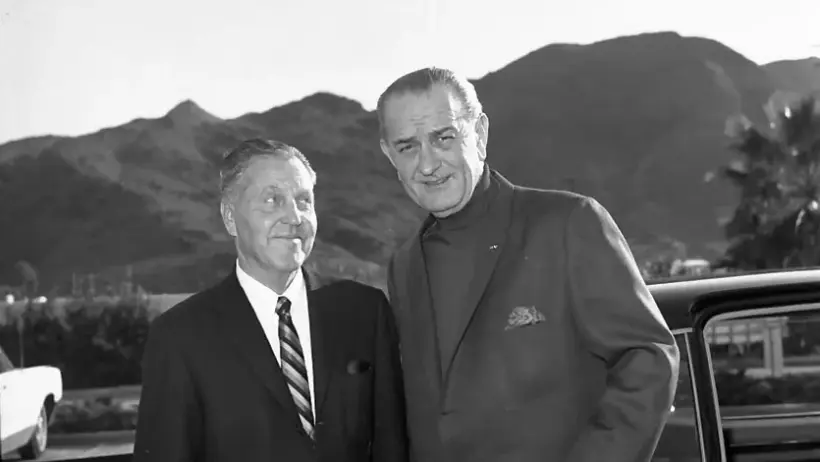
Nov. 4, 2025, 8:00 a.m. ET
Dawso created integrated residential communities where the golf course functioned as both recreational amenity and aesthetic organizing principle.Dawson pioneered the modern desert country club, integrating residential communities with golf courses.An accomplished amateur golfer, his achievements as a developer ultimately surpassed his success in the sport.His projects, including Thunderbird and Marrakesh Country Club, established a new model for resort and retirement living.
Golfer Johnny Dawson arrived in the California desert when it offered little more than stretches of sand dunes, two modest nine-hole golf courses and space to dream. By the time of his death in 1986, he had been a major force in transforming the region into the winter golf capital of the world.
The 1975 Encyclopedia of Golf credited Dawson with developing Palm Springs and the Coachella Valley into a first-rate golf destination known throughout the world. Dawson didn’t merely develop golf courses — he invented the modern desert country club and, in doing so, created an entirely new model for how Americans would live, retire and play the sport.
More: A century of golf: How the sport became a defining part of life in this famous California valleyDawson was born in Illinois, worked for Spalding
Born in Illinois in 1902, Dawson grew up near a golf club, became a caddy, and soon excelled at play. In 1920, he graduated from high school and immediately went to work for A.G. Spalding Company, the top sporting-goods purveyor in the country. He was quickly following the tour to enlist top players to endorse Spalding products.
Explore how to live where you love to play Access community guides, golf real estate insights, trusted agent connections, and content built for passionate golfers.

Dawson began entering tournaments and achieving spectacular scores. He posted the low amateur score at The Masters Tournament in 1936 and tied for the same in 1949, competing against professionals in an era when the distinction between amateur and professional golf was serious.
The USGA ruled that working for a sporting goods company negated Dawson’s amateur status, prompting him to resign from Spalding in 1929. He remained ineligible to golf in USGA-sponsored amateur tournaments for more than a decade. During his career, Dawson made an astounding 11 holes-in-one, all during competitive play, and was the U.S. Senior Amateur Champion from 1958 to 1960.
But his golf résumé would eventually pale in comparison to his achievements as a developer.
Dawson started at Thunderbird Country Club
Thunderbird Country Club, which opened in January 1951, would be Dawson’s proof of concept. Thunderbird Dude Ranch was transformed into the Coachella Valley’s first 18-hole regulation golf course in partnership with Barney Hinkle and Frank Bogert.

Years before, during the despair of the Great Depression, Frank Bogert and Johnny Boyle traversed the country in a woody station wagon, driving from town to town promoting Palm Springs. Bogert and Boyle would set up a BBQ and throw on some steaks and draw a hungry crowd. The two bona fide cowboys would then put on a small western show, with Boyle singing in a luxuriant baritone accompanied by his guitar and Bogert amazing the crowd with his horseman skills.
The men conjured up the allure of the wide-open desert way out west. Bogert would extol the virtues of his hometown, where cowboys and tourists alike enjoyed exceptional hospitality. At the end of the evening, they showed a short film, passed out literature, and encouraged folks to make the trip, despite the economy.
The Chamber of Commerce had commissioned the nationwide tour to promote the village. Traveling town to town together, they literally put Palm Springs on the map for those who attended their show. Long before Palm Springs was known as an atomic-age, rat-pack, mid-century hangout, and before it was the golf capital of the country, it was defined by horseback riding and real roping cowboys like Bogert and Boyle.
Everywhere they went, Bogert heard the complaint that there were no serious golf courses in Palm Springs, precluding well-heeled, golfing travelers from choosing the destination.
Because of the oft-heard complaint, Bogert was very sure of the demand when he and Dawson assembled the parcels and the investors to make Thunderbird into a resort with an 18-hole course. Dawson put $5,000 in escrow and then sought investors among his friends to help.
By 1948, Dawson had completed exhaustive studies of the desert’s water, wind, sun, and views, with particular attention to soil composition, grass varieties, and fertilizers needed to create championship turf.
His observation that Rancho Mirage and Palm Desert received as much as 90 additional minutes of sunshine daily compared to Palm Springs was critical. Being further from the shadow of the mountain represented a strategic advantage of stretching the number of playable hours in a day.
Ben Hogan said Palm Springs wouldn’t work for golf
But the skeptics were legion. Ben Hogan flatly told Dawson the venture couldn’t succeed, while Dawson’s own friends and business associates, concerned for his sanity, pointed out that summer temperatures reached 130 degrees, and Bogert would joke — the same number as the summer residents. Further, the winter season was too brief, and the town lacked sufficient water for basic landscaping, much less for a huge golf course.

It didn’t stop them. Together with Lawrence Hughes, Dawson routed the course to maximize mountain views while incorporating natural desert washes and elevation changes. Dawson’s designs would emphasize strategic play over length and featuring with greens with subtle undulations and challenging pin positions. His fairways are said to have offered risk-reward opportunities that kept the game engaging for all skill levels.
Thunderbird opened the desert golf floodgates
The success of Thunderbird was vindication and ignited a development boom. Tamarisk Country Club opened shortly after, followed by Indian Wells in December 1956. But Dawson himself was just beginning. As both developer and designer, he created Eldorado, Seven Lakes Country Club, La Quinta Country Club, and Marrakesh Country Club, each project refining his concept of a desert golf retreat.
Marrakesh Country Club, which opened in 1969, represented the culmination of Dawson’s two decades of desert development. When Dawson first surveyed the empty Palm Desert landscape, he envisioned a golf and social community with views of the Santa Rosa and San Jacinto Mountain ranges.
He chose John Elgin Woolf to design the housing units in the Hollywood Regency style. The pink glow that arrived over the desert each evening was captivating and the clubhouse and the 364 condominiums surrounding the golf course would all be painted pink to harmonize with that twilight moment. After Woolf’s renderings were made, Cliff Henderson and one of Dawson’s friends suggested that it looked like Morocco and then the exotic theme was applied to street names and landscape was chosen accordingly.
Richard Harrison, who had started off with Donald Wexler in Palm Springs, created the clubhouse that was eventually realized, instead of Woolf’s original design. The project would be built out by 1979. Ted Robinson, one of golf’s most celebrated course designers, set out the links. The result was architecturally coherent yet stylistically audacious with the Marrakesh name applied.
The Southern California Golf Association described Dawson as “the visionary force that began the golf course boom in the Coachella Valley after World War II.”
Dawson didn’t simply build golf courses on open desert land — he created integrated residential communities where the golf course functioned as both recreational amenity and aesthetic organizing principle. The concept, now ubiquitous across American retirement and resort communities, was genuinely novel in 1951 with the advent of Thunderbird.

By the time he developed Marrakesh nearly two decades later, Dawson had perfected his formula. Palm Springs Life magazine quoted Dawson, “If you give a man a good golf course, a good view, and a concept that eliminates the millions of petty irritations he is going to run into elsewhere in life, you are off to a pretty good start.”
Dawson was posthumously inducted into the Southern California Golf Association Hall of Fame in 2007. He was a very good golfer, but his imagination of gracious golf course living was peerless. He didn’t just develop real estate — he envisioned a novel retirement life that would draw hundreds of thousands of people to the Coachella Valley.
Palm Springs Life Magazine captured Dawson’s perspective on his career, “Nobody in the world could be doing more interesting work than I’m doing. You’re creating something out of nothing. You’re changing a person’s way of living, and you’re not hurting a soul with what you’re doing.”
Tracy Conrad is president of the Palm Springs Historical Society. The Thanks for the Memories column appears Sundays in The Desert Sun. Write to her at pshstracy@gmail.com.
