
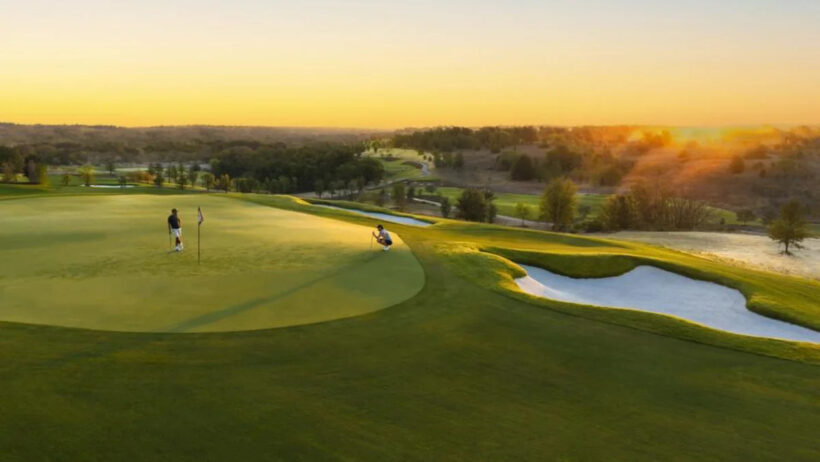
 A couple golfers playing the Tom Fazio 18-hole championship course at Maverick
Wrangling an entire family into putting down roots in a golf community takes more than a pretty course with a big-name designer attached.
A brand-new Tom Fazio golf course stretching beyond 8,000 yards with a view of the Fort Worth skyline from the first tee box is a siren call to avid area players. At Maverick Golf & Ranch Club, Discovery Land Company is betting a water park, kids’ adventure center and wellness barn will give the rest of the family reasons to buy in.
The championship course, which just opened November 6, is the centerpiece of a 1,100-acre development planned for nearly 500 residences. It joins the Pinkerton nine-hole par-3 course, which opened in November 2025, with an additional 12-hole executive layout still on tap. Homesites range from $1.5 million to $3.7 million, The Dallas Morning News reported.
But the golf investment is only one prong of the sales proposition. A spa, fitness center, racquets complex and fieldhouse are also on the docket. An organic farm and Maverick’s first full-service restaurant are scheduled to debut in 2027. Maverick offers a case study in Discovery’s business model: how much to invest in the golf that attracts prospective buyers, and what else it takes to persuade an entire household to call the place home.
Discovery expects the return on Maverick’s attractions to be reflected in the value of the surrounding real estate. A water park or racquets complex can earn its keep by helping sell homes and supporting the prices buyers will pay.
“The amenities are the product, not a profit center,” Michael Meldman, Discovery’s founder and chairman, said. “It’s a matter of whether they are making the community more connected, the member experience better, and every home around them more valuable.”
That strategy began taking shape before the championship course opened or homes were built. Within months of launching sales, Discovery opened the Wild Bunch Campground, an outdoor recreation and gathering hub with a ropes course, archery, axe throwing, walking and biking trails, a live-fire kitchen and a two-story tree bar tucked into live oaks. According to the club, the campground has already become the go-to hangout for post-golf festivities and member events.
“We wanted to provide a shared gathering place early on, so members could become neighbors before there’s any physical neighborhood,” Meldman said. By the championship course’s early November opening, about 80% of released inventory was already committed, he said, with demand prompting Discovery to accelerate the release of future phases.
“75% of buyers are coming from Texas, most of which are from the metroplex,” Steven Spieth, Maverick’s director of sales, said. His surname is a mighty familiar one around Texas clubhouses. He is the younger brother of three-time major winner Jordan Spieth.
“We expect a majority of buyers to use Maverick as a primary residence with many relocating from elsewhere in DFW, and some relocating from out of state to call Maverick home,” Spieth added.
The club also dispenses with some traditional country-club formalities. There are no tee times, no dress-code enforcement and if people want to bring their dogs along on a round, all good. Access, however, is tightly controlled so the sales pitch is not accompanied by a test drive. “The course is meant for members and their invited guests, so prospective buyers will not be permitted to play golf,” Spieth said. Nonetheless, he expects the championship course opening to sustain the development’s sales momentum.
With a continent-hopping portfolio that includes North Shore Preserve on Kauaʻi, Discovery Dunes in Dubai and Taymouth Castle in Scotland, Discovery seems to fancy itself as much a world builder as a real estate developer. At Maverick, that ambition comes down to how golf and residential life share the land.
Architect Tom Fazio knew he had to consider both the golfer looking down the fairway and the homeowner looking out the window when making routing decisions.
The dean of design’s guiding principle was “allowing golf to be the main focus while on the golf course but views and privacy to be the main focus while on the home sites.” At Maverick, the same landscape has to earn its keep twice, pulling off a Texas two-step as both a place to play and a place to hang one’s hat.
This article was originally published on Forbes.com