
July 15, 2022, 5:02 a.m. ET
Links life is good on the First Coast. There is a healthy mix of public, private, resort, municipal, military and short courses and there’s no lack of playing opportunities at any price point.
But not every facility has been able to sustain itself. There are many in the past that couldn’t weather economic downturns, or financial or agronomic mismanagement and were either forced to close or closed by the owner’s decision.
Some were iconic layouts with two designed by a member of the World Golf Hall of Fame and another by a past Players champion. Another produced a U.S. Amateur champion. One was the longest course on the First Coast at the time it opened and as such was a drawing card for long hitters who wanted to test their mettle.
Diamonds in the rough: Five public golf gems within an hour of downtown Jacksonville
Return to Ponte Vedra: Jerry Kelly calls Players Championship exemption for Senior Player winner ‘one of the great things we have’Love crosswords? Explore the Crossword page and play the new MidGrid Crossword.Tragedy: OSHA fines Clay County golf ball recovery company for safety violations in wake of 2021 diver death
Others were popular neighborhood hangouts that met the description of “a bar with 18 holes attached.”
For many golfers, it’s as if they were kicked out of their home. The courses meant something to the golfers that loved them, quirks and all.
Here’s a nine-hole layout of the most notable golf courses on the First Coast that no longer exist.
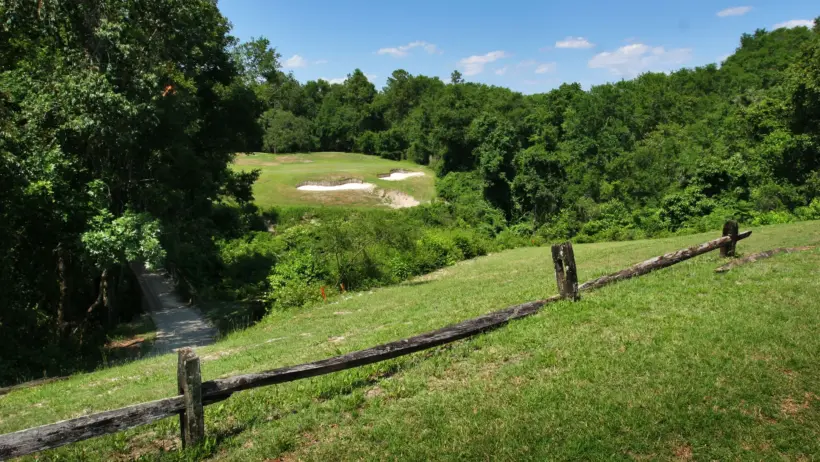
The Ravines, Middleburg
Lifespan: 1978-2006.
Architect: Mark McCumber.
Notable: Of all the courses that have closed on the First Coast, this one probably has met with the most regret over the years. It took advantage of natural elevation that simply doesn’t exist in other parts of the First Coast to create a winding, hilly track that featured dramatic elevated shots.
Golfers who played the Ravines loved the downhill par-3 seventh hole with a sloping green that carried balls close to the hole if they caught the right slope or the scenic par-4 ninth hole that required players who had just hit their approach shots to the green to ring a bell in the fairway to let players on the tee know it was safe to hit their shots.
It also had historical value: It was the first course designed by McCumber, the 1988 Players champion, and unusual for a player-architect, he actually designed the course before he got his PGA Tour card.
The Ravines was closed by then-owner Ken DeBusk after an attempt to shorten the course to a par-70 and develop more homes. The Clay County Planning Commission has ruled twice that the property is built out according to its terms as a Planned Unit Development.
Baymeadows, Jacksonville

Lifespan: 1969-2005.
Architects: Desmond Muirhead and Gene Sarazen.
Notable: Baymeadows was the first golf course on the First Coast that was more than 7,000 yards from the back tees and in its heyday offered as stern a test as any course in the area, even after that Players Stadium Course at TPC Sawgrass was opened in1980.
The par-5 eighth hole was a beast of nearly 600 yards long. The shortest par-3 hole was No. 11, at 170 yards.
Baymeadows became a favorite place for PGA Tour players who either failed to Monday qualify for a Greater Jacksonville Open (until that tournament morphed into The Players in 1977) or missed the GJO cut. Players would flock to Baymeadows looking for money games and find all the action they could handle.
It was during one of those weeks that PGA Tour veteran Jim Thorpe shot a 64 that was the course record until Baymeadows closed.
McCumber supervised a renovation in 1991 but the club eventually couldn’t sustain itself as a private facility and public play trickled away as new courses on the Southside such as Windsor Parke, Mill Cove (now Blue Sky) Queen’s Harbour, Glen Kernan and the Jacksonville Golf and Country Club opened.
D.R. Horton bought the property in 2005, closed the course, and had grand plans for 1,200 condos, 200 single-family homes, 150,000 square feet of office space and 60,000 square feet of retail. Because of traffic concerns and infrastructure concerns, former Mayor John Peyton vetoed the legislation and residential and commercial development has been downsized considerably.
The Dunes, Jacksonville
Lifespan: 1968-1995.
Architect: Unknown.
Notable: Money games on the course. Gin in the clubhouse. Pools on the Masters, U.S. Open, Super Bowl, NCAA basketball – there was always action to be found at the Arlington track which was home to a rogue’s gallery of hustlers and golfers who enjoyed some of the purest greens on the First Coast.
“You would find pipe-fitters playing with lawyers, mini-tour guys playing with insurance salesmen … everyone felt comfortable at the Dunes,” said former head pro Allen Brown, who rode his bike with friends to watch the construction of the course.
For most of the Dunes’ history, it was owned by Buster Reed, who later sold it to Eddie Davis, a club pro and PGA Tour caddie. Davis owned it until the city purchased the property and turned it into Ed Austin Park.
Although the Dunes was playable to high-handicap golfers, professionals gravitated to it since it was inexpensive and for most of its lifespan, was the only public golf course in Arlington – and did we mention the greens?
“No matter who the superintendent was, the greens are among the best in Jacksonville,” Brown said.
The first recorded 59 on a First Coast course was at the Dunes by Matt Jackson – and the day he shot it, he and his partner won their match only 1-up.
“It was a fun course for any ability level but if you came looking for a game, you had to be able to back it up,” Davis said.
Ponce de Leon, St. Augustine

Lifespan: 1918-2003.
Architect: Donald Ross.
Notable: Some real golf history was lost when the course closed after a residential development project stalled. At the time of its closing, the Ponce was the oldest existing golf course in Florida and was the first of a long line of Ross designs on the First Coast.
President Warren Harding and Babe Ruth were among the celebrities who played at the Ponce when it was a bustling, busy resort.
As is the case with many courses that fail, a string of owners all combined to make decisions that weren’t always the best for the property.
Case in point: One owner closed the holes that wound from the clubhouse west to U.S. 1, with plans to build a learning center and a short course. Five holes were built in the woods to the north that bore no resemblance to a Ross course, and most die-hards hated the stretch from No. 11-15.
But the front nine and the last three holes on the back were breathtaking with their views of the Intracoastal. And the signature hole was unlike anything on the First Coast: “Cyclops,” the par-3 fifth hole which required golfers to avoid a large greenside bunker with a round patch of grass in the middle.
Fort George, Jacksonville

Lifespan: 1927-1989.
Architect: Donald Ross.
Notable: There is some dispute that Ross designed the first nine holes on Heckscher Drive. It’s listed by the Ross Society in Pinehurst but there has been some documentation that Maurice Fatio, a St. Augustine architect, was involved.
The business interests that built the course were said to have wanted to offer golfers and vacationers an alternative between Jekyll Island and the Ponce de Leon but it never quite panned out. The club eventually became semi-private and its location and breathtaking views of the Intracoastal kept it going.
Another nine holes were added in 1968 and were called “the American Nine.” The first side was dubbed “the European Nine.”
Fort George had some elevations not usually seen near the Intracoastal, such as a par-3 to an elevated green, with the 18th tee a few feet away that regulars called “Mount Cornelius.” The 18th tee had a plaque that claimed it was the highest point on the Eastern Seaboard south of Wilmington, Del.
Fairfield bought out owner Paul Reinhold and closed the course with grand development ideas. Long-time residents, led by developer William Arnold, beat the plans after a long legal fight and the state bought the land and turned it into a park.
Among the biggest attractions is the stately Ribault Club, which is on the register of U.S. Historic Places.
Beauclerc, Jacksonville
Lifespan: 1955-1983.
Architect: Robert Trent Jones Sr.
Notable: Located nearly a mile from the San Jose Country Club, Beauclerc was the most inclusive course on the First Coast at the time, welcoming Jewish members who wouldn’t get consideration at other private clubs.
The Jewish Community Alliance is located at the spot of the former Beauclerc clubhouse.
The course was a relatively flat, short, tight layout because of the small piece of land on which it was built. However, the long, straight par-4 10th hole was used for long-drive contest and Beauclerc had one of the most active junior programs in town, thanks to veteran pro Norrie Wright.
“It was a lot of fun to play,” Davis said. “The par-5s were all reachable.”
The course also had an Island Green at the par-3 12th hole.
Former Times-Union sports editor Fred Seely said everyone was welcome at Beauclerc, from recreational players to organizations that wanted to play tournaments there.
“The JAGA Four-Ball Championship, when it was two rounds, would play one round at San Jose and one at Beauclerc,” Seely said. “They always held a lot of tournaments.”
Unfortunately, social progress eventually killed the course. Private clubs stopped discriminating against Jewish players and the course eventually lost too many members to sustain itself.
Deerfield Lakes, Callahan

Lifespan: 1964-2019.
Architect: Unknown.
Notable: Directions to someone who had never played Deerfield Lakes always went along these lines: “Go North on U.S. 1, and after you cross the Nassau County line, turn left at the big golf ball.
It’s still there – nearly 20 feet high and painted lime green. The ball itself has had a life of its own, and used to be on a driving range off University Boulevard and another on 103rd Street.
Plans are for an RV Resort, water park and perhaps re-opening nine holes of the course but for now the fairways are deserted.
Deerfield Lakes also is known for producing a U.S. Amateur champion. Bubba Dickerson grew up playing the course and won the Amateur in 2001 at East Lake in Atlanta.
Panther Creek, Jacksonville

Lifespan: 2005-2010.
Architect: Andy Dye.
Notable: No course flamed on and flamed off like Panther Creek, the first design by Pete Dye’s nephew and was the longest golf course ever built on the First Coast, tipping out at more than 7,600 yards.
At the time, course management was hopeful Panther Creek would fill the void left by the closing of Pineview, Baker County’s only golf course, the closing of Westland and West Meadows, and a steady stream of ownership and management changes at Bent Creek.
But development was slow and the economic downturn in 2008 slowed home buying and resulted in the course being closed by owner Kent Curley.
Course at Westland, Jacksonville

Lifespan: 1976-2006.
Architect: Pete Cooper.
Notable: The track off Blanding was initially called the Duclay Golf Club, since it was so close to the border of the two counties. It was later called Willow Lakes and had 27 holes until McCumber Golf purchased the 18 that made up the “Troon” course and embarked on renovations.
Westland had one of the toughest stretches of holes in the area, Nos. 10 through 13, which included a long par-4, a short, tight par-4, a long, tight par-5 with a tee shot coming out of a chute through trees and bordered on the right by a canal, and a long par-3.
It also was known for the family of foxes that had a den on the left side of the first hole.
Adams Homes purchased the property and closed the golf course, developing it with apartments and condos.
Other notable closings
Jacksonville — Pine Lakes, West Meadows, University Country Club (now Blue Cypress), Lincoln Park. Ponte Vedra Beach — Oak Bridge (now The Yards). Atlantic Beach – Selva Marina (now Atlantic Beach Country Club). Green Cove Springs – River’s Bend (also known as Cattail Creek and Reynolds Park). Macclenny – Pineview. Orange Park – Country Club of Orange Park.
Contact Garry Smits at gsmits@gannett.com