
Not long ago, LIV Golf seemed poised to become the future of golf.
As of Thursday, it is officially in the past.
The league, initially backed by billions of dollars from Saudi Arabia’s Public Investment Fund and adored by President Donald Trump, released a statement Thursday saying it plans to wind down operations.
“In light of the current circumstances, we believe shifting toward an orderly wind-down is the most responsible path forward for the League at this time,” the statement read.
That came a day after a report indicated that BC Partners, the private equity firm that had prepared to provide LIV with a league-saving capital investment after PIF ceased financing the rogue tour after the 2026 season, was dropping its investment after the league failed to secure enough player commitments for next season.
LIV’s Saudi funding dried up during the 2025 season as the PIF began refocusing its investments amid regional uncertainty. The league began courting investors interested in funding “LIV 2.0,” reportedly asking for as much as $300 million to keep it going, despite that being a drop in the bucket given its financial needs, especially around retaining top talent. Many of LIV’s star players had already jumped ship. Jon Rahm made his departure public last month, and Wednesday’s news implied that other stars like Bryson DeChambeau, Cam Smith, Dustin Johnson, or Joaquin Niemann also opted to exit the league.
The league had declared bankruptcy in September. In filings, it became clear how much of a death knell LIV’s lack of media rights deals was. It had 20 broadcast deals worldwide that accounted for only 5% of overall revenue, amounting to about $10 million. By comparison, the PGA Tour’s current media deals with NBC, CBS, and ESPN are reportedly valued at $700 million annually.
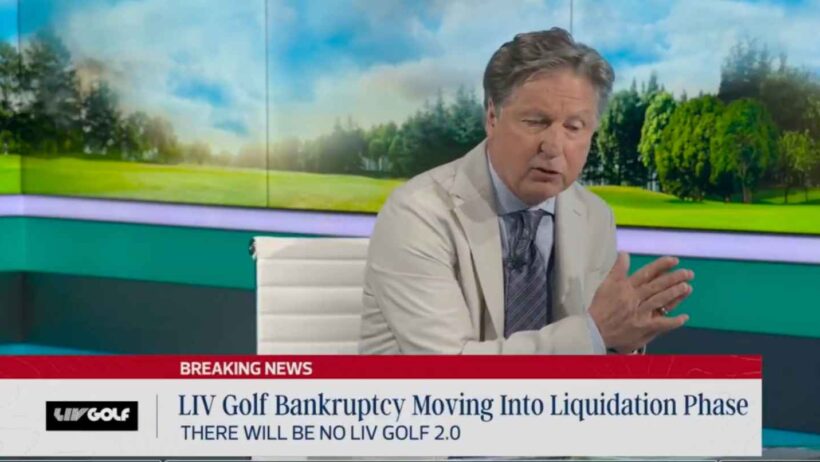
Golf Channel analyst Brandel Chamblee, who has long clashed with the league and delighted in its failures, took a victory lap on Thursday when the news broke.
Brandel Chamblee on LIV: “They all thought that they were like beachfront property in Malibu. And the market was telling them, ‘No, your timeshare’s in Toledo.’” https://t.co/fqt4WIlS4d
— Josh Carpenter (@JoshACarpenter) November 5, 2026
“You know, you can point the fingers a lot of places here, but in order for it to have gone forward, you needed some cooperation from whatever players were going to make up this LIV 2.0,” said Chamblee. “The players and player representatives, from what I’ve read, were making financial demands that could not be met.
“When you think about what the Saudis were paying these players, in essence, I’s call it hazard pay, because they knew that they were going to take on reputational damage. They knew that it was going to be disruptive. They probably also knew that it was going to be disruptive for their careers. So when you start to look at the players wanting to take debt for equity, speculative ownership, they were going to have 52.5%, from what I’ve read, ownership going forward of the product. And the fact that they were unwilling to take on that ownership tells you that they didn’t even have any belief that they as a group of players could make this work.
“They all thought that they were like beachfront property in Malibu, and the market was telling them, ‘No, your timeshare’s in Toledo.’ And maybe finally they’ve got a slap in the face of reality.”
As for what comes next, the big question will be where the LIV cast-offs play next year. Most are likely to end up on the DP World Tour in 2027 while they serve their PGA Tour suspensions, but the path back to the tour they left behind remains murky.