
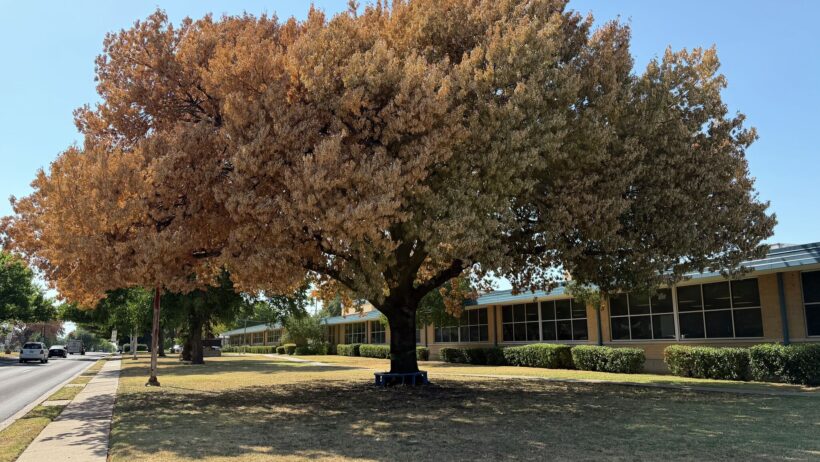
A tree in North Texas experiencing heat stress on Aug. 20, 2026. Heat-stressed trees may develop yellow, brown or pale green leaves.
Courtesy of Amy Langbein Heath
While tree leaves changing color typically signal fall weather on the way, yellowing or browning leaves in the middle of a North Texas summer can mean something else: the tree may be under stress.

After more than a month of little to no substantial rainfall and extreme temperatures, some North Texas trees are facing what experts call a “double whammy” of prolonged dry conditions and extreme temperatures.
“It’s like they’re in a constant state of stress. They don’t get a recovery period,” said Tara McCain, planting program lead at the Texas Trees Foundation.
Article continues below this ad
Here’s how to recognize signs of heat stress and what homeowners can do to protect their trees.
How does the summer heat affect trees in North Texas?
McCain said trees can experience stress due to a variety of reasons, including extreme temperatures and drought conditions.
Related: Dallas-Fort Worth breaks into top 10 longest dry streaks on record as drought concerns grow
“Just like humans, trees can [have] their health affected by the heat,” McCain said. “When they go into stress, that just means they’re using up a lot of energy just to stay alive.”
Article continues below this ad
When there’s no water for trees to transpire through their leaves, McCain said the leaves can start to dry out and appear scorched.
Related: With a heat wave roasting North Texas, when could Dallas cool off?
What does heat stress look like in a tree?
Early warning signs can include the soil around the base of the tree cracking, which McCain said indicates the soil is too dry and needs to be watered.
Tree leaves may also curl, wilt or begin turning pale green, yellow or brown, particularly around the edges.
Article continues below this ad
Premature leaf drop is another common sign, said William King, certified arborist and consulting manager at Texas Tree Surgeons.
Homeowners with trees often don’t notice a tree is under stress until the problem has been developing for some time.
“By the time you see some of these signs, we’ve already been experiencing stress there,” King said.
King said tree species with larger leaves, such as maples and mulberries, are among those that may have premature leaf drop and yellowing in North Texas’ current conditions.
“That situation doesn’t mean the tree is drying or dead,” King said. “That is a defense mechanism the tree does in order to preserve moisture inside.”
Article continues below this ad
What is sudden limb drop syndrome?
King said Texas Tree Surgeons has seen an increase in calls this summer for diagnostics involving trees shedding leaves and sudden limb drop, which is where branches on seemingly healthy trees fall off.
“Heavy green branches, they’ll drop without warning, without any indicators,” King said.
The phenomenon does not have an exact cause, King said, and arborists say multiple factors like environmental stress and disease can contribute.
Chronic tree stress can open the door to pest invasions or disease, King said, so some trees may be weakened due to several causes.
Article continues below this ad
Related: Does Dallas’ heat cause ‘sudden limb drop’ in trees?
How can I tell if my tree is dead?
McCain recommends checking a lower section of the tree by gently scratching through the outer bark. If the layer underneath is green, the tree is still alive.
Homeowners can also check by shaking individual branches and limbs to see if leaves fall off. If the leaves easily separate, that indicates the tree may be stressed but still alive and trying to preserve moisture by dropping its leaves.
McCain said to never assume a tree is dead without verifying with an arborist. Trees experiencing heat or drought stress may recover with proper watering, so homeowners may be able to help their trees by catching warning signs.
Article continues below this ad
Related: Wilting from the Texas heat? With these tips, at least your plants won’t be
How can I protect my trees from the heat?
The best way to help a stressed tree is to get water deep into the soil and toward its root system.
“Just doing a really quick shallow watering isn’t going to reach much of the root system of the tree,” McCain said. “It might water the grass around the tree, but it’s not really watering the tree itself.”
King recommends water slowly for several hours, rather than relying on irrigation systems that may not deliver enough water deep into the soil, especially with Texas’ clay soil.
Adding mulch around the base of the tree can also help protect trees from the heat, as it helps the soil retain moisture and cooler temperatures. King said to place a 2- to 3-inch layer of mulch around the tree, keeping it about 3 to 6 inches away from the trunk.
Related: Texas heat can damage your home’s foundation. Here’s how to protect it
Will rain help?
Yes. King said even a small difference in rain and cooler temperatures could provide some relief for stressed trees.
“Here in Texas, we go through these droughts all the time,” King said. “This year is going to [have] a long-lasting effect, and recovery of this type of environmental stress is a multiyear process.”
The developing El Nino expected to bring a wetter winter to North Texas could help trees in the region recover from this summer’s prolonged drought, King said.
Related: Could Dallas see snow this winter? What El Nino means for North Texas