
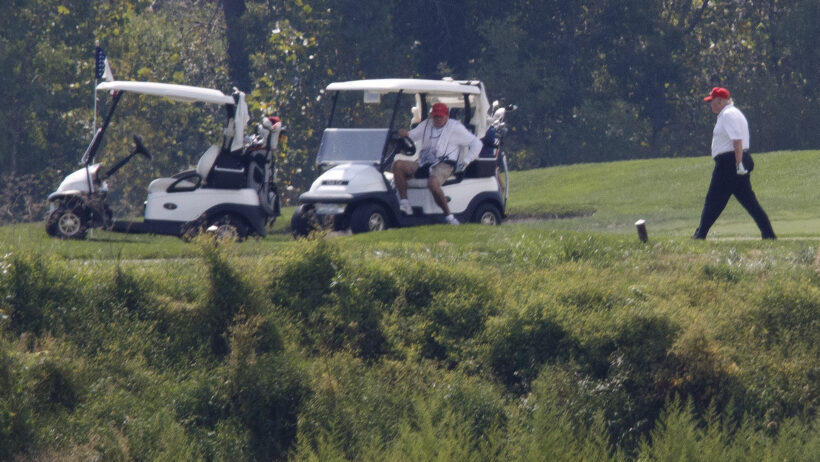
President Donald Trump, right, participates in a round of golf at the Trump National Golf Course in Sterling, Va., in September 2019. Among 11 properties named in New York Attorney General Letitia James’ civil complaint is Trump National Golf Club Hudson Valley, where the former president is accused of running four schemes to inflate the value of the club. (AP Photo/ Tom Brenner)
Tom Brenner
NEW YORK, NEW YORK – AUGUST 10: Former U.S. President Donald Trump leaves Trump Tower to meet with New York Attorney General Letitia James for a civil investigation on August 10, 2022 in New York City. (Photo by James Devaney/GC Images)
James Devaney/GC Images
Left: Former President Donald Trump (Alex Brandon/AP); Right: New York Attorney General Letitia James (Richard Drew/AP)
Associated Press file
EAST FISHKILL — Among a litany of fraud allegations laid out in the lawsuit filed Wednesday in state Supreme Court by New York Attorney General Letitia James against former President Donald J. Trump, his children and several family businesses are what James says are five long-running schemes designed to inflate the value of Trump’s clubs in an effort to secure favorable loan rates and pay lower taxes.

Four of those alleged schemes — referred to throughout the lawsuit as the “fixed-assets scheme,” the “unsold-memberships scheme,” the “membership-deposit scheme” and the “brand-premium scheme” — played out at the Trump National Golf Club Hudson Valley, located in the Dutchess County hamlet of Hopewell Junction.
Article continues below this ad
Here is how the attorney general’s office claims they worked.
The fixed-assets scheme
In 2009, Trump spent $3 million via a limited liability company to purchase what’s known as a ground lease interest in Trump National Golf Club Hudson Valley.
Under a ground lease, the lessee — in this case, the Trump Organization — can make and own improvements on the property, but is not the owner of the land. But in financial statements related to the property, Trump and his associates are accused of not disclosing the leasehold interest and “misleadingly suggest(ing)” that the organization owned the property outright, enabling it to take advantage of the fixed-assets scheme.
Article continues below this ad
According to the lawsuit, the fixed-assets scheme was an improper valuation of Trump enterprises based on assets purchased for long-term use — such as land, buildings and equipment — that cannot be converted quickly into cash. In the case of Trump National Hudson Valley, that meant failing to account for ground lease expenses, such as rent, when determining the value of the property between 2011 and 2021.
Because Trump National had negative cash flow, valuing the club based on its fixed assets, as opposed to its income, made the enterprise more valuable on paper — thus opening up more favorable treatment from banks and insurance companies, according to the attorney general’s office. By contrast, the lawsuit notes that the Trump Organization consistently valued its golf courses based on income when assessing them for property tax purposes, where the incentives worked the opposite way: a lower property value means lower property taxes.
The lawsuit further alleges that from 2011 to 2013, Trump and his associates further inflated the value of Trump National Hudson Valley based on “an assessment of the cash flow that is expected to be derived from club operations.” James called this “false and misleading for a number of reasons,” including because Trump and his associates used the fixed-assets approach when valuing the club during those years, and cash flow is not a fixed asset.
Article continues below this ad
One example in the lawsuit sheds light on how much Trump National may have been overvalued: In 2021, the club was valued using a combination of fixed assets and income, and its valuation fell by 25 percent — almost $4 million — from the previous year.
The unsold-membership scheme
This one is easier to explain. The lawsuit alleges that at many of Trump’s clubs, the former president and his associates inflated the value of unsold memberships, often by tens of thousands of dollars each. Higher membership fees would theoretically lead to higher future revenue for each of the clubs where the attorney general said the scheme was deployed.
At Trump National Hudson Valley, the listed initiation fee for 2011 and 2012 was $10,000. But in financial filings for those years, The Trump Organization inflated those values by as much as 300 percent, according to the attorney general’s lawsuit. In 2011, the company valued 93 percent of 161 unsold memberships at prices between $15,000 and $25,000, and in 2012 the company valued 78 percent of 254 unsold memberships at prices between $15,000 and $30,000, the filing alleges.
Article continues below this ad
During those years, most initiation fees were waived for new members, according to Trump Organization records.
The membership-deposit scheme
When the Trump Organization purchased Trump National Golf Club Hudson Valley, the purchase price it listed on financial documents included more than $1.2 million in refundable membership deposits. This was despite declaring in separate filings that the liability for the deposits was zero dollars, according to the lawsuit.
Doing so allowed Trump to inflate the purchase price of the club, according to the lawsuit. Generally accepted accounting principles call for using the “present value of the liability,” which according to the Trump Organization’s internal analysis was a fraction of the “actual” or nominal dollar value.
Article continues below this ad
The brand-premium scheme
From 2013 to 2020, the lawsuit alleges, Trump and his associates added a “brand premium” based on the Trump brand to artificially inflate the value of Trump National Hudson Valley. This was despite the fact that including internally developed intangible brand premiums is prohibited by generally accepted accounting principles.
A pattern of alleged misconduct
Trump National Hudson Valley is one of 11 clubs and related facilities named in the attorney general’s wide-ranging complaint, which follows a three-year investigation that Trump tried to block in federal court with a lawsuit that was dismissed in May. A notice of appeal is pending.
Article continues below this ad
The civil action adds to Trump’s legal travails, which also include the Justice Department’s investigation into his retention of classified materials at Mar-a-Lago, and investigations by the Justice Department, Congress and a Georgia district attorney into Trump’s efforts to upend the results of the 2020 election based on false claims of ballot fraud.
“This investigation revealed that Donald Trump engaged in years of illegal conduct to inflate his net worth, to deceive banks and the people of the great state of New York,” James said at a news conference Wednesday. “Claiming you have money that you do not have does not amount to the art of the deal. It’s the art of the steal.”