
A nearly six-year legal fight to build 200 homes on Eastwood’s former golf course led to defeat for the developers Friday, when a circuit judge ruled Orange County had good reason to reject the project and preserve the community’s established development pattern.
Circuit Judge Michael Deen’s Oct. 23 final judgment sided with Orange County and the Eastwood Community Association, finding that commissioners’ November 2020 denial was consistent with the county’s comprehensive plan, according to a report in GrowthSpotter.
Benge Corp. and Eastwood Golf Club LLC had sought an order requiring approval of the housing plan in the small community abutting Waterford Lakes. Instead, Deen left the denial intact, rejecting the developers’ argument: that unused housing approvals elsewhere in Eastwood entitled them to build on its golf-related land.
The ruling followed final written arguments filed by both sides Oct. 20. The developers may seek appellate review, and the court reserved jurisdiction to consider attorney’s fees and costs.
At the heart of the dispute was a 72.5-acre application area encompassing portions of the former golf course, which closed in 2020, clubhouse and practice range within Eastwood, east of Alafaya Trail and north of Stoneybrook Parkway. Eastwood Golf Club LLC owns the land, while Benge holds the development rights.

Willie J. Allen Jr./Orlando Sentinel
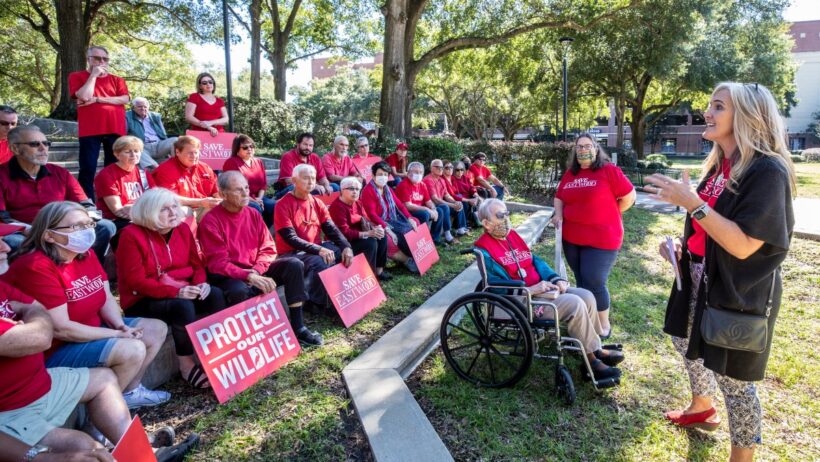
Eastwood Community Association Treasurer Sarah Gonder, standing, spoke with residents aboard a bus headed to the Orange County Administration Building for a November 2021 hearing over plans to build homes on the former Eastwood Golf Club property. A circuit judge upheld the county’s denial of the development on Oct. 23, 2026. (Willie J. Allen Jr./Orlando Sentinel)
County approvals dating to 1993 allowed a maximum of 2,320 homes in Eastwood, but only 2,016 were built. The developers sought to assign the remaining 304 units to a new residential phase on golf-related property without increasing the community’s overall housing allowance.
At the Nov. 17, 2020, commission hearing, they reduced the request to 200 homes and removed the narrowest portion of the proposed development area, which their planning expert identified as the most sensitive area for compatibility with surrounding development.
Commissioners denied the request 4-3.
District 4 County Commissioner Maribel Gomez Cordero, who represents Eastwood, was a vocal opponent of further development in the community. Open space was integral to the neighborhood people chose as their home, she told GrowthSpotter in an Oct. 26, 2026, email.
“My position reflected the importance of evaluating those effects and applying our Comprehensive Plan’s compatibility requirements. Adding more homes … would have substantially changed the community’s layout and character,” she wrote. “Residents deserve meaningful consideration when a proposal would substantially change the character of their established community. I must recognize the resident’s collective effort.”
While the golf course no longer operates, what remains are the views and the landscape woven through the community.
Residents’ opposition began before the golf course closed Aug. 31, 2020. They raised concerns about flooding, as well as school crowding and the additional traffic that comes with a denser neighborhood, the Sentinel previously reported.
A year after the denial, residents returned to commission chambers, many wearing red “Save Eastwood” shirts, as the county considered its response to the developers’ compensation demand under Florida’s Bert J. Harris Jr. Private Property Rights Protection Act.

Willie J. Allen Jr./Orlando Sentinel
Jen Augustine, left, Dave Augustine, left center, Tom Allen, right center, and Mary Allen, right, attend the Eastwood community rally Saturday to prevent a developer from building about 200 homes on the community’s former golf course near Orlando.
Commissioners unanimously stood by their decision despite a warning from the developers’ attorney Hal Kantor of Orlando-based Lowndes, Drosdick, Doster, Kantor and Reed PA of about $20 million in potential liability, including the claimed loss in property value and interest, the Sentinel reported.
That compensation claim was among three Deen dismissed Oct. 2 following a five-day trial. The others asserted vested development rights and reliance on county representations, leaving only the comprehensive plan challenge, which asserted that commissioners wrongly rejected housing that complied with the county’s growth policies.
In pursuing that claim, the developers emphasized that Orange County’s Development Review Committee unanimously recommended approval with conditions. They accepted requirements to match lot widths where new homes abutted existing homes and eliminate previously approved 40-foot lots.
Their attorneys argued that commissioners disregarded professional review and relied instead on generalized neighborhood opposition.
Deen found those adjustments did not resolve the broader question of whether another neighborhood belonged on the golf property. He gave considerable weight to county planning expert Allara Mills-Gutcher’s testimony that the proposal fundamentally changed Eastwood’s established development pattern.
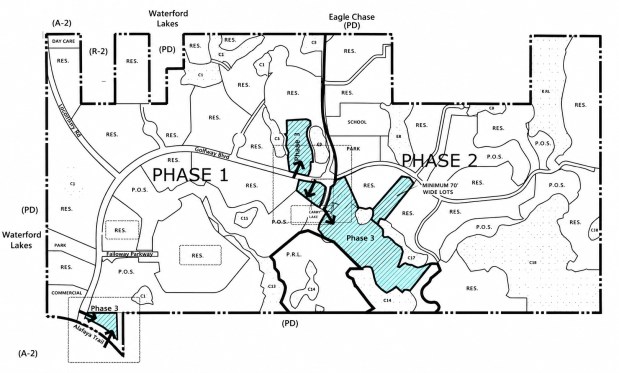 An illustration submitted at Orange County’s Nov. 17, 2020, hearing highlighted Eastwood’s proposed Phase 3. Residential areas are shaded in blue. Circuit Judge Michael Deen issued his final judgment on Friday, Oct. 23, 2026, upholding Orange County’s denial of the Eastwood Golf Club housing proposal. (Benge Corp.)
He also found the committee’s staff report lacked a detailed analysis supporting its conclusion that the project was compatible.
The property’s low-density residential designation did not require approval, either. Its allowable density ranged from zero to four homes per acre, and no residential units had been assigned to the golf-related land under Eastwood’s approved development plan.
“Thus, the BCC’s decision to maintain the status quo was more than reasonable and accomplished a legitimate public purpose,” Deen wrote.
The homeowners association was represented by Tallahassee-based Theriaque Law and Orlando-based Spain Law.
Representatives for the association, county and Benge Corp. could not be reached for comment before publication.