
Oct. 17, 2026, 12:01 p.m. ET
PGA Tour player Ryan Armour coined the term “the mules” to describe rank-and-file players who felt undervalued.A proposed PGA Tour restructuring for 2028 would create a two-tiered system with promotion and relegation.Armour is optimistic the new format will provide more playing opportunities than the current signature event model.The changes aim to address frustrations that the Tour favored elite players at the expense of its broader membership.Now competing on the PGA Tour Champions, Armour has found success in his rookie season on the senior circuit.
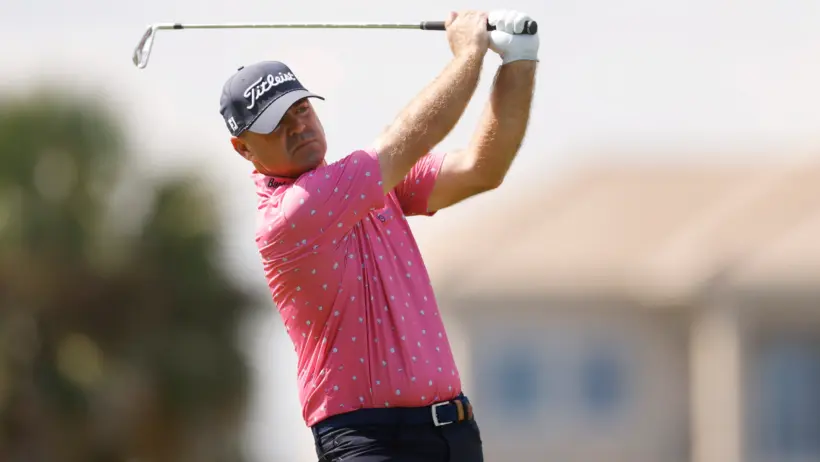
PALM COAST, FL. — When Ryan Armour called the PGA Tour’s rank-and-file players “the mules,” he never expected the nickname to become part of golf’s vocabulary. He was simply voicing a frustration shared by many of his peers: They were good enough to represent the Tour at pro-ams, charity events and hospital visits, but not good enough to compete in its biggest tournaments.
Now, as the PGA Tour prepares for a sweeping restructuring in 2028, Armour believes the players he once championed may finally have reason for optimism.
After a year of work by the Future Competitions Committee, Tour CEO Brian Rolapp unveiled a vision in June that would divide the Tour into two competitive tiers. The Tour’s Championship Series will feature fields of at least 120 players competing for purses of $20 million, while the Challenger Series offer fields of 144 players and purses closer to $4 million. At season’s end, 20 players would earn promotion, while 20 others are relegated.
The schedule for the new format remains under development, but Armour likes what he sees.
“I’ve tried to be optimistic when that came out,” Armour said. “They are going from 72 players in a signature event field to 264 playing opportunities in a week. That is awesome. The more, the merrier and you get to go out and prove it on the course. There’s going to be a cut and you don’t just get handed no-cut money.”
Explore how to live where you love to play Access community guides, golf real estate insights, trusted agent connections, and content built for passionate golfers.

For Armour, the proposed changes represent a potential return to something he felt the Tour had lost: Meaningful opportunities for more of its members to compete.
His criticism came to a head in March 2023, when the Tour was working to keep its biggest stars from leaving for LIV Golf, the renegade Saudi-backed league offering lucrative contracts. The response included signature events with elevated purses, limited fields and no cuts — a model Armour believed favored the game’s elite at the expense of the players who helped sustain the Tour week after week.
“Guys who keep their cards, they’re good players, but they’re not going to have a chance to play the playoffs,” Armour told Golf Digest’s Dave Shedloski at the time. “They’re not getting into any of the designated events. But they want those players to go be mules for you at all the pro-ams, all the charity visits, all the hospital visits and sponsor events. And we’re good enough to do that, but we’re not good enough to play in designated events like we did this year?”
The nickname stuck, taking on a life of its own in certain circles.
Armour recalled that he was simply working through putting drills while talking with Shedloski, who jotted down quotes that went viral. Soon, fellow players were repeating his words and telling him he had captured their frustrations perfectly.
“Oh my God,” Armour said with a chuckle. “I’m doing putting drills and talking to Shed and next thing I know the mules stuck. Guys in the locker room were like, ‘You’re right.’ My peers were like, ‘You couldn’t have said that better.’”
The issue, he explained, was never simply about his own playing opportunities. Armour was in his 40s and understood that his best years were behind him. But he was dismayed to see the meritocratic nature of the Tour be sacrificed ― and for what? What troubled him, too, was watching friends in their mid-to-late 30s, many of whom were successful past champions, struggle to find the same access to tournaments they once enjoyed.
“I’m not saying it’s a bad thing what they are doing, I’m just not sure how it’s going to work out,” he said.
Those players had traditionally been able to enter 12 to 16 events through past-champion status. Under the changing structure, many found themselves squeezed out of the fields they had once called home. Armour also believed the Tour had drifted from the principles established by former commissioner Deane Beman, who had helped shape the organization around creating opportunities for its membership.
“They just crapped on everything Deane Beman stood for,” Armour said.
As a member of the Player Advisory Council, he was concerned that it had lost its influence as decisions increasingly appeared to favor a smaller group of top earners while ignoring the sentiment of the pros elected to weigh in on such matters.
Still, Armour is not declaring the Tour’s new plan a guaranteed success.

His own career has offered a reminder of how uncertain professional golf can be, even for players who have spent years competing at the highest level.
Armour turned 50 earlier this year after making the cut in exactly half of his 270 career starts in the big leagues, and entered PGA Tour Champions with one career PGA Tour victory, the 2017 Sanderson Farms Championship. With roughly $8 million in career earnings — not enough to secure an exemption — and Q-School canceled, he had no certainty that a path to the senior circuit would open for him.
Then came an unexpected opportunity to compete in Boca Raton, Florida, at the James Hardie Pro Football Hall of Fame Invitational.
“All of a sudden, I turn 50 and I get into Boca, and I figured I better get practicing,” Armour said. “I wasn’t prepared as much as I should be.”
There was a good reason for that. After years of travel and competition, Armour had spent much of his recent time away from the Tour focusing on his family. Patrick, his older son, 17, plays basketball, while his 15-year-old son, Nick, plays hockey. With just three PGA Tour starts in each of the previous two seasons, along with 15 total Korn Ferry Tour appearances, Armour had finally been able to experience something that had often eluded him during his playing career.
“For the first time in my life I had a chance to be at everything,” he said.
Now, the veteran golfer, who starred at Ohio State, appears to be making the most of his second act.
After a slow start to his rookie season on PGA Tour Champions, Armour has found his form. Heading into the SAS Championship, he had finished inside the top 14 in each of his previous six starts, recording three top-five finishes along the way.
It is a strong run for a player who spent years fighting to ensure that golfers outside the sport’s inner circle were not forgotten.
The man who gave those players a name is now thriving in a new chapter of his own career. And as the PGA Tour looks toward 2028, Armour sees the possibility of a structure that gives more players a chance to earn their way forward.
The old mule, it seems, still has plenty left in the tank.

Adam Schupak is a Golfweek senior writer.