
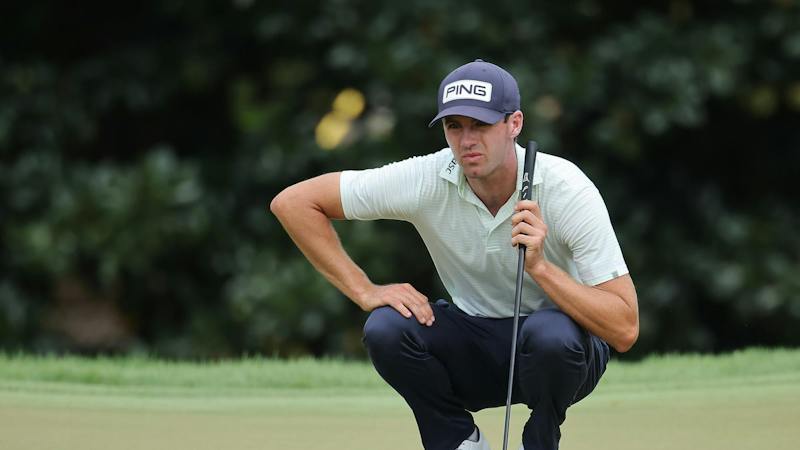
After three rounds of the PGA Championship in May, former Duke golfer Alex Smalley was the talk of the golf world. Smalley’s third day included seven birdies, five of which coming on a white-hot back nine, pushing him to 6-under par and earning him a two-shot lead ahead of Sunday’s final round. The PGA Championship is one of professional golf’s four annual “major” tournaments, so incoming favorites to win featured household names like world-No. 1 Scottie Scheffler and Rory McIlroy — both lurking within five shots of the lead at the close of round three. Smalley’s name was much less familiar to most fans, but he was in the best position of all to secure the Championship’s Wanamaker Trophy on Saturday evening of the tournament.
“It just kind of felt like I was able to put four good rounds together,” Smalley told The Chronicle. “Everything was firing on all cylinders for most of the week, and I just kind of caught lightning in a bottle for a few days.”
Smalley arrived at Aronimink Golf Club in Newtown Square, Pennsylvania, about five months ago for the fifth major of his career, seven years removed from the last time he teed it up as a Blue Devil. From 2015 to 2019, he was an indispensable part of head coach Jamie Green’s Duke men’s golf squad. Coincidentally, Smalley spent three years of his Duke career living in Wannamaker Quad on West Campus, a residence hall that bears a strikingly similar name to the hulking silver cup awarded each May to the winner of the PGA Championship.
While still at Duke, Smalley was already proving he could take down the household names of the amateur golf world. When he was a junior in May 2018, the No. 2-seeded Blue Devils were facing down a powerhouse Texas team in the match play quarterfinals of the NCAA Championship. Among the Longhorns that year was Scheffler, then a senior phenom who had long been recognized as a rising star with tremendous professional potential. When it came time for Coach Green to decide who to pair against arguably Texas’s most formidable asset, he knew that Smalley was the one to meet the moment.
“My gut told me, ‘This is the guy that’s our best player, and I think a lot of people, maybe Scottie included, don’t know that. And I don’t think they’re aware of how many birdies this guy can make,’” Green told The Chronicle.
Few would now question that intuition. Smalley came out firing, draining a relentless flurry of birdies on Oklahoma State’s tough Karsten Creek Golf Club. He ultimately took down Scheffler by a dominant score of 5&4, meaning Smalley was up on Scheffler by five holes with four remaining — ending the match after just the 14th hole. For the Duke junior, it was just “one of those days where it felt like I couldn’t miss,” as Smalley put it. “I think that’s what makes golf a really unique game, that anybody can beat the best in the world on any given week.”
That idea of constant possibility defined Smalley’s PGA Championship week. On a course setup that some considered the hardest in recent PGA tour history, Smalley, the leader after three rounds, produced a gritty final-round even-par 70. That wasn’t quite good enough to take the title — champion Aaron Rai’s 5-under 65 stole the show Sunday. Nevertheless, Smalley tied with two-time major champion Jon Rahm for second place amidst a tight leaderboard packed to the brim with superstar talent, beating 154 players out of the 156-player field. And for the first three rounds of the tournament, the apparently unassuming Smalley stood alone as the only player to open with three straight rounds under par.
The making of a pro career
Long before any of the fanfare and majors and headlines, and before he wrote his name all over the Duke men’s golf record book, Smalley was a kid from Wake Forest, North Carolina. At Wake Forest High School, he took four AP courses and graduated with a 4.71 GPA, while winning the 2014 North Carolina Junior Boys’ Championship as a rising senior. That kind of profile would have already made Duke a natural fit for Smalley, but there was even more to that picture than met the eye — Smalley’s mother, Maria, herself graduated from Duke with a Ph.D. in Chemistry, and his father Terry holds the same doctorate as an assistant professor of biochemistry at Wake Forest University.
Nevertheless, the college destination of one of the best players in Duke golf history wasn’t always a sure thing. According to Green, Smalley was chock-full of tremendous potential as a junior golfer, but his searing low rounds were often complemented by ballooning scores on days when he wasn’t quite at his best. For Smalley’s collegiate coach, consistency was key, and he wanted a player who could claw their way to solid tournament rounds even when their A-game was nowhere to be seen.
“He simply had the ability to go low when he was feeling well and he was hitting it well,” Green said of his former player. “But that level of consistency, that’s what I was looking for in a top tier recruit in that class.”
With that in mind, Green at first chose to hold off on signing Smalley. That is, until his decision suddenly became a lot easier. During Smalley’s senior year of high school, Green traveled to the foothills of western North Carolina to see him play in a tournament. There, the sixth-year Duke coach watched as Smalley posted two consecutive rounds in the low 60s, a lights-out performance that Green said quickly “nailed it down” for him. Knowing that just one competitive round like that was a monumental feat for any amateur yet to enter college — let alone two under the watchful eyes of college coaches — Green couldn’t pass on the North Carolina native.
The new recruit quickly turned into a proud Blue Devil and a team player, one who Green describes as a leader by example. Even his freshman year, it didn’t take Smalley long to break into the lineup and impress older players with his playing ability. Immediately, Green recalls, Smalley was “right there with them,” and the broken records and national accomplishments would soon follow suit.
Reflecting on his development as a player, Smalley credits his parents with building a support system that has been critical at every step of the way. When he was in high school, Smalley would often hit the links with his father after school, getting nine holes in before sunset. Most weekends, they’d make golf the priority, usually playing a full 18 holes on both Saturdays and Sundays. During Smalley’s first forays into competition as a kid, and continuing until he left for college, it was Terry Smalley on the bag in junior tournament after junior tournament.
“He was the one that would take me to some of the amateur tournaments as well, as my mom typically stayed at home with my sister, because my sister was also active … so my dad and I were typically the ones that were traveling to some of the local tournaments together when I was growing up,” Smalley said.
Maybe most importantly, the Smalleys have always been flexible in supporting their son’s golf career. Even after Alex took his talents to Duke golf, his parents travelled sometimes long distances to catch as many tournaments as they could. Things only got more hectic at the outset of Smalley’s professional career, his schedule bouncing between minor tour events and “Monday qualifiers” for events on the larger Korn Ferry Tour and top-tier PGA Tour.
By then, because of Terry’s work schedule, it had become easier for Maria to take on a larger role within his burgeoning career. So she did, beginning to accompany her son on the road. There, she helped out with travel and tournament logistics so that Smalley could devote more of his attention to the grueling competition of professional golf’s minor leagues. Frequently, she would caddy for him, too.
Maria Smalley’s current and most important role, though, entails something she’s been doing since Alex was still in high school. She acts as a statistician and videographer outside the ropes, filming swing videos, recording detailed stats, and taking notes on Smalley’s game at tournaments. Every round, she generates a set of data more detailed and personalized than any the PGA Tour could provide on Smalley’s performance, a report that he routinely examines for further insight into his game. On Sunday at the PGA Championship, the final round telecast at one point flipped to the mother and son together making the walk to the practice area and first tee, Maria ready to pull all the numbers on the biggest round of Smalley’s life.
“Definitely both of my parents have played quite a significant role in golf and my life up to this point, and they’re a great support system to have,” he said. “And I certainly count myself as really lucky to have both of them, for sure.”
Smalley has perhaps never faced more pressure to put it all together than during his rollercoaster ascent to the PGA Tour. Even for the best of the best, the path from college golf to the pinnacle of professional golf is treacherous, unforgiving and sometimes brutal. The summer after college, Smalley maintained his amateur status to compete in the prestigious Walker Cup, a team match play tournament held biennially between the United States and Great Britain and Ireland. After that, Smalley bounced between several professional tours, his journey being complicated by the COVID-19 pandemic less than a year after he graduated from Duke.
As time went on, however, by earning several “sponsor’s exemptions” into events and playing well enough in qualifiers, Smalley fought his way into increasingly higher-profile tournaments. Taking full advantage of those opportunities, his consistent play earned him a spot in the 2021 Korn Ferry Tour Championship. There, he finished in a four-way tie for 15th, good enough to lock up his PGA Tour card for the following season. He’d made it.
“It was just kind of a whirlwind at that point in time … I went from not really having any status on the Korn Ferry Tour to having a PGA Tour card in a matter of weeks,” Smalley recalled. “So it’s kind of one of those things where I was able to get some playing opportunities, and I just happened to play right — I happened to play good at the right time, was able to take advantage of those opportunities. And that led me to a PGA Tour card.”
The mind of a winner
Smalley holds a calm manner that has had a tendency to deceive, but five years on, his professional career has been elite by any measure. It features five full seasons on the PGA Tour, with 18 top-10 finishes there, and just over $14 million in total earnings. However, a first win on the world’s top tour has been elusive, and at first glance, Smalley’s even-keel personality may not jump out to fans as that of a flashy dark horse on the precipice of seizing a major championship. But make no mistake — in a sport that prizes patience, mental strength and inner ballast, Smalley has proven himself to have the goods. The rest is a matter of time.
That came through for anyone to see this May at Aronimink, in moments big and small. Smalley was as self-assured as ever all week on golf’s biggest stage, knowing what to do and when to do it even when other people were looking elsewhere and thinking differently. Coach Green, watching the final round of the PGA Championship on TV, took note of a poise he recognized from Smalley’s days at Duke University Golf Club.
Smalley came to the 299-yard par-4 13th hole sitting three shots back of Rai’s lead, in need of an explosive push down the last six-hole stretch to force a playoff. Due to the hole’s short yardage that tournament, some players had been taking the risk-reward play of gunning for the green with a driver. Up against the wall, Smalley could have ripped at one, a Hail Mary. But never the player to let the game change the game plan, he stuck with what he’d drawn up: a controlled fairway finder down the middle.
“I don’t know if he knew that he was behind at that time, but he didn’t veer from his strategy on that hole with that hole location,” said Green. “He just … hits a [fairway wood] off the tee, and he’s got a wedge in his hand, and he stuffs it inside 12 feet. He didn’t make the putt, but the point was that level of discipline to know that ‘this is my best chance to make birdie.’”
Nobody could catch the white-hot Rai that Sunday, but Smalley fought to the end, playing that final stretch in 2-under par and punctuating it with an emphatic eagle three on the par-5 16th hole. That kind of disciplined persistence was nothing new for the home-grown North Carolinian, manifesting itself in tight moments during Smalley’s days in Durham.
Another story Green tells goes back to a tournament the Blue Devils played at Louisville in the fall of 2018, during Smalley’s senior season. On the range before the opening round, Smalley couldn’t find his rhythm with the driver, hitting one snap hook after another minutes ahead of his tee time. Waving off help, Smalley calmly stepped back to the drawing board and the basics. He ultimately chose to take a more controlled left-to-right “low squeezer” shot onto the course rather than his natural draw, a last-minute pivot that set him into another gear, and then some.
“He didn’t hit probably more than two or three of those, and just goes to the first tee and shoots 61 … That’s just special,” Green said.
The ensuing 10-under par 61, a course record, was the second lowest single-round score in both Duke and NCAA history. Smalley went wire-to-wire on his way to the individual title that weekend, recording a three day mark of 16-under par to set a new 54-hole Duke individual scoring record. Meanwhile, the senior led his team to what became a truly historic weekend. The Blue Devils won the tournament by 17 strokes over the hosting Cardinals, setting new program records for 18, 36 and 54-hole team totals in the process.
Now, Smalley’s one of the best golfers on the planet. There are still hooks on the range. Things still frequently don’t go to plan. After tying for second at Aronimink in May and taking a share of third place the following week, Smalley’s summer got tougher. He missed the cut in three of his next four starts, and in the season’s two remaining major tournaments — the U.S. Open in June and the British Open Championship in July — he walked away with a missed cut and a T53 finish, respectively.
Just as he was on that September afternoon in Louisville, Kentucky, though, the 46th ranked player in the world is never one to be written off. Smalley’s best year yet at the sport’s highest level has spoken for itself, and he quickly found his groove again when he needed it most. In early August, Smalley tied for seventh at the PGA Tour’s final regular season event, the Wyndham Championship in Greensboro. That top-10 finish secured his position at 25th in the season-long FedexCup points standings, easily qualifying him for the FedexCup Playoffs — the slate of season-end tournaments held every August that whittle down the best of the best on tour.
Keeping the ball rolling, Smalley rode finishes of T24 and T16 in the playoffs to comfortably qualify for the final event, August’s Tour Championship in Atlanta. Featuring only the top 30 players in the points standings, it was a fitting final touch on Smalley’s season for the books.
He’s come a long way since leaving Durham, but fittingly, Smalley still gets ample reminders here and there of the place where he cut his teeth as a Blue Devil. An especially memorable one came up during the 2025 PGA Championship in Charlotte, where Scottie Scheffler ultimately ran away with a five shot victory. But it was anyone’s tournament to win after the first round, when Smalley ran into Scheffler’s father in the player family lunch line.
“I played pretty well the first round last year at the PGA Championship, too,” Smalley remembers. “I saw his dad in the lunch line, and he’s like, ‘Man, Scottie and I still talk about that time that you beat him in the NCAAs.’ He’s like, ‘That was just … that was crazy!’”
Sooner or later, the No. 1 player in the world just might find himself in a high stakes rematch. For now, Smalley looks forward to what will be another major moment in his career, already circled on the calendar. Next April, he makes his Masters debut at Augusta National Golf Club.