

TROON, Scotland — It always looks so easy until it doesn’t. The approach so quick he hardly settles over the ball before beginning the backswing. The swing itself so swift and smooth it hardly looks like there’s effort. The smiles and laughs from each little error make you assume nothing will ever affect him. Ludvig Åberg is handsome and chill and just altogether cool.
But golf history is filled with 20-somethings who tear up courses without a fear in their bones. The McIlroys and Spieths who rack up majors by age 25 with a bounce in their step and take risks without concern for the repercussions. Until the day comes that they think about it.
So as the golf world roared and cheered for Robert Macintyre on Sunday in North Berwick, as “Flower of Scotland” belted from the grandstands to honor their local Scotsman winning the national open, it was understandable to miss a 24-year-old Swede walking off the 18th green with his eyes lasered forward and his mouth tightly clenched. He certainly shook Macintyre’s hand and congratulated him out of respect, but in the moments after we saw something we had yet to observe before.
For the first time, Ludvig Åberg looked pissed off.
Before we go any further, this must be prefaced with a little perspective. Åberg is so dramatically ahead of schedule that no rational person should flag an alarm. Åberg has been a professional golfer for 13 months. That’s it. If he’s not top five in the world, he’s sixth. He won two professional tournaments and a Ryder Cup before playing in a single major. He finished second to Scottie Scheffler at the Masters. Two months later he went T12 at the U.S. Open. He’s finished T27 or better in 12 of his last 13 tournaments. He is a unicorn. (Also, you should hear him say the word unicorn at the 0:44 second mark.)
But something is starting to happen, bubbling underneath the surface of Åberg’s historically high floor. He is having issues on Sundays. He is putting himself in contention at the biggest tournaments in golf — way more often than your normal 24-year-old rookie ever should — and making costly errors to fade away. He last shot below 70 on Sunday three months ago, at the Masters.

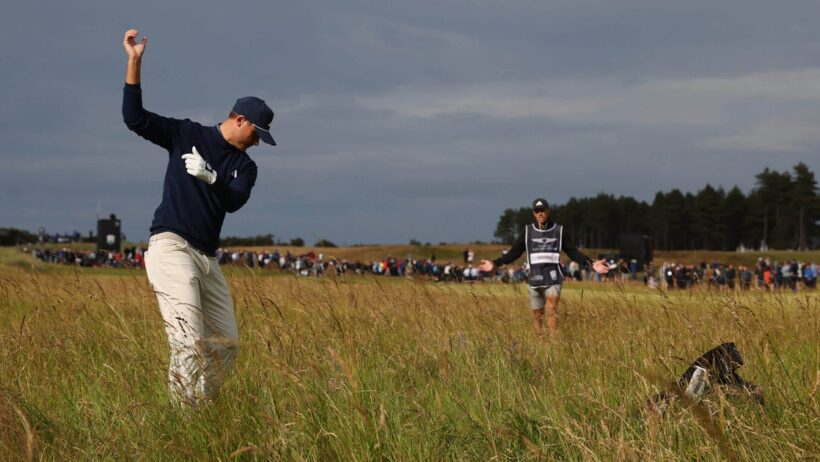
Ludvig Åberg’s third professional win has proven elusive. (Luke Walker / Getty Images)
It is all a reminder of the ways so many young, exciting golfers thrive without the scar tissue that comes with failure until the day comes that scar tissue forms. The question for Åberg is if he’s so affable and resilient that this won’t affect him — that these are simply valuable growing experiences — or if there is something more at play.
It started at the Masters in April. For a few moments in Sunday’s final round, it appeared to be a thrilling four-man race with Scheffler, Åberg, Max Homa and Collin Morikawa all tied nearing the turn. But Åberg put his approach on 11 into the water, double-bogeying the hole and ultimately costing himself a chance to catch Scheffler.
“I think this week has given me a lot of experiences and a lot of lessons learned in terms of those things,” Åberg said that Sunday, even following the water ball with two birdies. “It makes me really hungry, and it makes me want to do it again and again, I think. “
In June at the Memorial, he shot a Sunday 74 to drop out of contention as his normally flawless driver missed fairways and ranked near the bottom of the field. The next week in the U.S. Open, Åberg held the 36-hole lead and continued to thrive until a disastrous 13th hole on Saturday led to Åberg playing tennis around the greens, chipping from one end to the other for triple bogey. His mojo was gone from there, and on Sunday he triple-bogeyed the second hole and shot 3-over par 73 to drop to 12th.
But even then, he stayed calm and playfully extended his tongue in exasperation before moving on. It was another impressive debut at a major, and he could downplay the slide as flukey blowups.
“Had some freaky things happening, but other than that, I felt like it was a good experience,” he said at Pinehurst.
All of these felt like isolated incidents, little learning moments for a young prodigy adjusting to major golf. It was fine. It probably still is. But Sunday at the Scottish Open, it officially progressed from something to keep an eye on to a part of the Åberg discussion. Because Åberg opened 64-64-65 to enter Sunday with a two-shot lead over Macintyre. Yet from the first hole Sunday, something wasn’t right.
His chip on No. 1 fell way short. His drive on 3 went far right into the high grass before a bogey. He missed more fairways on Nos. 4 and 5, going way left on a scorable par 5. He battled for pars and made it through the first 10 holes still in the lead. As he laughingly put it Monday at Royal Troon, “I got away with it.” Until bogeys came on 11 and 13 thanks to more missed fairways. Another bogey on the par-5 16th knocked him four shots back of the eventual winning score.
Suddenly, it became a popular question on podcasts and golf conversations: Does Åberg have a Sunday problem?
Monday, speaking before the Open Championship on Scotland’s west coast, Åberg calmly addressed his issues at Renaissance Club as the result of a slight swing issue that’s been nagging him for a few weeks. Åberg is generally one of the three or four best drivers of the golf ball in the world, but he has a little tendency he’s trying to fix. “Kind of like coming under it, behind it, flipping it, and it’s not a very nice place to hit drivers from,” he said. He doesn’t believe there are any woes specific to clutch situations or certain days of the week. He thought he got away with the driver issues early in the week, and on Sunday he simply wasn’t able to convert from missed fairways.
And the strangest part about any mistakes or collapses is Åberg is known for playing calm, mistake-free golf. He’s not nervy. He doesn’t run too hot or rely on streaks. He plays simple, replicable golf. It’s why him struggling on Sundays feels surprising or out of character.
But Åberg spoke Monday like a man still unaffected by any sort of trend. He reminded the room that he’d have taken a top 5 before the week. There was no concern or steering of narratives. It was all rather matter of fact. The scar tissue did not present itself.
Then, he was asked if he’s learned anything from falling short on some Sundays.
“Absolutely. I’ve learned a lot that I like being in that situation,” Åberg said, comparing it to great soccer players wanting the ball in big moments. “I think that’s the main thing. I try not to shy away from it…
“I’ve been fortunate to have had a few of those experiences over the last couple of months,” he continued. “I think anytime you are there, it just gets easier.”
This week, Åberg enters the year’s final major with the third-highest odds to win the Open Championship, a reminder that for any concerns he is still so far ahead of the normal expectations of a 24-year-old major rookie.
Åberg is going to be just fine. We’ll probably see him on Sunday again soon.
(Top photo: Luke Walker / Getty Images)