

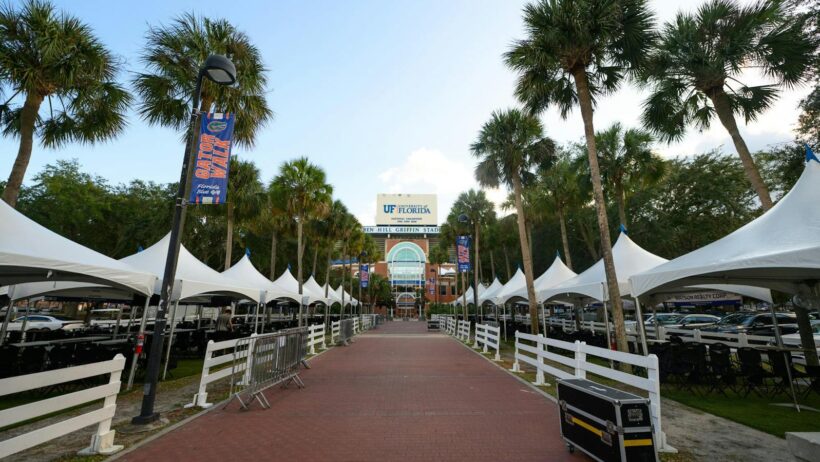
The UF Lake, Vegetation and Landscaping Committee unanimously voted Thursday morning to pause plans to remove over 200 trees outside Ben Hill Griffin Stadium.
The trees were slated for removal because of planned upgrades to the stadium’s facilities.
The pause will allow the committee to consider parking lot and road closures to minimize the construction project’s environmental impacts.
Bill Smith, UF’s assistant athletics director of facilities, said parts of Stadium Road will already be closed for the project, and closing parking lots would create inconveniences on campus. Emergency service vehicles might also face accessibility issues if stadium renovations demand extra road and lot closures, he added.
Laurie Hall, the vice president of engineering company NV5, said most of the trees planned for removal would block construction work. The trees will be removed gradually throughout the multi-year project, rather than all at once, she added.
NV5 has contributed to other large UF projects like the construction of Malachowsky Hall and the Condron Family Ballpark. At Thursday’s meeting, Hall presented a PowerPoint by Stephen Caron, a UF planning, design and construction project manager.
Per Caron’s PowerPoint, the tree removal would be part of a “multi-phase renovation” intended to improve the stadium utilities and broadcast truck parking. The project’s plans haven’t been finalized, but early renovations are likely to include improvements to infrastructure like sidewalks
Despite the trees’ removal, the project plans to preserve 15 live oak trees along University Avenue and Gale Lemerand Drive.
The trees slated for removal are regulated, meaning Gainesville needs to approve permits to remove them. Nearly 40 of the trees are heritage trees, which UF’s 2019 Tree Mitigation Policy defines as canopy trees measuring 20 or more inches in diameter or 30 or more inches for some species.
If the current plans are followed, UF would remove 10 tree species, including three heritage species, ranging from 8 to 31 inches. One magnolia, three winged elms and 33 live oaks would also be removed.
UF’s mitigation policy looks to compensate for the removal of healthy trees by planting new trees elsewhere. To mitigate the removal of the 202 trees from the Ben Hill Griffin area, 564 trees would be planted in other spots across campus, costing $141,000.
Ryan Klein, a UF arboriculture professor, said $141,000 is considerably low compared to the value of the 202 healthy, living trees. He believes UF has fallen into a bad trend of removing trees planted during previous construction projects dating back up to 30 years, he said.
Enjoy what you’re reading? Get content from The Alligator delivered to your inbox
In February, UF’s LVL Committee proposed the removal of up to about 1,100 trees from Graham Woods as part of the Graham Stormwater Improvement Project.
Klein proposed relocating the existing trees instead of replacing them with new, younger trees.
UF’s mitigation plan considers relocating trees, but doing so can cost over 10 times more than replacing them, and there are tree diameter limitations. According to the policy, relocating a 20-inch tree costs $12,000 — compared to a $1,000 replacement — and UF avoids relocating trees with diameters more than 30 inches.
NV5 vice president Hall also said there’s not enough room or time to relocate trees.
Joanne Tremblay, the secretary of the Suwannee St. Johns Group, said UF’s pattern of removing trees for construction is concerning.
The health of the campus, its students and nearby residents are impacted by the removal of trees, she said.
A 2023 analysis on 237 trees throughout Maguire Village, a UF graduate housing complex, found they remove over 500 pounds of pollution from the air, store over 100 tons of carbon and produce 15 tons of oxygen per year, according to documents obtained by The Alligator.
When UF replaces trees in accordance with its mitigation policy, Tremblay said, it doesn’t fully address the value of the removed trees or consider the multiyear maintenance required to ensure newly planted trees develop properly.
Campus construction, according to UF’s mitigation policy, should avoid impacting trees. During Thursday morning’s meeting, the LVL commissioners discussed how tree removal could be avoided during the stadium’s renovations.
Adam Dale, a UF entomology and nematology professor who heads the committee, proposed using existing parking lots near the stadium to house construction equipment and minimize tree removal.
Many of the 202 trees proposed for removal, Dale said, have recently reached a point of environmental benefit, and removing them would restart a 30-year growth process.
If the plans are approved, the area will see minimal tree removal in the project’s first year, and it will increase with construction and renovation.
Kristina Lee, a 20-year-old UF plant sciences junior, said she values how UF’s trees contribute to the campus atmosphere.
“Taking trees down is a sign of disconnection from the environment,” she said, “which is a disconnection from yourself.”
Contact Christian Haas at chaas@alligator.org. Follow him on X @ChristianH58745.
The Independent Florida Alligator has been independent of the university since 1971, your donation today could help #SaveStudentNewsrooms. Please consider giving today.

Christian Haas
Christian is an environmental reporter with The Alligator, and studies journalism at the University of Florida. He is a fourth-year student who prefers to spend his free time trying new and random things, cooking, reading, watching TV or hiking.