

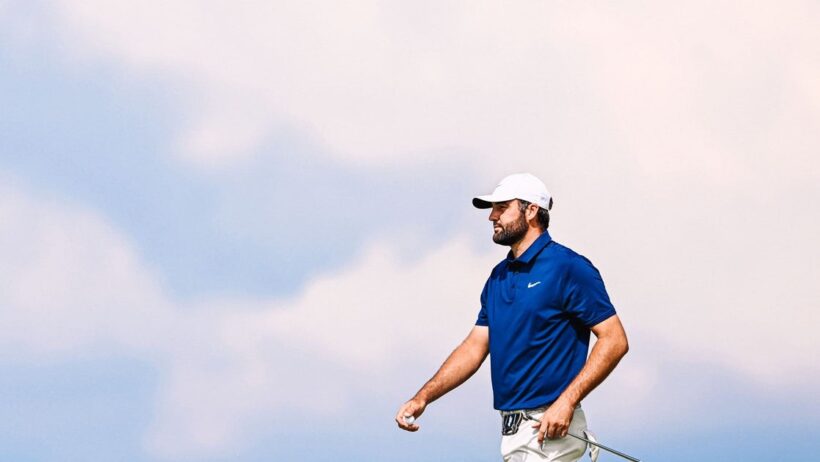
The strangest scene in golf is also the most valuable. It’s Scottie Scheffler surrounded by lighting boards and boom mics, EasyRig camera vests, and windscreens. A few dozen extras line a make-believe rope line. It’s the least likely place you’ll find the No. 1 golfer in the world — a commercial film shoot.
In many ways it’s made to seem as natural as possible for Scheffler. He’s on a golf course — the lush, manicured Lakeside Country Club in Houston, lined with live oaks and loblolly pines. He’s wearing a mint-colored Nike shirt and a white Nike hat. His caddie, Ted Scott, is here. Scheffler makes most of his money on the golf course, so it’s fitting it’s where he also makes the rest.
But it’s not a normal day. It’s Scottie Scheffler Day for Huntington Bank.
They get one day for this. A few hours in October to get everything done. The scenes for two commercials. The voice-over. Social media clips. A meet and greet with Huntington executives.
The 21st largest bank in the United States has a deal with the best golfer in the world? How? Well, it’s also why the 140th largest bank had a deal with him until a year ago. A Dallas-based banker founded Veritex Community Bank in 2010, and early on Malcolm Holland began supporting young golfers before they were anybody to anybody else. One of those was Scheffler, just as he was leaving the University of Texas. Holland believed in Scheffler, and “That’s stuff that I don’t really tend to forget,” Scheffler told The Athletic. So when Huntington bought Veritex last year and wanted to continue that strategy, Scheffler recommitted with a large Huntington Bank logo on his golf bag.
But why are we telling you about a marketing deal? Why does it matter?
Because the deals he does choose tell you so much about the ones he doesn’t.
Because Scheffler is the undeniable best player in the game, a superstar on a Tiger Woods-like run of consistency across five seasons with four major championships and a seemingly permanent spot at No. 1. But Scheffler may leave more money on the table than any modern superstar.
It’s intentional. It’s why he’s the second highest-earning golfer according to Forbes (and third, according to Sportico) despite doubling the field in on-course earnings. It’s why you don’t constantly see him in commercials, podcasts, or pushing products on social media. The primary contemporary to his fame, Rory McIlroy, nearly doubles him in off-course revenue. That’s not for lack of opportunity.
Behind the scenes of Scottie Scheffler’s Huntington Bank shoot
Courtesy of Huntington Bank
Since Tiger’s heyday, golf has been one of the largest openings for endorsement deals. The audience demographics make it attractive to higher-end commercial goods brands as well as financial institutions, and the freedom the players enjoy to wear logos on their polos and hats across hours of broadcast TV coverage each weekend is a selling point. Woods was the first athlete to reach a billion dollars in career earnings, despite just 10 percent coming from tournaments; Phil Mickelson, McIlroy and Jordan Spieth have also used their success to build commercial empires.
Yet while all of Scheffler’s peers earn at least $2 off the course for every $1 on it, Scottie makes $50 million a year in PGA Tour earnings compared to $30 million off it (per Forbes).
Scheffler has large deals with the classic tentpoles like Nike, TaylorMade and Rolex. Add in NetJets, Huntington and smaller deals that align with his own personal interests — GolfForever training, TurtleBox speakers and the sportfishing team, Texas Lone Stars Angling Club — and you have the scope of Scheffler’s endorsement portfolio.
But he has, so far, passed on many of those template deals that every athlete of his caliber takes. There’s no beverage, automaker or video game deal.
He doesn’t have a pharmaceutical or healthcare sponsorship. No classic corporate deals like KPMG or Workday. He hasn’t partnered with betting companies like Spieth, Justin Thomas and Max Homa, nor a prediction market like Jon Rahm and Bryson DeChambeau. He declined the payday from TGL when almost every other PGA Tour star joined. When Upper Deck relaunched a golf trading card series in 2024, Scheffler was one of the very few omissions.

Crowds follow Scheffler at every tournament. (Jonathan Bachman / Getty Images)
Even if you argue Scheffler isn’t that marketable — a criticism of his initial rise labeling him a Mike Trout-ian figure — the fact that Forbes reports Scheffler makes more in endorsements than Patrick Mahomes, Kylian Mbappe and Erling Haaland while turning down the obvious earning opportunities paints a different picture.
“It’s not necessarily not wanting to do things,” Scheffler said. “It’s just wanting to do things with the right people. You know, there’s always opportunities out there, but what are the right ones?”
Scheffler’s manager, Blake Smith, listens to every pitch and brings the right ones to Scheffler’s attention. Sometimes the commitments are too much. Sometimes the money just isn’t quite right. That’s all normal. But there’s a far simpler, underlying question at the center of each potential deal headed Scheffler’s way:
Is it really worth it?
There was a time Scheffler could pull up to the course any time he wanted and just work. It’s the part he loves most. He doesn’t chase victories so much as he chases each microscopic edge from distance control to the perfect grip, preparing for hours with his longtime coach Randy Smith — Blake’s father — fine-tuning the little details of a margin-determined game. He could mess around with his friends on tour and enjoy the entire process.
Then, he became Scottie.
After missing his first cut in nearly four years, Scheffler showed up on Sunday at the Open Championship this year, hoping an early practice round would give him some proper privacy to work. Wrong. Fans waited at Royal Birkdale’s first tee. When he hit in a bunker on the first hole, he turned to see two TV cameras within six feet of his face.
He said he spends far less time at the course than he used to. Some of that, he conceded, is just being 30 with two young kids. But mostly it’s the lack of energy for all the ancillary duties that come with it. Interviews. Pro-ams. Fans. Meetings.
“Now, I think I’m in a position more so where you know things are just heightened around where I am at the golf course, and people are watching, and it’s great to be able to play in front of the fans,” Scheffler said. “But I also have to be ready to go into competition too.”
Some people come alive in those settings. And while Scheffler is quite good in front of cameras, living each moment with a phone recording nearby “can be like you’re walking on eggshells a little bit, and that can drain people.”
You sign 100 autographs, but the 101st family goes home saying he doesn’t make time for fans. “He wakes up every day knowing he’s going to disappoint people,” a person close to Scheffler once said about him.
Scottie Scheffler wins the Tour Championship
Early in his career, he was labeled a boring quote. When he has gotten truly insightful in front of a microphone, those were taken in countless directions.
Before the 2025 Open Championship, he gave his now-famous “What’s the point?” speech about the complicated feelings of competitiveness contrasted with the fleeting nature of success. While a majority applauded it as a fascinating look into an elite athlete’s balance between family, meaning and competition, some turned it into a negative. Tom Brady even wrote a newsletter asking why Scheffler felt parenting and success were mutually exclusive, which was not what he said.
“People may have taken it as I didn’t really care about golf. Actually, the question I posed was why do I care so much? Like why do I want this so badly?” Scheffler said.
The internet’s fascination with clips is a long-standing annoyance of Scheffler’s, and he’s very aware of how that may affect his image. “I give an answer for three minutes, but only 15 seconds is going to make it on the clip on Instagram or whatever it is,” Scheffler said.
The part of that entire July 2025 speech that lingers a year later, though, was toward the end. “If my golf ever started affecting my home life or it ever affected the relationship I have with my wife or my son, that’s going to be the last day that I play out here for a living,” Scheffler said.
It wasn’t an idle thought or threat. The sentiment permeates all internal conversations about Scheffler’s business interests. The discussions are rarely about revenue streams or cashing in as much as possible. If it were, Smith, who also represents Brooks Koepka, would have millions more in deals for Scheffler.
Corporate consulting and accounting firm deals often require the athlete’s presence at outings and events. Beverages and consumer goods mean more photo shoots and commercials. TGL would have meant more flights to its base in South Florida, complicating already brutal travel schedules at the start of the PGA Tour season.
His close friend, Spieth, saw the transition in Scheffler’s thinking up close. How Scheffler dealt with the original rise in fame and then scaled back.
“He just wants to get away from the game and separate the two,” Spieth said in 2025. “He felt it was too much, that he was taking it with him.
Huntington takes very little of his time, and with Nike, TaylorMade and Rolex, he’s just one of many big fish at Goliath brands. His most recent Rolex commercial, a part of seemingly every commercial break all golf season, was actually a montage of old clips and highlights. Nothing new filmed.
This Scottie Scheffler commercial goes surprisingly hard pic.twitter.com/6jmgtqb06Q
— Jeff Eisenband (@JeffEisenband) April 18, 2026
The second trend is authenticity. He plays TaylorMade clubs. He commits to training his body, and his trainer, Troy Van Biezen, introduced him to GolfForever training systems. Nike and Huntington were the first two brands that he felt truly believed in him. He just happened to meet the Turtlebox founders at a concert, and they sent him home with one of their outdoor speakers. He loved it and had Smith reach out to do a deal.
“I don’t take the partnerships lightly,” Scheffler said. “Like I don’t want to just work with people that I don’t enjoy being around. Days like today would be a real pain in the butt if I didn’t enjoy the people that I was with.”
The two biggest stars of Scheffler’s generation are the two who understand his choices best. It just so happens they’re the most in awe of his discipline.
McIlroy has been in a constant war with himself over brand versus golf — nobody had more offers thrown his way over the last 15 years.
When he won the 2011 U.S. Open, his hat was a billboard for a Dubai-based luxury hotel company. He wore Oakley shirts, with logos across his chest and collar. He’s changed management companies multiple times since, joined Nike in 2013, and has only grown as a businessman. It’s a difficult dance.
“You have all these other opportunities that you can go and chase. I have quite a curious mind, so I do go and chase those, but then sometimes I do look at Scottie and be like, you know, maybe I wish I didn’t have so much going on because it works for him so well,” McIlroy told Fried Egg Golf earlier this year.
When Spieth was golf’s golden boy, with three major championships by age 23, he did what he was supposed to do. He became a face of Under Armour. He signed with Coke, AT&T and Rolex, among others. Spieth was still more restrained than some, but even he looks at Scheffler with awe.
“He doesn’t care to be a superstar,” Spieth said. “He’s not transcending the game like Tiger did. He’s not bringing it to a non-golf audience necessarily. He doesn’t want to go do the stuff that a lot of us go do, corporately, anything like that.
“… I think it’s more so the difference in personality from any other superstar that you’ve seen in the modern era and maybe in any sport. I don’t think anybody is like him.”

Scottie Scheffler, left, and Rory McIlroy are the two biggest golf stars of this generation but haven taken different approaches to endorsements. (Richard Heathcote / Getty Images)
But Scheffler has a slight advantage that makes skipping off-course opportunities understandable. He became elite at the best time in golf history for generational wealth.
After LIV Golf entered the space and lured stars away with deals worth north of $100 million, the PGA Tour desperately skyrocketed purses. LIV started in 2022, the year Scheffler won his first major championship. By 2023, he ran away as world No. 1. By 2024, he was an unstoppable force with no true rival.
Woods’ legendary 2000 and 2005 seasons both earned roughly $10.7 million. He then earned anywhere from $50 million to $110 million a year away from the course.
Spieth made $12 million on the course from his iconic 2015 season.
Scheffler has made north of $50 million on the course three years in a row.
Absurd purse sizes combined with Scheffler’s incredible run mean he doesn’t need to leave home in the offseason to accept an appearance fee in Australia or Dubai. He doesn’t need to appear in constant commercials or watch his bank account. He lives a relatively simple life, and there’s an understanding that he doesn’t need to chase all the money in the world.
It’s only jarring because, in this day and age, most people do.
As Scheffler is compared to one famous athlete after another, there’s one that demands attention, albeit from an entirely different era.
Scheffler grew up in Dallas attending The Byron Nelson, the annual PGA Tour event named for the five-time major champion in the 1930s and ’40s. It was the first PGA Tour event Scheffler played in as a 17-year-old amateur, and he won it in 2025. There’s even a picture of a young Scottie meeting an elderly Nelson two decades ago.
Nelson walked away from golf at the height of his powers. He was 34, fresh off a year in which he won 11 tournaments in a row and 18 out of 30. He’d “done what he came to do in golf.” He didn’t like traveling or being away from his family.
Nelson just wanted a home for his wife, Louise. So after his special 1945 season, he bought a 630-acre ranch, their dream in Roanoke, Texas, for $55,000 cash. And he retired. They lived there for 50 years, selling eggs from the ranch and making furniture he’d often give away.
Some athletes pursue fortune. Some pursue legacy. Some just love the game and others merely see it as a job. Scottie Scheffler is not like other contemporary megastars, that much has been made abundantly clear.
He doesn’t need to fit into a specific box. He is indeed a golf-obsessed, hyper-competitive force, and he is a family-focused man with simpler desires than most. Scheffler is most certainly leaving tens of millions of dollars on the table each year, and he is still one of the 20 most valuable athletes in the world with money that would make the average person’s head spin.
Scheffler is still learning how to live life as a celebrity. And the world is watching him figure it out in real time.
“It’s hard to go from like 100% on to 100% off,” Scheffler said, “and so I’m kind of finding the balance now on how much I can handle outside of the actual sport.”