

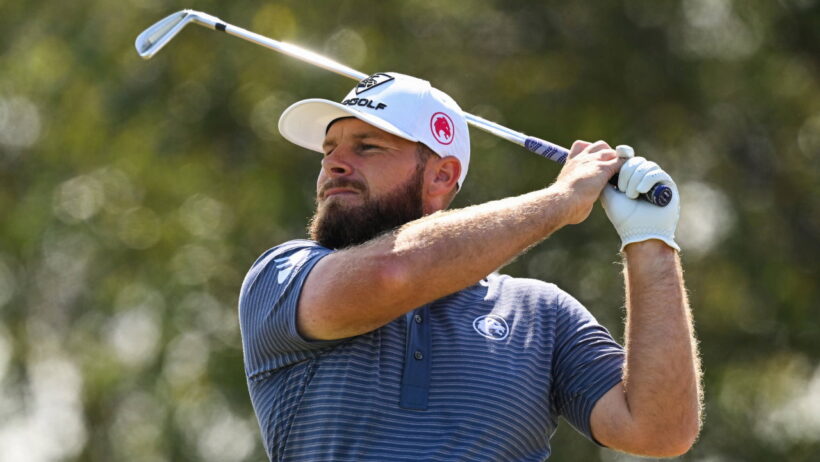
LIV Golf’s next challenge is convincing players that its survival is worth the sacrifice. Its proposed financing from BC Partners Credit depends partly on new agreements with golfers that the investor requires. Those names remain undisclosed, but securing their commitments is a condition of the funding.
Watch What’s Trending Now!
For European stars like Tyrrell Hatton, that commitment could come at a cost beyond money. Joining LIV 2.0 could mean losing DP World Tour membership and European Ryder Cup eligibility, leaving the league’s recruitment effort up against an ambition that equity alone may not outweigh. On October 12, the Tour made that choice clear.
“On their membership application for next year, if they said they intended to play on LIV, their application wouldn’t be accepted,” an insider told Telegraph Sport. “If they said they weren’t going to play on LIV 2.0 and they then go on to do just that, their membership would then be rescinded.”
This came shortly after DP World Tour CEO Guy Kinnings told BBC Sport that “players need to make a choice.”
Kinnings added: “We have rules and regulations, which are there to protect our tour and which our members must all abide by. Players who are not willing to comply with our rules and regulations should not be seeking to join our tour.”
The proposed ownership structure adds another complication. According to BBC Sport, LIV 2.0 would give players equity in the league, making them part-owners of a competing circuit. The DP World Tour views that arrangement as incompatible with its membership structure.
The tougher stance also comes as the DP World Tour discusses its strategic relationship with the PGA Tour, although the reporting does not establish those talks as the reason for the membership decision.
The decision marks a significant departure from the arrangement that allowed selected LIV golfers to retain their European Tour status during 2026.
On February 21, the DP World Tour announced conditional releases for eight members to compete in conflicting LIV events during the 2026 season. Tyrrell Hatton, Tom McKibbin and Adrian Meronk were included alongside Laurie Canter, Thomas Detry, Victor Perez, David Puig and Elvis Smylie. The agreements required payment of outstanding fines, additional DP World Tour appearances and participation in media and promotional activities.
Jon Rahm subsequently reached his own arrangement with the Tour, extending the accommodation beyond the eight players named in February.
That compromise was temporary from the beginning. The DP World Tour explicitly stated that the releases applied only to 2026 and were “not precedent-setting,” leaving no guarantee that the arrangement would continue the following season.
This isn’t just about choosing between the two leagues, because it affects a golfer’s European Ryder Cup eligibility. Although the Tour has not announced a separate Ryder Cup ban, golfers who lose their membership under the new policy would lose their route to selection under the published criteria.
Tyrrell Hatton is an obvious example of how critical the choice can be. The Englishman has played in the last four Ryder Cups, including Europe’s victories in 2023 and 2025. Before the biennial event at Bethpage, he described the Ryder Cup as “very important to me.” This reflects his stated desire to keep his DP World Tour membership while competing in LIV Golf.
That ambition now comes with a potential cost. Signing with LIV 2.0 could mean sacrificing his opportunity to represent Europe at Adare Manor in Ireland in September 2027.
A Ryder Cup appearance offers sporting prestige, a place in European golf history, and the opportunity to compete alongside longtime teammates. An equity stake in a restructured league, meanwhile, carries financial potential but no guarantee of future value.
If Ryder Cup participation remains a genuine career goal for someone like Tyrrell Hatton, refusing to sign with LIV 2.0 may be the more logical decision. The policy could therefore eliminate a significant portion of LIV’s potential European recruitment pool before negotiations are complete.
Around 15 LIV golfers, including Jon Rahm, Hatton, Victor Perez and Tom McKibbin, currently hold DP World Tour membership. Others, such as Joaquin Niemann and Thomas Pieters, lack that status and would need to qualify through the tour’s qualifying school or secure tournament invitations through separate agreements. And as established, those invitation arrangements would not be open to players who choose to compete in LIV going forward.
The timing could hardly be worse for LIV Golf. After Saudi Arabia’s Public Investment Fund announced it would end its backing after the 2026 season, LIV Golf and related entities voluntarily filed for Chapter 11 bankruptcy protection on September 8. Court filings listed assets of $100 million to $500 million against liabilities of $500 million to $1 billion.
The filing is part of LIV’s effort to restructure and relaunch, rather than an announcement that the league has shut down. BC Partners Credit has since committed initial funding and outlined plans to provide up to $300 million in financing, subject to conditions and bankruptcy court approval.
Under the October 5 restructuring agreement, that financing depends partly on securing new player contracts consistent with LIV 2.0’s business plan, including commitments from players required by BC Partners. The reporting does not identify those golfers or specify how many must sign.
However, the proposed relaunch would feature a smaller, 10-event schedule and a player-ownership model. The proposed relaunch would also feature significantly smaller event purses, reportedly around $10 million in total compared with $32.3 million at LIV’s 2026 events, per FOS, although the final prize-money structure has not been confirmed.
To introduce the new structure, LIV is seeking bankruptcy court approval to terminate its existing player contracts and replace them with agreements reflecting LIV 2.0’s revised compensation and ownership model. A hearing is scheduled for October 14, meaning that step remains pending as players assess the proposed terms.
Some prominent players have already indicated that they will not accept the new offer. For instance, Jon Rahm’s lawyer confirmed that the Spaniard would not participate in LIV 2.0. He said that the proposed terms were unacceptable. Bryson DeChambeau’s future, meanwhile, remains uncertain, with golf insider Alan Shipnuck reporting that he is still going back and forth on his final decision.
According to HANDICAP 54 on X, Joaquin Niemann, LIV Golf’s all-time leader with nine individual victories, is also closer to leaving as uncertainty continues to surround the league’s future.
“Obviously, if they can open a door for me somehow, that would be incredible. And if not, it will open eventually,” he said.
However, not every player has turned against the proposed relaunch. While Sergio Garcia had also been released from his LIV Golf contract through the bankruptcy proceedings, he has not ruled out returning to the league. BBC Sport further reported that Richard Bland had publicly expressed interest in LIV 2.0, with Victor Perez also voicing hope for its future.
Losing prominent names would make LIV’s rebuilding effort considerably harder. The league could still recruit players, but replacing the competitive credibility and audience appeal of established stars would be difficult.
The DP World Tour’s decision may be one of the biggest obstacles LIV has faced since its 2022 launch. Its impact extends beyond membership rules. It changes the incentives facing players as the league tries to secure financing and rebuild its roster. And the October 25 LIV commitment deadline and November 16 DP World Tour registration deadline leave players with limited time to assess their options.
For golfers who want to wear Europe’s colors at a Ryder Cup, the message is simple. LIV 2.0 could demand a sacrifice they might be unwilling to make. If enough players reach that conclusion, the Tour’s decision could become a defining setback for LIV’s attempt to survive.