

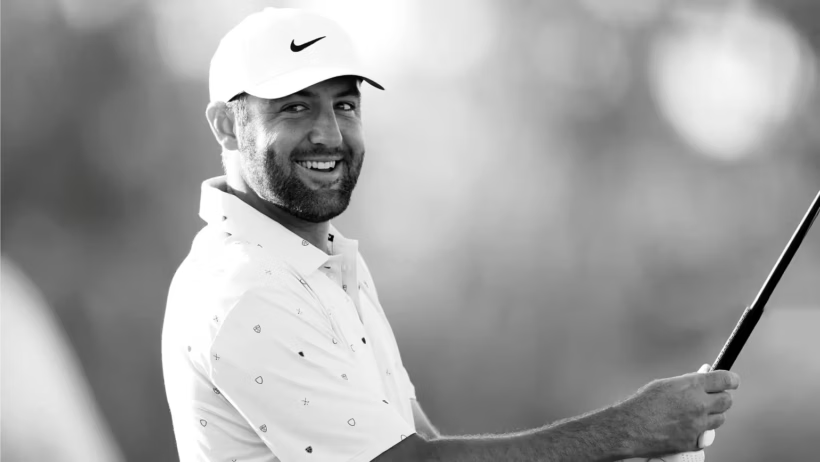
Paradoxically, to get a peek into the mind of this golf Megatron, it can be more illuminating to look at Scheffler’s non-victories.
At February’s Genesis Invitational, where there are only 72 players but still a cut, he occupied last place after an opening 74 on bumpy greens and in a stiff wind. Three days later, after rounds of 68-66-65, Scheffler had not only made the cut on the number (fist pump), but he’d finished T12. Only a birdie by Cameron Young on the 72nd hole kept him from continuing his run of 18 finishes of 10th or better that dated to the 2025 Players Championship, the longest such streak in 90 years (Byron Nelson’s jaw-dropping 65).
“I’ve never been one to quit,” Scheffler said, “I’d feel pretty silly to quit in a PGA Tour event. Overall, being out here and competing, that’s what I love to do.”
This dogged refusal to give up on a tournament or even a single shot is one of many parallels between Scheffler and Woods. “Tiger was obviously the best at it,” Scheffler said at last year’s PGA Championship. “But every shot he hit was the most important shot that he’s ever hit.”
They are living examples of an argument put forth by author Brad Stulberg in the new book “The Way of Excellence: A Guide to True Greatness and Deep Satisfaction in a Chaotic World.” Taking inspiration from Robert M. Pirsig’s “Zen and the Art of Motorcycle Maintenance,” Stulberg writes that greatness in its healthiest form is about values-aligned, sustainable effort rather than just hustle and perfection, and that the real reward of excellence is that you become a better version of yourself. What fuels it all, Stulberg writes, is an intimacy with one’s craft.
“It is a sense of familiarity, respect and attention that helps you feel connected to what you are doing and to yourself,” he writes. “It requires minimizing distractions and getting as close as possible to your pursuit. It’s being in the pocket of a deadlift, song, or painting; it’s being immersed in developing an idea, leading a team, or learning a new skill.” He goes on to argue, “The intimacy of excellence is a powerful antidote to modern alienation and its associated feelings of disconnection, disassociation and numbness.”
Granted, excellence does not necessarily equal happiness, and burnout is real. Scheffler seemed to have a reckoning, of sorts, when he openly questioned the meaning of his accomplishments in his pre-tournament presser at The Open Championship at Royal Portrush last summer. “What’s the point?” Scheffler asked rhetorically.
“Sometimes the feeling only lasts about two minutes, it seems like, when you’re celebrating,” he said of winning, “and then it’s like, OK, now you’ve got to go do all this other stuff, which is great, but sometimes the feeling of winning only lasts a few seconds. It’s pretty exciting and fun, but it just doesn’t last that long.”
It was good column fodder, but as it turned out, Scheffler was not burnt out or in the throes of an existential crisis. He won The Open to set up his first attempt at the career Grand Slam at this year’s U.S. Open. And if you go back and check the transcript, it’s clear that he was misunderstood – he was trying to say that there is no finish line, and that no matter whether he won or lost, he would go into the start of the FedExCup playoffs in Memphis at even par. He’d still be himself, still a man of faith, a husband, a dad, a Texas Longhorns fan.
Here is author Stulberg on excellence and meaning: “What are we here to do? Each and every one of us asks ourselves this question. I’ve made the case that the answer is to strive for excellence, to figure out our values and goals and go after them with as much vigor and intimacy as we can. Another fitting answer is that we are here to love. But then again, what is excellence – what is caring deeply and paying attention and repeated practice and learning from failure and staying curious and steadfast dedication and getting really close and feeling deeply and showing up over and over again – if not love?”
Now go back to Scheffler’s Open press conference and forget the headline quote. Look at the answer right before that:
“I don’t look at wins and losses or stuff like that,” Scheffler said. “I don’t sit down at the beginning of the year and say I want to win X number of times, I want to win this many majors. … What works best for me is just to stay present, continue to put in the work, which I would argue that’s the most fun part for me. I love being able to practice … and just try to get the most out of myself each day.”
Presence. Love. Practice.
There, before an audience of scribes in Northern Ireland, Scheffler had spoken to not just The Open and golf but also the entire human condition. Onward. Upward. Let it fly.