

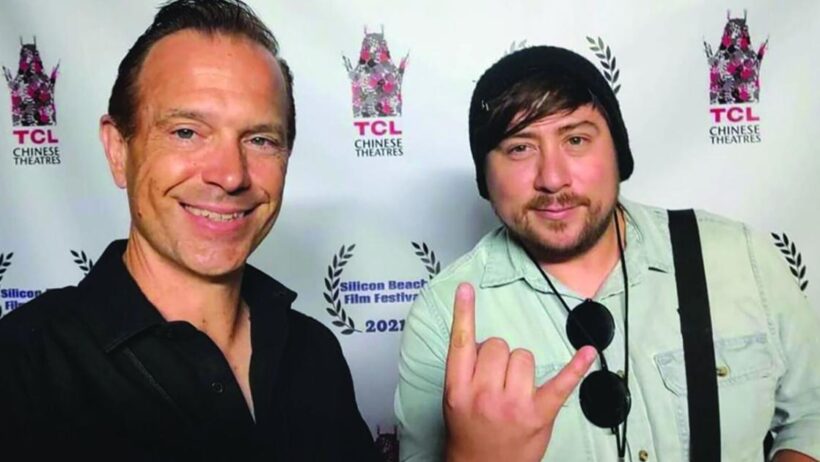
When Christopher Studenka wasn’t playing a corrupt politician in an Arizona-made thriller, there was a decent chance he was holding a light or microphone for somebody else.
That’s what happens when a feature film has about 30 actors but essentially a two-man crew.
The Scottsdale resident and Gilbert filmmaker Justin Rose spent roughly a year and a half making “Down Radical,” an independently financed thriller shot entirely in Arizona and scheduled to make its world premiere Oct. 2 as the opening feature of the Tarzana International Film Festival in Los Angeles.
Studenka not only plays Joe Wheeler, the politician whose secrets help drive the film’s plot.
He also helped cast the actors, find locations and produce the film while sharing much of the physical work required behind the camera with Rose.
“The crew is just Justin and myself and occasionally his fiancé, Bri,” Studenka said. “We do and have done everything ourselves for all of our films.”
And they say they made this one for about $1,200.
“It takes us a bit longer this way, but we like having the control over every aspect,” Studenka said. “If I wasn’t acting in a scene, I was holding lights or a microphone.”
Studenka and Rose have filmed their projects here, including two shorts, “Red Velvet Evening” and “Father’s Day,” and their earlier feature, “Run Rabbit.”
Their latest movie took them considerably farther around the state.
“Down Radical” was filmed in Scottsdale, Gilbert, Chandler, Mesa, Phoenix, Superior, New River, Sacaton, Casa Grande, Picacho, Goodyear, Buckeye, Gila Bend and Prescott.
“Arizona is the perfect state to base this particular story in, especially because it’s a border state and trafficking is a serious issue here,” Rose said. “If the locals keep an eye out, they might recognize a classic motel off Main in Mesa.”
Rose, a 20-year Gilbert resident, said the film contains nonfiction elements.
“I did hours of research on notorious cartel bosses and operations to help craft the story,” Rose said. “I mean the list is quite extensive but I would say the famous one and one of the inspirational characters would be Pablo Escobar and how he managed to buy out politicians and officials to help operate his drug empire.”
Studenka’s years as an actor also gave him a network to draw upon when assembling the cast.
Studenka said he personally selected the roughly 30 actors, who all agreed to work without pay.
Intentionally tiny production
The unusual economics of “Down Radical” are possible partly because Rose and Studenka own their equipment and perform jobs that would be divided among scores of people on a conventional feature.
Their out-of-pocket cost covered largely locations where they couldn’t obtain free and food during production.
Whether “Down Radical” can compete with big-budget productions will ultimately be decided by audiences, but Studenka is confident in the result.
The movie grew from a script Rose began developing after “Run Rabbit.”
By fall 2024, the two were meeting regularly to plan it. They cast the film in January and February 2025 and began shooting that March.
Production continued into summer 2026.
“We both are working full-time, and we made the movie with every moment of our free time the last year and a half,” Studenka said.
“We were 100% committed to making sure everything is done the way we envision as best as possible.”
Politician with secrets
Studenka’s character gave him another challenge.
He describes “Down Radical” as a dialogue-heavy thriller involving numerous characters and intersecting stories that build toward an explosive conclusion.
At the center is Wheeler.
“Joe Wheeler, on the surface, is a perfect politician,” Studenka said, “but in reality, he is involved in all sorts of things he should not be and it all catches up to him.”
His actions set much of the story in motion.
Studenka compares the movie’s structure and emphasis on dialogue and converging characters to the films of Quentin Tarantino.
Added Rose: “Chris’s background in politics defiantly brought a unique light to his character. I wrote the character for him because I knew he would have fun exploring the antagonist and bringing a new look for him to the screen.”
Partnership started at SCC
Studenka’s most important filmmaking connection, however, began when Rose was emerging from Scottsdale Community College’s film program.
Rose was preparing to make his first short film and cast Studenka as its principal actor.
“We soon realized we had a great rapport and both wanted to make stuff on our own,” Studenka said.
He came away particularly impressed by Rose’s cinematography and storytelling.
“I’ve worked plenty in LA and in the industry,” Studenka said. “He is as talented as anyone I have ever worked with.”
Their first short, “Red Velvet Evening,” won awards at the film festival.
They followed it with “Father’s Day,” which Studenka wrote and describes as semi-autobiographical.
That film eventually brought him back to Central Michigan University, his alma mater, for a festival.
Their subsequent feature, “Run Rabbit,” traveled much farther.
Studenka said it appeared at more than 50 festivals around the world and received numerous awards, including honors at festivals in Toronto, Prague, Athens, Rio de Janeiro, Albuquerque, Orlando and California.
The reception persuaded the pair that they could attempt something more ambitious.
“Down Radical” was the result.
The movie has roughly twice as many actors, three times the locations and three times the scenes as “Run Rabbit,” Studenka said.
Before casting it, the filmmakers spent months determining whether two people with extremely limited resources could realistically make what Rose had written.
Then came a table read with the cast.
Studenka’s doubts began disappearing.
“It was immediately apparent that we were going to make a great film,” he said.
The filmmakers intend to use festivals to expose “Down Radical” to audiences and pursue distribution.
But for Studenka, getting the movie onto the screen already demonstrates something about the partnership that began years ago at Scottsdale Community College.
“We have zero connections to anyone or anything in the industry,” Studenka said of their earlier success.
Rose added, “With the last project, we met a lot of people and were introduced to a true Hollywood and learned about how a project is just a new step to something bigger but with this, I would think if we could get a deal in which we can work on the next project and make something even bigger, then that’s when I say we were successful.”