

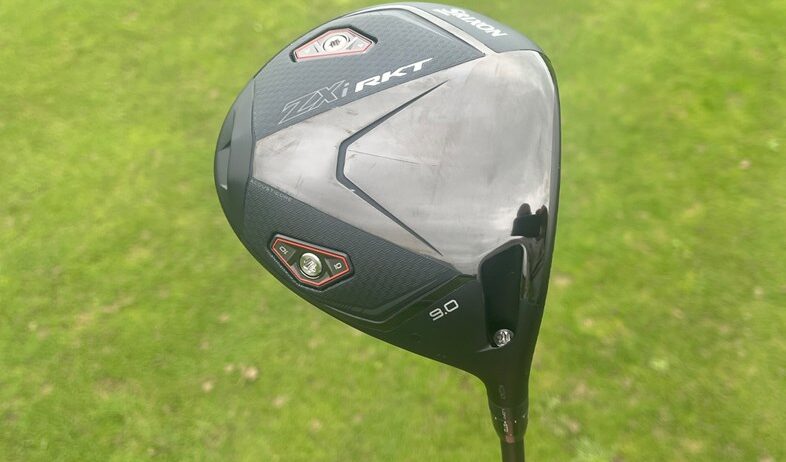
The Srixon ZXi RKT is fast, forgiving, and seriously tempting – but there’s one small detail that might stop me putting it in the bag.
I feel a bit sorry for Srixon when it comes to drivers.
They make very good ones. TG Equipment Editor Lewis Daff called the previous-generation Srixon ZXi the straightest driver he’d ever hit, and Srixon models routinely deliver solid if not table-topping performances in our annual whole-of-market driver tests.
And yet, no one seems to use them.
That’s a sweeping overstatement, of course, but look in the bags of the people you play golf with. I’ll bet there’s the usual mix of TaylorMade, Callaway, Ping, and Titleist drivers. Maybe the odd Cobra, although that will probably be an older model rather than a recent release.
Even Srixon staff players like Keegan Bradley, JJ Spaun, Sepp Straka, and Andrew Novak use the company’s irons, wedges, and balls, but put another manufacturer’s woods in the bag. There are a few full-bag Srixon guys – Shane Lowry, Hideki Matsuyama, and Ryan Fox – but the general point still stands.
I think the issue with Srixon woods is that they’ve failed to carve out the same identity they have in other parts of the bag. Srixon have a strong reputation in irons, wedges, and balls, but their woods don’t garner the same level of love and respect.
During my testing of the new Srixon ZXi RKT range, one of my regular playing partners kept getting Srixon mixed up with Cobra. That might sound like a throwaway anecdote, but it gets to the heart of the problem: people just don’t think ‘Srixon’ when it comes to drivers.
Can the ZXi RKT be the range to change that and offer you a genuine alternative to the big brands? Let’s find out…
Quick verdict
The Srixon ZXi RKT is an excellent all-round driver. It’s fast, forgiving, and easy to launch, and has made me question whether I actually need the low-spin driver I normally use. There’s just one thing stopping me putting it straight in the bag: the alignment aid looks off-center at address.
A driver good enough to rival the big boys

Pros & Cons Ratings Specs Features
Pros Looks greatImpressive speed and distance that matches low-spin modelsVery forgiving and easy to launch Cons Alignment aid looks off-center at address
Looks/Feel
Technology
Performance
Overall
RRP $649 / £569 Lofts 9º (RH) / 10.5° (RH/LH) Head Size 460cc Lie 59º Standard Shaft Length 45.75” Stock Shaft Mitsubishi Kai’li Dark Waves Blue 60g Stock Grip Golf Pride Tour Velvet 360 RKT Face for fine-tuned and enhanced performanceTour-Driver Chassis for premium looks and eye-catching designACOUSTICORE rib structure for crisp feel and strike awarenessPlayer-Focused Adjustability for complete flight control
Looks/Feel: 4/5
I really like the look of the ZXi RKT, but, like a crisp white shirt with a small gravy stain, there’s one niggle that ruins it for me.
Let’s start with the good. I like the sole. It’s dark, modern, and understated. It reminds me of the TaylorMade Qi35, which is no bad thing. And I like the matte crown, with a pattern that’s so subtle it adds class but no distraction.
My main issue is the alignment aid, which looks as though it’s quite significantly off-center.
It’s less noticeable on the more forgiving ZXi RKT MAX and barely noticeable on the low-spin ZXi RKT LS – both of which have slightly different head shapes – but the same thing is present across all three models. Look at any of them directly from above and the alignment aid sits noticeably heel-side of center.
It’s not a complete deal-breaker, but it’s something I noticed every time I addressed the ball. If I use the alignment aid, I feel like I’m setting up for a heel strike. If I don’t, it’s a distraction.
The sound is loud but not too loud, and on the crisp side. It’s not quite at a Ping level, but definitely more punchy than the muted thwack you get from a Callaway or TaylorMade driver.
The feedback is great. I can tell exactly where I’ve hit it on the face. My playing partners, however, haven’t been able to tell when I’ve struck one off-centre.
Perhaps that’s the best of both worlds: enough feedback to help me make adjustments throughout a round, without my playing partners knowing when I haven’t quite found the middle.

Technology: 4/5
Every club in the new ZXi RKT family shares the same starting point: the RKT Face.
It’s not one individual piece of technology, but the combination of face geometry, flex characteristics, bulge and roll, and body construction that Srixon say has been developed to increase ball speed while maintaining stability across more of the face.
The headline change is a completely new face material called VR Titanium, a proprietary titanium alloy incorporating silicon. Srixon say the material is stronger than conventional titanium, allowing engineers to create a face that flexes more efficiently at impact without compromising durability. More flex should mean more energy transferred into the ball, and that means higher ball speed and more distance.
VR Titanium works alongside two technologies carried over and refined from the previous generation.
i-FLEX uses a variable-thickness face pattern designed to increase flex across a larger area, rather than concentrating maximum speed around the center. The idea is to maintain more consistent ball speeds on off-center strikes.
Behind the face, Rebound Frame uses alternating stiff and flexible sections throughout the head. As the face flexes at impact, the surrounding structure is designed to store and release additional energy, helping transfer more of the clubhead’s speed into the ball.
In simple terms, VR Titanium is the material, i-FLEX controls how the face flexes, and Rebound Frame helps the rest of the head contribute to the collision.
Srixon have also introduced a new Variable Roll Design, which tweaks the curvature of the face to make bulge and roll work more effectively on mishits. The aim is to produce more predictable launch and direction when you don’t find the middle.
There’s plenty of adjustability, too. Heel and toe weights allow fitters to alter the launch and directional bias, while the hosel offers up to 1.5° of loft adjustment in either direction, as well as lie-angle adjustment.
Srixon have even worked on the sound. A new ACOUSTICORE chassis uses AI-optimised internal rib structures and a lightweight carbon-fiber crown to tune the acoustics of each head.
There are certainly plenty of technologies packed into the ZXi RKT, although most of them are ultimately trying to achieve the same thing: more speed without giving up forgiveness.
Whether all those clever-sounding technologies actually translate into better performance is what matters, though – and that’s where my testing becomes interesting.

Performance: 4.5/5
I tend to play low-spin drivers as driver is typically the strongest part of my game and I don’t need to extra forgiveness of a model that helps you on severe mishits, instead opting for the extra distance I get from a low-spin model.
As expected, the Srixon ZXi RKT span more than the low-spin heads I tend to use, but it wasn’t excessive, jumping from 2,000-2,100rpm in my own driver to 2,500-2,600rpm in the Srixon. That was offset, though, by the slightly faster ball speeds I was getting from the Srixon over the Ping G430 LST currently in my bag.
Putting them both head-to-head in 9° lofts, the Srixon definitely flies a little higher than I’m used to, but carry and total distance came out almost identical.
The interesting thing then is that the extra spin doesn’t appear to be costing me distance. I’m giving up some of the low-spin flight I’m used to, but not any meaningful yardage. And I’m getting a more forgiving head in return.
MetricSrixon ZXi RKTClubhead speed108 mphBall speed159 mphLaunch angle14.3°Spin rate2,623 rpmCarry distance262 yards
What would tip me towards the Srixon was how forgiving it is and how easy it makes life feel. I’m yet to hit a particularly bad drive with it. Mishits have come up a little shorter than pure ones, as you’d expect, but have been far from card-wrecking.
I’m going to test the ZXi RKT LS to see how that compares to both this standard ZXi RKT and to my Ping, but as it stands, I’d be tempted to keep this model in the bag. I might lose a few yards on my best drives, but if it continues keeping me on the straight and narrow the way it has so far, that’s probably a compromise worth making.

Overall: 4.2/5
The Srixon ZXi RKT is a very good driver. It looks good, sounds good, offers great feedback, is forgiving, and doesn’t leave much on the table in terms of distance.
In fact, I like it enough that I’m seriously considering keeping it in the bag.
There’s just one thing putting me off: that alignment aid.
I know it might sound silly to reject a driver because of a small graphic on the crown, particularly when the performance is this good. But if every time I address the ball the alignment aid makes me feel as though I’m setting up for a heel strike, that’s a problem.
Hopefully I can get used to it, because otherwise the ZXi RKT has done something I didn’t expect: it has made me question whether I actually need the low-spin drivers I’ve been using for years.
Is a driver that’s really very good enough to suddenly make Srixon a major force in the driver market? Honestly, probably not.
Ryan Fox winning the 2026 Open at Royal Birkdale immediately after putting the low-spin ZXi RKT LS into his bag will help, but a single major victory is unlikely to change golfers’ buying habits overnight.
Golfers buy with their hearts as much as their heads, and having the big stick used by the world’s best golfers is still – rightly or wrongly – part of the excitement of buying a new driver.
But perhaps Srixon don’t need to beat TaylorMade, Callaway, Ping, and Titleist at their own game. They just need to make a driver good enough that golfers start asking themselves why they aren’t considering one.
The ZXi RKT is certainly good enough to do that.
Similar drivers to consider
The king of drivers for any amateur golfer

Pros & Cons Ratings Specs Features
Pros Significant improvement noticed on-course from previous model, notably dispersion across the face. Premium adjustability for all golfersCan suit a professional golfer or a 36 handicapper Cons Preferred the aesthetics of the GT family, but that is subjective
Looks, Sound, Feel
Technology
Performance
Final Verdict
RRP £629.00 / $699.99 Lofts 8.0º / 9.0º / 10.0° / 11.0º (RH/LH) Head Size 460cc Lie 58.5º Standard Shaft Length 45.5″ Weights Dual-weight system; 11g forward, 5g back (standard) Stock Shaft Options Mitsubishi Tensei 1K White / Mitsubishi Tensei 1K Blue / Mitsubishi Tensei 1K Red / Project X TITAN Black Stock Grip Titleist Universal Grip Full-Body PMP Split Mass Frame for higher MOISpeed Sync face for improved off-center strikes
The holy grail of spin consistency
Pros & Cons Ratings Specs Features
Pros I haven’t hit a more consistent driver ever from a data point of viewThe best driver ever made for golfers who strike it low on the facefar more flattering shelf appeal and profile at addressThe perfect amount of adjustablity Cons I cannot get on with the feel of this club, many other brands feel a lot better
Looks
Technology
Performance
Overall
RRP £549.00 / $649.00 Lofts 8º (RH), 9° / 10.5°/12° (RH/LH) Head Size 460cc Standard Shaft Length 45.75 Stock Shaft Options Mitsubishi REAX MR,LR,HR Stock Grip Golf Pride Z-Grip Black/Silver New, slimmer profile More loft optionsCustom fitting revolutionary shaft procedure 60x Carbon face