

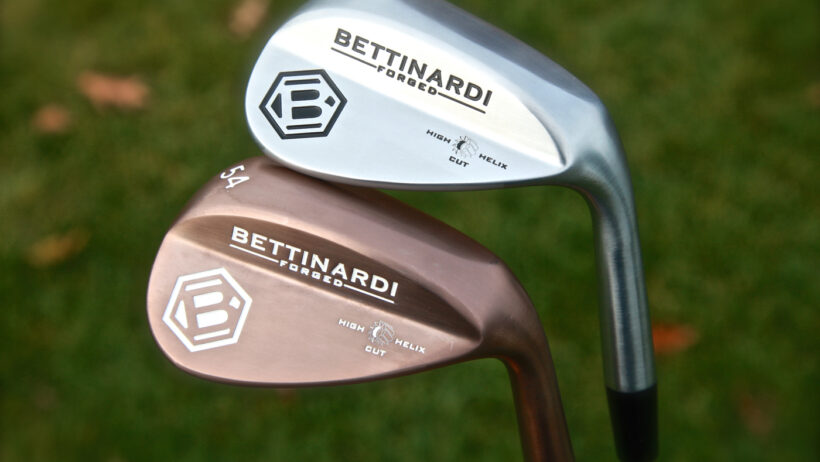
Bob Bettinardi’s journey into the wedge market started in 2001 with a single block of steel.
“It was 12 or 13 years ago that I milled a wedge from a solid block of steel, just like we do with our putters,” Bettinardi said. “A guy from one of the wedge companies said ‘I can’t believe someone had the [guts] to do that.’”
Since that time, the renowned putter maker has established a cult-like following for his high-end milled putters, but he has only released wedges in small batches. That changed this month, when Bettinardi unveiled his first line of retail wedges, the H2.


Bettinardi’s earlier wedges, which were produced in batches of 1,000, sold out in a matter of months. But they were expensive to produce because of their fully milled construction and carried a price tag of $400-to-$500 each.
Unlike a putter, which golfers can use for decades, wedges are more disposal. As their grooves dull, so does their ability to produce spin, which is why avid golfers usually need new wedges every six months to three years depending on how much they play.
Was there really a place in the market for a $400+ wedge, Bettinardi asked himself? Probably not, at least not for a full-scale release. He knew wanted to bring Bettinardi wedges to the masses, however, so he worked to get the cost down.
Bettinardi called over to the company’s Japanese facility and told the engineers that he wanted to try making wedges with its forging technology. After nearly two years of tinkering, Bettinardi has produced wedges that look, feel and perform nearly the same as the fully milled models and cost less than half the price. The new H2 wedges, which are forged from 1020 carbon steel, sell for $180 with a Satin Nickel finish and $195 with a Cashmere Bronze finish on Bettinardi’s website.
According to Bettinardi, his goal for the wedges was for them to look, feel and sound better than any wedge golfers have ever played. A lofty goal? Yes, but judging by the success of his putter line it might not be out of reach.

The wedges’ H2 name stands for “Hi-Helix,” which is a machine tool that mills the wedge faces at very high speeds to create a rough face texture that improves spin. While many of the top-name brands have dozens of grind and bounce options, Bettinardi keeps it simple — two finishes and five lofts (52, 54, 56, 58 and 60) for a total of 10 wedge options.
With the H2 wedges, you’re not paying for grind options. You’re paying for wedges of the highest of quality and a buttery soft forged feel.
“If golfers want [a cast wedge] — something more rough around the edges or need more forgiveness — they can buy from one of the cast makers,” Bettinardi says. “If they want a high-performance, precision-forged wedge, or they just like the Bettinardi name, they’ll buy these.”

The wedges have a traditional profile and a C-Grind sole that has mild heel and toe relief. Why the C-grind?
“That’s what I like,” Bettinardi says. “That’s what my son plays, who is a scratch golfer, and that’s the grind that I play. It’s a really versatile grind because the leading edge sits low with the face square, and still sits low to the ground when the face is open.”
Bettinardi’s H2 wedges are available for pre-order and will ship starting Dec. 8. They will be in boutique golf stores in the U.S. starting Jan. 15.
Models include a 52-08, 54-10, 56-12, 58-10 and 60-08 and come stock KBS’ High Rev shaft and Pure Grip’s P2 Wrap grip.
Click here to see what GolfWRX members are saying about Bettinardi’s wedges in the forums.