

Even after the USGA and R&A streamlined the Rules of Golf in 2019 and in subsequent years to make it more user friendly, no one expects you to remember how to proceed every time something unusual happens. That’s why you should download the USGA Rules of Golf app and reference it when you’re uncertain—and be on the lookout for Rules AI, which is currently available as a beta version in the GHIN app and set to reach all GHIN users by 2027.
There are, however, some rules situations that happen so frequently—including in casual rounds—they are worth committing to memory. Not only will it keep you from being penalized unnecessarily, it saves time.
Here are six that you should have a handle on.
Out-of-bounds starts on the interior edge of the boundary
For your ball to be considered OB, all of it has to be OB. But often the course’s boundary is marked with items that are as wide, if not wider than a golf ball. If you happen upon your ball, and it appears to be right on the line of being in or out, the boundary line is the straight line between the course-side edge of the fence posts or stakes being used to make the out of bounds. Same with areas marked with white paint. If your ball is sitting on top of the paint, it’s considered out of bounds when all of it is beyond that interior edge. It’s a razor-thin line, not the width of the sprayed paint, that is taken into consideration. (Definitions: Out of Bounds).
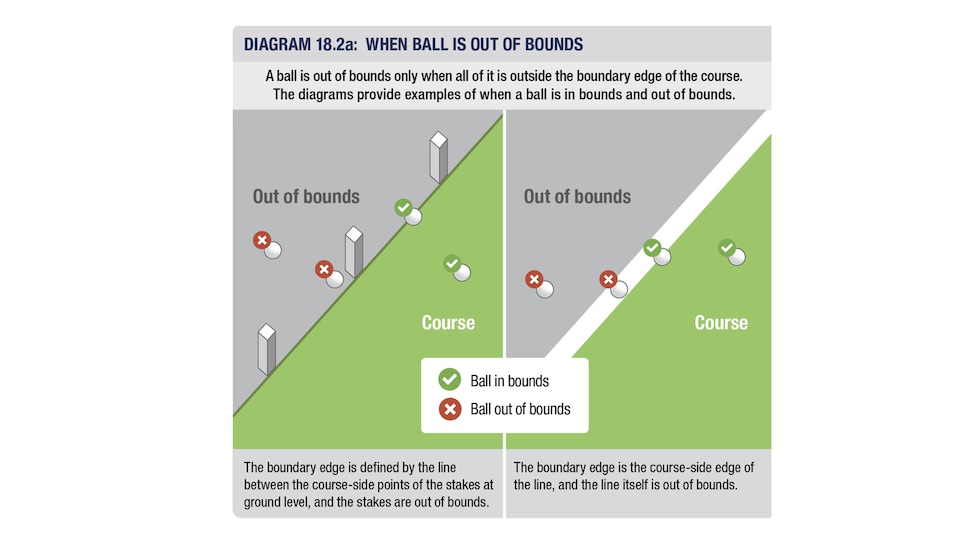
Graphic courtesy of the USGA
If your ball falls off the tee at address or in your backswing, there is no penalty
Your playing partners might pull out the old (and bad) joke of saying “1” when this happens, but it’s not a stroke and you can re-tee without penalty. The only time it would count as a stroke is if it happened during the forward movement of the club when your intent is to hit the ball (which is the official definition of a stroke). And to be clear, if it happens during the downswing and you’re able to stop your stroke before impact or deliberately miss the ball, there also is no penalty. (Rule 6.2)
More Rules Reviews from Golf Digest  Rules Review Rules of Golf Review: He rotated his golf ball without marking it. He says it’s OK because he didn’t lift it. True? Ron Kaspriske – Jun 10
 Rules Review Rules of Golf Review: My buddy’s ball hit mine into the hole on a par 3. Did I make a hole-in-one? Christopher Powers – May 28
 Technology Got a rules question? The USGA is harnessing AI technology to get you fast, accurate answers Ryan Herrington – May 27 If you hit your ball in a penalty area, you can’t play a provisional
The Rules say that for a provisional ball to be allowed, there must be some possibility that you might not find your ball and it’s somewhere outside the penalty area or out of bounds. But if you know or are virtually certain (95 percent likely) that your shot went into a red or yellow penalty area, that isn’t the case. In this instance, if you announce and play a provisional, that’s now your ball in play with a one-stroke penalty. (Rule 18.3)
You can leave the flagstick in when you putt, but you can’t change your mind after the stroke is made
If your intent is to putt with the flagstick in but realize during the stroke that you might be better off pulling it out, you cannot authorize someone to do so without getting hit with the general penalty (two strokes or loss of hole in match play). However, if you took the flag out before the putt and now your ball in motion might hit the stick lying on the ground, it can be moved without penalty. Mind you, if it did hit the stick on the ground, there is no penalty and the ball must be played as it lies. (Rules 13.2, 11.3)
 You can take relief outside a bunker, but it comes at a cost
Whether it’s a bunker filled with rainwater or your ball is buried so deep in the sand that it would take a month to get out, you’re allowed to take relief outside the bunker. In the case of taking relief from temporary water, you can drop by going back-on-the-line as far as you’d like keeping the point where your ball lies in the temporary water between you and the hole. Unfortunately, that comes with a one-stroke penalty even though you had no choice (unless a committee decides to treat the water-filled bunker as ground under repair, creating the opportunity to get free relief). When you’re taking relief outside the bunker for an unplayable ball, it gets worse. You can drop using back-on-the-line relief, but it comes with a two-stroke penalty. (Rules 16.1, 19.3)
You can lift a ball off the ground to identify it, but you better mark the spot first
Too often golfers in casual rounds will approach a ball in the rough and pick it up to make sure it belongs to them. They might even fluff it up from its former lie (which is a penalty, but we’ll stay on topic). It’s OK to lift a ball to identify it, but you have to mark the spot before you lift it. Oh, and once it’s in your hands, don’t clean the ball. You can clear the area needed to identify it, but that’s it. Violate any of these rules for lifting, marking and cleaning and it’s a one-stroke penalty—and put the ball back in the right spot! (Rule 7.3)
MORE GOLF DIGEST RULES REVIEWS
What do I do if my ball just hit another ball on the green?
What happens if my three-minute search for a lost ball gets interrupted?
I hit myself with my own ball. Is that a penalty anymore?
My ball ‘might’ be in a pond, but I can’t find it. Can I drop, add a penalty stroke and move on?
What exactly is an embedded ball?
Can you get relief from aeration holes?
Does a ball have to be unplayable to declare it unplayable?
I accidentally hit my ball with a practice stroke … does it count?
I’m on the green. My opponent is not. Who’s away?
My opponent dug his feet in a bunker, got another club and did it again. Is that legal?
I bent my putter and it actually works better. Can I still use it?
This article was originally published on golfdigest.com