
More forgiveness sounds great, but if you’re fighting a slice, that extra stability might actually be making things worse. Here’s why the latest super-stable drivers don’t always help…
For years, golf drivers were marketed on speed and distance. Hot faces. Speed slots. Carbon crowns. Turbulators. Every brand seemed to have some spicy-sounding tech that promised the longest drives of your life.
But over the last few seasons, something’s changed. Sure, every new model still talks a big game when it comes to distance, but the real battleground has shifted to forgiveness.
AI-designed faces that maintain ball speed across the entire hitting area. Back-weighted heads pushing MOI numbers past anything we’ve seen before. Adjustable weight tracks that help stabilize mishits. Drivers aren’t just being sold as “long” – they’re being sold as “unmissable”.
There are a couple of reasons for that.
First, brands know they can only shout about gaining another 5-10 yards every year for so long before we all start asking why we’re not yet driving greens on 450-yard par fours. And second, they’ve pretty much hit the ceiling on ball speed and distance. The rules of golf limit how hot a face can be, and most modern drivers are already flirting with that limit. Once you’ve reached it, there’s not much more an R&D team can do to give you more distance for your swing speed.
So manufacturers have instead turned their attention to forgiveness. And in many cases, that’s great. But forgiveness comes with unwanted side-effects – particularly if you’re one of the millions of golfers battling a slice. To explain why that is, let’s look at what makes a golf driver forgiving to identify when it helps, and when it’s actually a hindrance.
 What actually makes a driver “forgiving”?
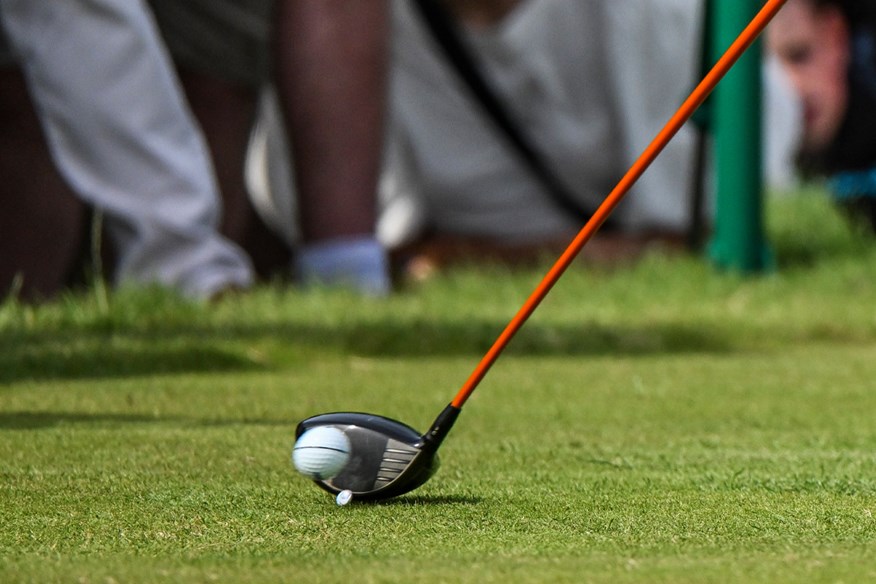
It all comes down to MOI – moment of inertia – which measures how much an object resists rotation. MOI is measured in grams per centimeter squared, and the higher the number, the less the object will rotate.
In golf, higher MOI equals more stability. When you hit it off the heel or toe, the clubface doesn’t twist open or closed as much, so you keep more ball speed and hit it straighter.
So at first glance, high MOI sounds like the obvious choice for everyone… but here’s where things get interesting.
The problem with high-MOI drivers for slicers
Studies show that around 60 percent of all golfers suffer with a slice off the tee.
And the root cause is simple: an open clubface relative to the path. If the face is open at impact, the ball is always going to peel off to the right (or left for lefties).
Club path plays a role, but the face is king.
Research shows that higher-handicap golfers – those who tend to struggle most with a slice – have their clubface 3-5 degrees more open on the downswing than lower handicappers. The numbers show a direct correlation between handicap and how open the face is at impact.
And this is exactly where forgiving, ultra-stable driver heads can hurt you.
Lewis Daff, one of TG‘s golf equipment experts and a Master Custom Fitter and club builder with more than 5,000 custom fittings under his belt, explains: “Forgiveness does have disadvantages to it as well.
“One of the side points of having weight and the center of gravity really far back in the head, you’re increasing MOI – that’s your forgiveness rating – but MOI is resistance to twisting, so that head is suddenly going to become a lot harder to square up.
“If you’re suffering from a slice, it’s just going to make that slice worse. Something that is on paper less forgiving might actually end up being the club that squares up easier for you and you can hit it straighter.”
That’s the paradox. The most forgiving drivers on the market might actually be the worst choice for players who need the most help.
A high-MOI driver resists rotation. That’s the entire point. But if you’re already someone who struggles to close the face in time to point towards your target at impact, that extra stability doesn’t suddenly help you square it. It actually works against you by making the head harder to rotate.
 So what should a slicer look for in a driver?
The obvious answer is to buy a draw-biased model, but it’s not necessarily as simple as that.
Here are a few things worth considering…
1. Lower-MOI heads can be easier to square
A slightly more compact, more workable driver often lets you rotate the face more easily – helping you stop leaving it so open at impact. If you tend to strike the ball out of the center of the face but slice it because the face is open, this could be an option. But be aware that there will be less forgiveness on off-center hits. If you’re prone to a slice and tend to hit it out of the heel, a lower MOI head could make matters worse.
2. The right shaft can change everything
“With the world of custom fitting options now available, you can find a shaft and head combo that does pretty much anything,” Daff says. “We can use shafts to affect your release, tempo, timing, and many other factors, but what I’d use it for is helping to center strike more consistently.
“A shaft that matches your swing will improve your contact and help you hit closer to the middle of the face more often. That opens up more head options, giving a better balance between your needs for ‘forgiveness’ and a model that lets you close the face more easily.”
3. Small tweaks can make a big difference
“If you don’t want to consider a lower MOI head, my next option would be looking at the adjustable loft sleeve that most modern drivers come with now,” Daff explains. “Adding loft will close the face, by roughly 2° of face angle per 1° of loft adjustment.”
If your driver is currently lofted down from its standard number by 2°, tweaking it to +2° could close the face by 8°, which will have a big impact on your shot shape.
Of course, if you cure your open face problem but still have an out-to-in path, your slice could turn into a straight pull, though most golfers will adjust and stop cutting across the ball so much once their face angle is fixed.
4. Heel-weighted drivers genuinely help
Whether it’s a draw-biased model or a standard model with adjustable weighting, getting more weight towards the heel will encourage the face to close during your downswing.
“The warning here comes for the minority that slice the ball from the toe side of the face,” Daff adds. “More mass in the heel means less weight, and less stability, behind toe strikes, leading to more twisting and less retention of ball speed and distance.”
The bottom line
While maximum stability and forgiveness sounds like it would be your friend, if your main miss is a slice caused by an open face, a high MOI driver head can actually be working against you, not for you.
Sometimes the answer isn’t more stability – it’s choosing a driver that gives you the freedom to square the face.