
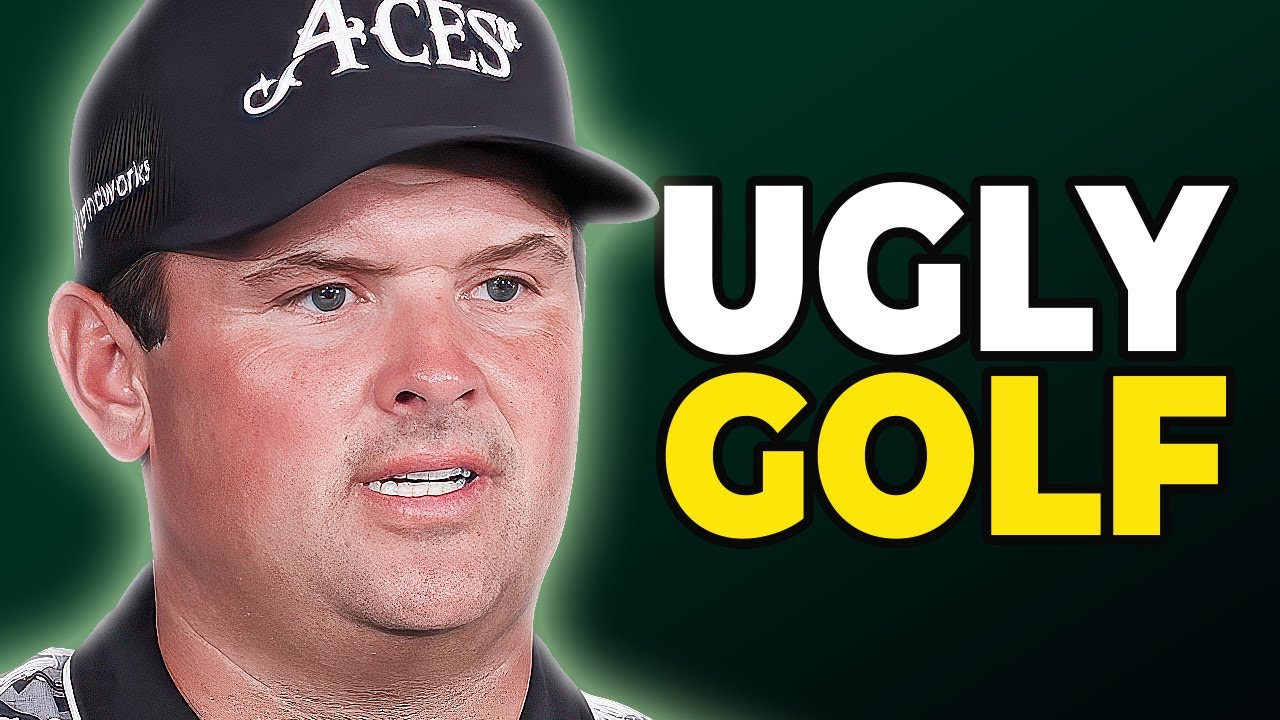
patrick reed, patrick reed cheating, patrick reed cheating moments
Patrick Reed did what every golfer dreams of.
He won the Masters. He earned millions. He became a Ryder Cup hero.
And yet…
He’s booed by crowds.
Iced out by fellow players.
Branded as golf’s “most hated”.
How does a green-jacketed major champion reach a point where fans don’t just tolerate his failures… they enjoy them?
In today’s video we look at The Satisfying DOWNFALL Of Patrick Reed… Keep watching to see patrick reed, patrick reed cheating, patrick reed cheating moments
Also check out: https://youtu.be/lxevoNJzWD0
On our golf channel Golf Legacy, we explore golf documentaries, PGA Tour, LPGA Tour stories, and golf swing mastery. Stay tuned for the latest U.S. Open golf highlights and golf tips that define the spirit of the game we love: golf
Click here to subscribe: http://bit.ly/4n9tIBt
Click here to subscribe: http://bit.ly/4n9tIBt
#golf #golfswing #patrickreed
Patrick Reed did what every golfer dreams of. He won the Masters. He earned millions. He became a Rder Cup hero. And yet, he’s booed by crowds, iced out by fellow players, branded as golf’s most hated. How does a green jacketed major champion reach a point where fans don’t just tolerate his failures, they enjoy them? The answer isn’t one moment, it’s a pattern. family drama, college scandals, rules, controversies that always seem to benefit one person, and eventually a career move that turns him from polarizing into an outright villain. This is Patrick Reed’s story. Patrick Nathaniel Reed was born on the 5th of August, 1990 in San Antonio, Texas, and raised in Baton Rouge, Louisiana. His parents were supportive but strict and his father especially pushed his golf hard from a young age. Very early on, Reed wasn’t just good. He was a problem for everyone else. at University High School in Baton Rouge between 2005 and 2007. He led the team to back-to-back state championships, picked up state medalist honors, earned Rolex AJGA All-America recognition, and even won the prestigious Junior Open Championship in 2016. That edge would follow him into college. And that’s where the first real cracks in the Patrick Reed image appeared. Reed began his college career at the University of Georgia, arriving with the hype of a future star. On paper, he was exactly what a top program wanted. But within a year, he was gone. Dismissed from the team. The official details still muddy. But teammates accused him of cheating during qualifying rounds and stealing things like cash and a watch from the lockers. These allegations were first reported in Shane Ryan’s book and were never formally proven. Reed has always denied them, insisting it was alcohol-related violations that led to his dismissal, not cheating or theft. Either way, Georgia cut ties. He transferred to Augusta State University and in a twist of irony turned into their anchor. He led Augusta State to two national championships, proving that whatever drama followed him, his game was absolutely real. But the shadow of that Georgia era never really left. Because when your name keeps popping up next to words like cheating and stealing, even without formal proof, people remember. By the time Reed turned pro in 2011, another storm was building. Not on the range, but at home. In his early 20 seconds, Reed cut off contact with his parents and sister. When he got married, his own family wasn’t invited. Then, at the 2014 US Open, his parents and sister showed up using a friend’s tickets and were escorted off the grounds after his wife Justine reportedly asked officials to remove them. That wasn’t a one-off moment. Even when he won the Masters in 2018, the biggest week of his life, his family wasn’t there. They weren’t just absent from the celebration. They reportedly weren’t even allowed through the gates at Augusta. Again, we don’t know every private detail. But from the outside, it added another layer to Patrick Reed’s story. And while all this drama played out off the course, his game was only going up. on the leaderboard. Reed was climbing fast in. Then he grabbed the mic and said he believed he was one of the top five players in the world. Bold words, especially for a guy who entered the week, ranked 44th. Some loved it, others rolled their eyes. But here’s the thing, Reed kept backing it up. He collected PGA Tour wins. He showed he could close under heavy pressure. And if there was one arena where he truly came alive, it was team golf. Reed became a Rder Cup monster representing the US three times. His fiery energy, animated reactions, and aggressive shotmaking earned him the nickname Captain America. The peak of that persona came at Hazeline in 2016 in that electric duel with Rory Mroy. It was chest thumps, fist pumps, and ridiculous shotmaking from both players. Reed won the match and cemented his status as one of Team USA’s most dangerous weapons. Then came 2018. Reed won the Masters, holding off Ricky Fowler and Jordan Spe to grab the green jacket, his first and only major so far. It was the pinnacle of his career. For a brief moment, all the noise stopped. No college drama, no family stories, no whispers, just a master’s champion in a green jacket. But that silence didn’t last because the same patterns that showed up in college were about to come back in 4K HD. Later that same year, Reed found himself at the center of a firestorm. At the Hero World Challenge, cameras caught him brushing sand away from behind his ball, not once, but twice. To most people watching, it looked exactly like what you’re never supposed to do. Improve your lie. Reed said he didn’t do anything wrong. He blamed the camera angle. Said it made things look worse than they were, but the footage said otherwise. Golf Channel analyst Brandle Shambbley called it cheating. Fans were outraged. And even though Reed was penalized two strokes, the damage to his reputation was already done. Even his peers weighed in. Cameron Smith said, “If you make a mistake, maybe once you can maybe understand, but to give a bit of a bolt response like the camera angle, that’s pretty up there. I don’t have any sympathy for anyone that cheats.” Now, remember those old unproven allegations from Georgia? They suddenly didn’t feel so far-fetched anymore. 2 years later, at the 2021 Farmers Insurance Open, the script repeated itself. Reed’s ball landed in the rough. He claimed it was embedded and took relief without waiting for a rules official to arrive and verify it in its original position. By the time an official got there, Reed had already marked the spot and picked up the ball. Later, TV footage showed the ball had bounced before stopping, which typically means it wouldn’t have embedded. Technically, he didn’t break the rules, but the optics were ugly because at this point, fans weren’t judging that one decision in isolation. They were connecting dots. College allegations, the Hero World Sand incident, and now this. What could have been a small rules debate turned into something bigger. A storyline that painted Reed as a repeat offender who always seemed to find the gray area and come out ahead. By 2022, Reed wasn’t just battling the court of public opinion. He went after actual courts. After joining LIV Golf in June, he filed a $750 million defamation lawsuit against Golf Channel and several analysts, including Shambbley. He claimed they’d been spreading malicious falsehoods about him for years, and that there was a coordinated plan to destroy his reputation. But most people didn’t see the suit as a noble fight for truth. They saw it as a PR move from a player whose public image had already spiraled. So now you had a player already viewed as a villain by a chunk of the fan base joining the most controversial league in golf and suing the media for calling out the very pattern everyone thought they could see with their own eyes. This wasn’t the redemption arc Patrick was hoping for. Then came 2023 and the Dubai Desert Classic. Reed hit a wild T-ot that looked like it lodged high in a group of palm trees. He insisted he identified his ball in one specific tree and took a drop below it, but later video replays showed the ball likely landed in a different tree entirely. Again, the ruling technically followed protocol, but fans didn’t buy it. To them, it was deja vu. Another sketchy moment. Another benefit of the doubt given to someone they thought didn’t deserve it. Reed defended himself as usual. But the reaction from the golf world was different now. They weren’t arguing anymore. They were just rolling their eyes. So, what do we actually have when we look at Patrick Reed’s career as a whole? On one side, he is a Mast’s champion, a Rider Cup legend, and a ninetime PGA Tour winner. On the other side, he is a player who’s been accused of cheating multiple times, who has alienated his own family and sued journalists for criticizing him. Some people argue he’s misunderstood, that he doesn’t technically break the rules, he just doesn’t follow Golf’s gentleman code. Most others say that’s exactly the problem. When your name shows up in controversy after controversy, eventually the benefit of the doubt disappears. And that’s where the satisfying part of his downfall comes in. Because to a lot of people, Patrick Reed isn’t just a villain. He’s the rare sports villain whose struggles feel earned. Not because of one mistake, but because of years of smoke that made everyone sure there was
2 Comments
Great golfer. I hope he wakes up.
Never liked this prick, he oozed arrogance and reminded me of the idiot jocks in high school, unlikeable, its unfortunate cause he has talent, but his big mouth and ability to piss of everyone u know ur an asshole. He deserves every negative press he gets. Cheater on camera, how stupid can you be, well you can its called Patrick Reid…