
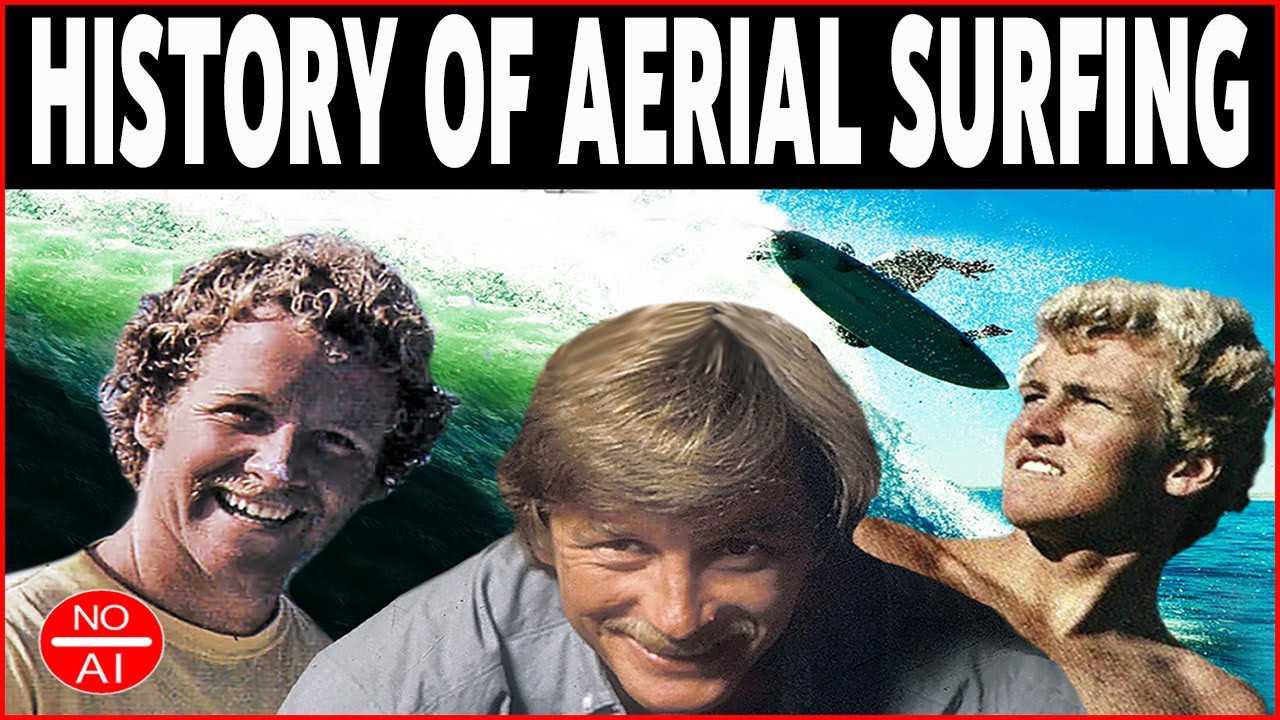
The History Of Aerial Surfing actually follows a very clear timeline and history. This video breaks it down, the stories behind the first aerialists, the techniques they used, and the inspiration behind it. We answer many unanswered questions about the origins of aerial surfing.
Firsthand eyewitness accounts by Richard Schmidt, Bruce Walker, Tom Curren, Martin Potter, Cheyne Horan, Brad Gerlach, Steve Olson, Anthony Ruffo, T.R. and more.
One of those skaters was Kevin Reed, who was not only a pro skateboarder, he was also a pro surfer, and the first surfer to master the aerial in the water. He was the first top level pro in both sports at once. Not only did he do the first airs surfing, he was doing them switch, various grabs, and also doing barrel rolls and other futuristic tricks, all of which he would draw with a pencil in his flip books, then study, visualize, and accomplish.
Next was Davey Smith, then Matt Kechele, who would use airs to win the first contest where they included them in the judging criteria, and the early 80s surfers like Bud Llamas, John Holeman, Cheyne Horan, Martin Potter, Steve Price, John Mc Clure, Johnny Futch, Luis Neguinho, and a number of other surfers were taking to the air and successfully landing.
In the mid to late 80’s and early 90’s the second generation of aerialists like Christian and Nathan Fletcher, Matt Archbold, Flea, Barney, Ratboy, Crimo, Mattison, Wardo, Scabs, The Beschens, David Neilson, Nick Wallace, Joca Junior and many others redefined the sport, taking over the surf media, and changing the game forever. We will dig in deep on that in Chapter Two, Coming Soon To Real Surf Stories. Be sure to subscribe to stay in the loop.
“I would draw it in my flip books to a certain point to where I understood that there is no way to land it unless you are following the wave. Learning that theory was too simple to understand. It was normal for me. No one else was doing airs on a surfboard….I wasn’t influenced by and didn’t look up to anyone. I surfed with Shaun, Rabbit, all the best….I couldn’t get inspired by that…I got bored.”
– Kevin Reed
“I heard Kechele was doing them, and I heard Kevin Reed was doing them, at the same time I was doing them, and it was a cool era because there was nothing, no way to communicate unless you went to that person and you were able to talk.”
-Davey Smith
“Aerials then… Were raw, fresh. It was about trying something that had never been done before. They were unique. They were frowned upon. I remember Simon Anderson said surfing’s meant to be done on the water, not out of the water. To me aerials were an expression of my imagination and an extension of the way I wanted to surf. Projecting the board out of the water was a continuation of a re-entry to me and they were exciting.”
– Martin Potter
“Bruce Walker started talking about Alan Gelfand, that’s what really clicked for me, he was describing how he would hit this hip and tail-high transfer his board to point back down and ride out on the transition, and make it look good with style. That same day I was trying them at Sebastian Inet…right away I was doing them”
-Matt Kechele
“I’m not gonna go out and do the same tricks as everyone else. It’s like beating a dead horse….My dad was the only one behind me on this thing…we helped push surfing into the Air…We were crucified by ‘industry’ who did their best to destroy us…But here we Are”
-Christian Fletcher
Music:
Enogh Light- The Now Sound
The West Coast Pop Art Experimental Band- Where’s My Daddy
Finch – Thunderbird
Mood- Who’s Next
Additional imagery:
Steve Soderberg
Rick Blake
Surf Splendor
Surf Scene- Peter Townend
Moneytothemoon
TY Cultura
Herbie Fletcher
Scott Deitrich
Aitonn
Jimmy Metyko
Doug Waters
Kevin Welsh
David Natal
Joe Mickey
David Puu
Mike Moir
Vern Fisher
Chris Klopf
Bob Barbour
Bruce Walker
Glen E. Freidman
Chris Byström
Warren Bolster
Gary Mederios
…lost
Skateboarding Hall Of Fame
Jack and Clark Poling
SURFSPLENDORPODCAST.COM Subscribe today!
OUTRACULTURA.COM “Born in Brazil, Created in California”.
CHRISKLOPF.COM Order the “Shooting the Decades” Books Collection.
SHOOTWITHTR.COM Lets make YOUR Real Surf Story!
Under Section 107 of the Copyright Act 1976, allowance is made for “fair use” for purposes such as teaching, and research. This video is focusing on groundbreaking surfing technique and historical context. This content is used under fair use principles and is intended to be transformative and educational in nature.
#AerialSurfing #KevinReed #SurfHistory #SurfLegends #SurfingTricks #RealSurfStories #SurfPioneers #ChristianFletcher #MattKechele #CheyneHoran #SurfingEvolution #80sSurfing #BarrelRoll #SurfingAerials #snapt5 #SurfCulture #SurfStories #AerialSurfingTimeline
Welcome back to Real Surf Stories. Following the deepest roots of aerial surfing, take us all the way back to the early 1960s when surfer skateboarder Herby Fletcher started riding waveshaped transitioned swimming pools. With the invention of urethane wheels, skaters started taking to the air. The actual story of aerial surfing itself started in the early 1970s with a surfer skateboarder named Kevin Reed who visualized heirs by drawing flip books then took it to his backyard ramp and then to the water. Where did you do your first air skateboarding? in my ramps on my backyard. When was your first air surfing? Been doing air since 72 on a 76 pin tail single fin. Yeah. Richard Schmidt, everybody’s in the water. Robert Waldmire. I come off the point and clear that section. First time I’ve actually figured it’s majorly possible with my flip book and looking at how the wind is, how the currents go. The first air I ever saw somebody accomplish was Kevin Reed in 1974 and I’ll never forget it. There’s an image there in my head of him soaring above a middle peak wave about a 4 foot wave with a lighthouse in the background and the setting sun. He was silhouetted and just it blew my mind. I’ve never seen anybody in that position uh ever until that point. And to have him landing right away, it just blew my mind. And um I got to know Kevin, you know, in high school, so you know, 74 uh 73, his mom was active putting on these little contests, you know, during that time period. And um I used to hang out with him and he was really futuristic, you know, he’d he’d sit down there and he sketched like u maneuvers that he was going to pull off um in the water. And I remember going to his house and he showed me this picture of these gets out of a like a roller like what Barney ended up doing like a you know pip by the the Barney rolls that he would do inside the barrel. And I remember there was a time I was surfing with Kevin up at Bedell and he was doing what Kevin does which was just rip. I’m paddling out and this set comes through probably four, five, six feet, whatever. And uh Kevin drops in when he comes down and he’s sid slipping and he’s holding his rail and he’s 100% committed but he’s sliding down and the and he’s left so he’s backside and he’s sliding down and then all of a sudden his board catches and then he gets thrown up and over the lip with the lip. lip. So, he did like a barrel roll and like and landed it and I’m paddling out and I’m like screaming obviously and then he pulls it off and kind of squirrels out of it but he made it right. Whatever. And uh I was just like he paddled back out and he’s like, “Did you see that?” I was like, “Yeah, I saw it.” I was paddling out. He’s like, “Can you believe I pulled that one?” And I was just like, “Yeah.” And he was like, you know, I meant to do that. I was like, oh, [ __ ] But he pulled it. Who cares if he meant to or not, but it was one of the coolest things that I saw a a dude do on his surfboard. And it was insane. Flip bugs are simple. I’d start from the back, right? Using a pencil. Draw that wave. Fold it down. Draw it a little further down the line. Fold it down. Draw it a little further down the line. Then go back to the beginning and put the trail in that I’m looking for. So at that point, the flip book’s 100 pages from back to front. Just like watching a cartoon. We’re doing a thousand frames per second movie. You watch it enough time that in your mind you could visualize yourself. Visualize it and draw it to a certain point where I understood that there’s no way to land it unless you’re following that wave. Learning that theory was too simple to understand. I was like after the flip books, um, that’s too normal for me. Who else was doing airs on a surfboard? No one. No one. Who do you think was the second person to do a air surfing? Dave Smith. The first aerial I did was at Rocky Point in 1975. was on a a a 6foot CI single fin. So, I remember taking off and I’m like, “God, this wind is really, you know, it’s holding me back.” Um, but then I got a bigger wave and I was going really fast and um I hit the lip and I was I was trying to do it like a regular uh like big carve but the board and my body just came up and the wind just held it and I was like, “Oh, this is cool.” And then just landed it on the flats and I’m like, “Wait a minute.” I’m looking around to see if anybody saw it. You know how surfers are. Did you see that? Um but and I’m like, so I just kept trying it after that and I I completed one that same day, but the rest were flops. Do you remember the first air you saw like in person? Yeah. Maybe it was some Dave Smith probably in person. I think um the little spot that we used to surf in Santa Barbara was a little beach break. So it was kind of ideal. Yeah, I remember seeing Kevin Reed on a magazine do air you know. I think it was surfing magazine and um you know I don’t remember the year but it was I remember that for sure. It was definitely something different. Um, yeah, that opened your mind to like try it or was it just seemed like some other thing? Uh, yes. It was interesting because it was like a skateboard thing, you know, it’s like skateboarding. And I was really big into skateboarding at the time. I guess was it late 70s or and mid70s and um so that was definitely a skate move for sure in surfing it uh it just kind of evolved the whole aerial thing and it evolved from skateboarding because at that time I was skateboarding Kevin Reed I believe was skateboarding and Matt Keckley was skateboarding And the big thing was getting coping in pools, the Dog Town crew, and then people started getting air out of the pool. So, it just seemed like a natural progression there, and I was like, “Oh, it’s just going to go in the air.” By 1977, skaters were taking to the air all over the place. Ed D. Roza got the surf community together. Then we all built SoCal in 1977. And before it was open to the public, Kevin was already making a history with his futuristic moves. Third bowl of the Rita run. You get all this speed and you do like a oie to lip slide. The air to lip slide. If it wasn’t for my c my my skateboards 36 inches long propped up that high off of tracker trucks. Okay, that wouldn’t have been possible on that round surface. By the time the park opened, he was mastering his heirs, grabbing and not grabbing and influenced a young group of skaters, including myself. Not only in the park, but in the water. TR, you’d show up at the gate sometimes in my backyard. And usually if I wasn’t there, no one skated those ramps. or my mom would basically come out the back door and stick a gun in your face and tell you to wait till I came home. You know those stories. I’m ampedextrous. So basically it doesn’t matter. I can go left, front side or backside. I can go right, front side or backside. I remember seeing you get pitted at the harbor backside in front of the rocks. And I’ll never forget witnessing you land two lofty ollies on one wave at the rivermouth. And the second was switch. How did you do that? I had a tendency to do because of that left went down the line so fast. I take off regular foot. The first air you saw is backside and landing and switching and doing it front side. One of the things TR is I didn’t look up to anybody. I surf with Sean Rabbit. I surf with all of them. big wave riders basically bottom turns, a coaster here and there, a roundhouse, you know, maybe a tube ride, but improvising off of that and like I got bored. You know, I’d heard that Kley was doing them and and I heard that Kevin Reed was doing them right during the time I was doing them. And so it it was uh it was a cool era because we there was nothing there was no way really to communicate unless you went, you know, to that person and you were able to talk. It was so many different individuals and they were in their own little pockets of energy isolated from the other pockets. We’re talking no internet, no computers. I served with Kekley in Newport during that era and yeah, he was he was busting the fins out. Bruce started talking about Allan Galan. That’s what really clicked for me at Sebastian Inlet when Bruce was describing like how Allen would hit this hip and then kind of tail high transfer the board to point back down and and ride back down the the transition smoothly and make it look good, you know, with style. And uh so for me it was just like right away I was like you know that same day I was trying those at Sebastian you know I had a twin fin you know I was able to get this speed and right away I was doing them and Bruce kept encouraging me to keep doing them. I was 16 at the time. March and April 1979, KEK is on the twin fins that Lore had shaped for these skateboard maneuvers. They started out on the shoulder and they were little little shoulder hops, but the the idea was the goal was to see if you could get the fins completely out, do an aerial, land it, and ride out of it. And so he was doing it, he was consistently landing them, consistently riding out of it. skateboarding was taking off, you know, and uh yeah, so as as same with you, it all connected at that time. It all it all made sense to me to kind of start fooling around and and experimenting out in the water and figuring out what I could do, translating certain skate tricks to surfing. And this is it. This is where surfing’s going. You know, it’s just just a matter of time. So all of that is the culmination of like really what inspired me. And Sebastian Inlet is just it’s kind of a no-brainer. The the way that wedge is, she’d be riding on the left and all of a sudden the wedge would just be coming at you, you know, kind of at a 45 degree angle. All you had to do is just come off the bottom, hit that thing, and you know, and just get the tail transfer and you could ride out pretty smooth right away. I started doing those errors. Keali started doing aerials just boom straight up boom popping it out and they just got better with time and then the Stubbies event came to town and then they brought it to Sebastian inlet the very first one in 1981. All the best surfers from up and down the east coast. Yeah, I was 18 years old. I was going to cut my teeth against the best all the best guys, you know, at my home break. the event was getting ready to start TR right and it was pretty heavy. Um Leon Johnson was a judge at the Stubbies and he pulled like a sidebar sort of conference together with the judges and it kind of blew my mind like I kind of there were some surfers kind of on the outskirts of this little pow-wow meeting the judges were having and Leon stuck his neck out. He was saying that aerials are going to be the future of surfing and you know and he’s saying just like the skateboarders he goes it’s here it’s now it’s happening and we need to start scoring them you know and I was kind of like you know in respect to all my peers and and and you know all the other surfers that I really looked up to I was kind of like like shy and kind like, whoa. Like kind of blown away. Like I couldn’t even believe what I was hearing. I was really impressed that somebody, you know, that Jeremy Johnson’s father had that insight and really stuck his neck out like at a big event like that. Like they could have just said, “You’re fired. You’re out of here.” you know, like it put a really a lot of pressure on me cuz it was like the waves were pumping and you know, and it was like well and I I didn’t get clarity to like are they going to be scoring errors or not? To do errors proper, you need like the good wins, you know, found myself in the finals, you know, against Pat Mohern and uh the winds, you know, the swell was dying down a little bit. Kind of got a little bit chunkier. there was like thousands of people on the beach, you know, and it was just like crazy pressure like but in my mind I was like I you know I’m kind of known like already kind of come down this path. I’m kind of known to be like a an air guy and I’m going to do some errors in in this final and uh I sent you that shots where I do two little errors on one wave that was in the final and they announced that I won. It was it was pretty special. The significance of Kek winning this contest can’t be understated as it took another three full decades for heirs to be part of the judging criteria. I had heard about Holman kind of shortly after the Stubbies I want to say and you know hey there’s this other kid in town he’s doing errors like you ke oh cool you know and I want to check it out and and then finally I’d seen Holman doing them and he was doing some really cool stuff and and he was focused on that and that only I was stoked for him and I was stoked to see that it inspired somebody else to pick up those rings those that baton and run with it as Well, and Matt Keckley started doing these skateboard tricks in surfing out on a wave. He would, one of the tricks he would do that he was known for was called a kek flip. He would paddle fin first and ollie his board three, four feet. I mean, how the kid could ollie that high on a surfboard was amazing. But he would ollie his board three, four feet out of the water and rotate the board under his feet, land on it, and keep going. just one of many aerial tricks this kid was doing. He was mesmerizing. I would sit on the beach for hours and study and take note and try to copy what he did. And uh back then, Olly Hops, as uh ridiculous as they came to be in many people’s eyes, it was the start of aerials for us on the East Coast. I I can’t speak for anyone else. I was so young and naive back then. I didn’t travel. We didn’t have the internet. We were very limited to what was going on in the world. We could only see what was going on in front of us in those days. And what Kek was doing was revolutionary. He would ollie his board three or four feet out of the water, land it, and keep going. And he would do these front side laybacks under the lip and the lip would throw over him and he’d stand up and come out of it. And he was doing things no one else would do. And that got me interested in aerials because everyone else looked the same to me. So I would study him and study him. I started mimicking his maneuvers and I started out with the olly hop of course. And then the olly hop, my olly hops got higher and higher. And I noticed that by olly hopping my board high, the board would almost rotate into a 180 and then I would land it and spin it back around regular and keep going. And it wasn’t it didn’t take me long. This this all went down in 1980. So I told my friends I wanted to rotate it all the way around a complete olly hop reverse. Land it and keep going. No one believed me. Everyone thought I was full of garbage. And I got made fun of for even bringing it up. And but I started working on it. And sure enough, in the spring of 1980 at the south end of Paradise Beach Park, which is a very well-known surf spot here in Bvoulevard County, uh a friend of mine just happened to be videotaping with a VHS recorder, which was uh new technology back then, 1980. He just happened to be on the beach and I olly hopped, took off on a chest high wave. I’m goofy foot. Took off on a left, chest high. Got a bunch of speed. Was looking for a chop in the face of the wave that would launch me higher than normal. I hit this chop. I rotated full rotation. Landed it and kept going. The beach went nuts. Everyone in the water went nuts. I couldn’t believe I actually pulled it off after months of working on this. I went straight in, looked at the camera, and had my buddy Greg Mashai play it back for me. And I looked at it three or four times, memorized it, went back out and continued working on the olly hop. And there were some tricks of the trade that I learned. If you do the olly hop up high on the face of the wave, you can get higher and rotate easier all the way around and etc, etc. Matt Keckley was the first person I ever saw do aerials in person in Florida. I started copying him and then others started copying whoever. I don’t know if they were copying me or copying Matt or copying Jay Smith or I don’t know. I can’t speak for these other surfers, but we had a gentleman by the name of Kevin Elliot, and he could actually do an Olly Hop Air Reverse 360 probably a few years after I started doing them, and he was he was pretty good at them. Um, Charlie Haych, of course, uh, he was doing aerials. And there’s a there’s a number of other people uh that started doing them years later. Uh but but Kek was the first I mean he was a pioneer and of course he went through the whole thing. Silly kick trickster for kids and it was all the guys it was all the pros who were fullon top eight top 10 and pro surfing. None of them did aerials. And suddenly this young upstart is here doing area a silly k. They there was a lot of guys that were looking for their own survival in a in a tough sport. And it seemed natural for them to criticize and to try to subject. And they kind of got a thing going that kind of suppressed Ariel’s to to a certain degree, you know, and Dave Smith, I greatly admire like how he stuck with it and like started doing like all kinds of other sort of skate maneuvers and you know, like I was watching some of his old footage. He was doing like a corrupt flip with the close outl Jimmy Medico who got me hooked up with Davey and he took me surfing and uh Jimmy documented the couple sessions we had and we were kind of trying to push it push our surfing and see where it was going to go and I did a couple errors and Dave did some really cool stuff and it was a really cool uh kind of thing that we got to share together and um but I I admire that he really really stuck with it And I think he deserves a a lot of credit as well. He He got a lot of credit. He did. He definitely of all the Californians, he he probably might have gotten more credit than Kevin. I do recognize that Kevin was doing some some super cool errors and stuff, too. And you know, and you know, there’s going back to mentioning like a lot of other names that I really think, you know, stuck with it and they kept pushing it. Johnny Futch was another guy that really pushed his errors at first peak getting that slingshot off the wedge. Even like Bud Bud Llamas as well. So I remember watching Bud Llamas at Sebastian Nland boosting uh backside oies really high. Well, I like to do a lot of aerial stuff, but uh been trying to throw everything together. Well, I was kind of working on that stuff. Yeah. And I made a few and then later I got better at it and it just extended from me doing a real off the lip in the early 80s. Chris Klopp’s amazing photos of Kevin Reed were all over Breakout magazine, a small California publication. All the photo editors at Surfer and Surfing Magazine would not publish them. A new wave of local Groms started getting above the lip, directly influenced by Kevin Steve Price, 2 feet above the lip and short distance, but he was proud of himself for landing every single one of them. And for an eastside surfer, surfing pleasure plate, him and I used to go at it at Santa Mo. He watched, he learned, he listened. Couldn’t skate for [ __ ] but hell of a surfer. The cool thing about Kevin Reed is is his quote. I I do this for a living. I remember seeing that as a kid going, you can do this for a living. Kevin Reed was a was a freak of talent and he had his own way of doing things and he blew people’s minds. Kevin Reed, Mr. Radical, so gnarly. So early on, first guy to ever do an aerial and landed on a surfboard. Let’s face it, he was pure innovator. His name alone should be on everyone’s lips when they talk about surfing or skateboarding. Nobody skated like Kevin Reed. He had his own gig going on. super innovative, stylish surf skater. No, he just invented [ __ ] and just went for it and suddenly he was doing it. Kevin Reed was definitely uh ahead of the ahead of the crowd and ahead of the pack. Why his name isn’t known, I have no idea. It should be It was a controversial thing. Aerials were still not accepted even into the, you know, 83, 84. I mean, sure, you’d see some guys in the magazines, you know, busting the air and and doing them in a contest. like there really wasn’t at that time like you know that I know of doing them in a in a contest so much I in 82 like I did a couple at the OP pro you know and uh but again it was like it wasn’t something that I was like I was just like I don’t want to really be known as only this you know never saw anybody do an air we were all practicing it when I first did an air I did an air before I’d even seen it we were all going for airs look the guy who was better at air than what I was was a guy Bud Llamas. There was another guy I think his name was Reed from up in Santa Cruz. Yeah, exactly. Uh Kevin Reed. Kevin Reed. Yeah. See, Kevin, those guys were much better than me. They had good control of it. I was out of control in the air. I, you know, I made some, I didn’t make some. It was all about trying to get we were all just trying to get above the lip line and out and our boards were always at the wrong angle and you know but we were landing them you know we weren’t landing all of them and that’s where the airs came from. Well, you know I was the first guy in Australia doing it. First guy I ever saw do it was probably Bud Lus. The first guy who do proper errors in Brazil was Louis Nim probably early 80s. He was doing some errors proper errors launching landing. for in Jesus. There’s guy John Mccclure, you know, Malibu guy I I recall he started taking to the air. Then Pots got that surfing magazine cover, you know, and and uh yeah, it was a it was a rad super rad shot, you know, and it was like, wow, it’s like aerials aerials are here. Ariel’s probably uh the maneuver of the future. Uh, a lot of young guys these days are doing them and uh, I think it they need a lot more work in it and maybe in a few years they’ll be recognized as a functional maneuver. It’s really hard to explain how how an aerial feels. I guess you just have to do one. But I think if you were to ask him, I bet he would kind of have some similar stories as to what I’m saying about like the errors are are good for that the right time and place. You know, I think an aerial is a a functional maneuver if it’s done in the right way. To do an aerial, you got to hit the lip before you can do an aerial. And guys like Matt Archer Ball and Bud Lamas do proper aerials because they use the lip to launch themselves off. Think a proper arrow has to be done with a lot of speed off the bottom. Hit the lip and launch yourself off the lip. His errors were all about power and woof woof. Yeah, pretty rad. Martin Potter was one of my favorites. Okay. Power style surfing in with the new uh like Kelly Slater and aerial stuff. I Matt Archerald aerial stuff. I I think you got to have a mixture of both. So many names, you know, that that picked up the ball and ran with it. And in fact, you know, when uh I was competing in Japan, they were starting to recognize and I believe they were some of the first guys that started doing air shows and they would have it as a sidebar event and they would have air shows. Um like at Nijima they had an air show and at Chiba they started having air shows and they were giving out away pretty good prize money and it was pretty cool and and not everybody was entering them. um Willie Morris and Frohoff, Ted Robinson, Bud Llamas. Some of those are the names that kind of come to mind that were like, you know, wanting to wanting to do airs and events and and pushing it. How about Mccran? Yeah, Scott McCranels, too, for sure. He was incredible vert rider and uh yeah, McCranles used to do some of those air show events as well in Japan. By the mid 80s, air surfing, although still seen as a sideshow, was working its way into surfing’s collective consciousness. A few were starting to land some in their heats, and a new breed of free surfers were emerging who took over the magazines and would change surfing forever. We will dive in deep in chapter 2 of the history of aerial surfing here on real surf stories. The future of surfing is going to be definitely uh based on how radical and how high you can get. Hate anticipation. I choose to bring the real kids. Squash the imitation most handy up and get missing like John Candy inside a dissent concept a demanding this is not the first certainly not the last choke off the vibe like the crew that flew your cash off it through the window dog in the window for concept results makes my pimple my styles come out teaching not to [ __ ] around with strangers the three face reservoirs are striking distance on the mic existence it’s very hard for all types of pigeons I make it rough like final Dun so fly got to land them out at a greater Cincinnati. Excel like the accelerator on a nine caddy. Who’s next on the shield? You got to come real at home and bring your skills to the line. Who’s next on the field? You got to come real. Leave your lines at home and bring your skills to the Who’s next on the steel? You got to come real at home and bring your skills to the Who’s next on the steel? You got to come real. Leave yours at home and bring your skills to the back in the days. What? What? I’ve been around since to shells and fossils. Homeless and felonious. I rock the ark. Slow down and dirty like Billy from the south. You want me to paddle out and show you how it’s done or we’ll just move this contest to rivermouth. This way you all have a chance. I didn’t surf in it. I’m a judge. Second air show. Moved it from the lane during storm to Santa Maria and watch Ratty show everybody how it’s done.


23 Comments
I still prefer a good tube ride to anything. But being in the air above the wave is super fun too.
I'll never forget seeing KR do an air OVER Brandy Gargas at the Rivermouth in '82. The guy was…IS a specimen!
Looking forward to this one. Thank you TR ✌🏼
I’m sure it’s going to be way bitchen!
I remember in the 80's how aerials were all the rage. Best times of America. Aloha!
Bruce Orwitz, Jim Pechenino, and another few guys (The Crew, og SC punks/criminals lol) at a certain ES rock reef cove right on the border to midtown. Not the first, but hella early. Starting in 1979. Cause of that wedge that comes at you from Rock Island. Reverse Sebastian. At first just chop hops, but then above the lip. Bruce was especially insane (in every way) and went on to win snowboarding contests in the 90s. TR, you did such a great job with this. I hope more people see your channel, cause this stuff is important to surfing history. Dylan Graves gave you a shout out. I hope it gets more viewers to your surf and skate channels.
They're urethane they come from oil, they make you grip
Someone needs remaster and re release “Barrels of Fun” such a classic surf flick
Legendary, thank you for sharing. You’re one of the reasons I started filming and get into the aerial movement.
My first company was catapult Enterprises. Had a catapult that lunched the Surfer doing a 360 air
for my business card.
My movie came out in 2006. Nobody’s hero’s skateboard influenced
Surf movie.
Rail slides, finger flips, Gorkin flips sex change. It should’ve came out in 2005 but my computer crashed, but it came out the same time as campaign and I think it would’ve made history anyway it’s a great movie. It’s on YouTube if you guys want to check it I didn’t post it. My channel was locked for 18 years. I just unlocked my channel. I could use some subscribers and nobody’s hero’s number two will come out December 15, 2025. I had a DVD extra and most people never seen it so I’m gonna release that part of the movie in a 20 year anniversary coming up for 2026. I saw Kevin read out Santa Cruz once at the harbor mouth Rat boy was coming out of the barrel of the Harbour mouth. I was filming him and even deeper was Kevin Reid. He pops out and just starts yelling screaming.❤❤❤ TR legend
I’ve got lots to say I’d love to be interviewed for number two. I followed all these guys like religion. I’ve got a whole documentary. I’m gonna do someday soon. I just finally found my vault, but I followed Madison Crimo McHenry Reinhardt Sleigh rat boy flea Barney Tecklenburg got a list goes on Hoyer Christian Nathan Mel
This is great, thanks much for putting this together!
Where's more vid footage of Kechele and Holeman from around 1980? 3 to 4 foot ollies?
24:25
Nice one, and paint-art job too @ 24:41
Come on y’all. I like this channel but right on the heels on Dylan graves just made me unsubscribe
Kevin Reed. What a legend
Great historical video, breaking barriers on what was thought possible, evolution. However you don't care about seeing airs at Mavericks or Chopes or Waimea, Big surf heavy carves and barrels are still quintessential surfing. Just my opinion.
No Laireals love Larry Bertleman was doing them around the Reed Smith time
Johnny Futch had them credit card kech airs down at first peak. Holeman was launching more then anyone i saw back then,but he never was into legit surf like Matt was. Matt excelled at Pipe and helped a bunch of the younger guys as far as going down to Mexico and charging proper waves.
So glad you got to interview Kevin Reed about roots of aerial surfing TR! Great documentation!
This was a really great video. I was so stoked to see and hear Davey Smith mentioned. It was he and Matt K for me to see this type of surfing. Dave was so creative and out of the box as to how he approached and did what he did on waves,just amazing.
A good video if you could ever find it with David Smith and some young Tom Curren was called "Barrels of fun".
Tom was just rippingit up at Rincon. Another flick if I have it right or may of been the name of one the songs in the video,
called "Flags blowing in the wind".
My FAVORITE CHANNEL. Thanks!
How poetic that the first aerial surfer was from santa cruz/steamer lane
Inspired a generation of air guys who were at the forefront of progressive aerials in the 90s like ratboy, barney and co
Epic ❤