
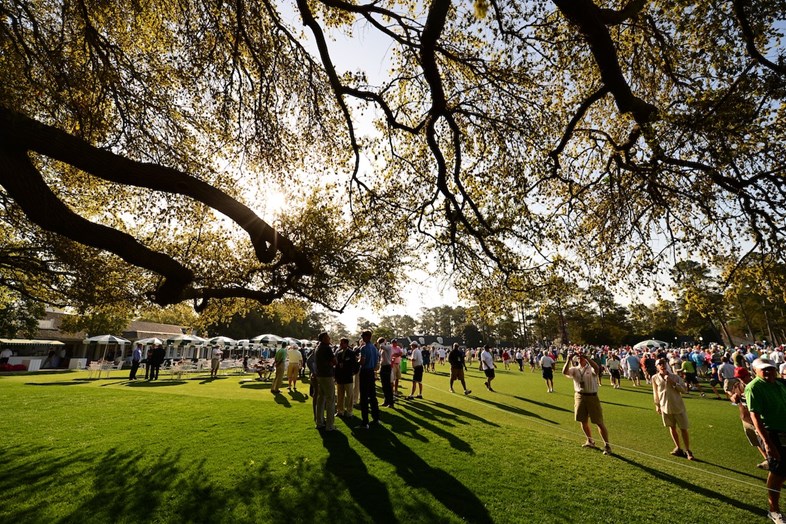
It is the iconic meeting spot at the Masters. But what really happens under the Big Oak Tree at Augusta National?
It’s a crisp morning under the tree. Sir Nick Faldo is clad in his resplendent Green Jacket and holding court beneath the sprawling branches. Rory McIlroy’s manager Sean O’Flaherty shakes some hands. Geoff Ogilvy is here. So too Colt Knost. Tom McKibbin’s father Robin is wearing a smile the size of Georgia during his first Masters week. Viktor Hovland’s representative stops by for a quick chat, but has to rush off to an “11am followed by an 11.30”. Meetings in this analogue nirvana are arranged in evenings prior due to Augusta National’s famous no phones policy. Just make sure you’re somewhere under the tree.
A gaggle of LIV Golf executives natter away nearby in a tight circle. Oh, there goes Mark O’Meara. Dozens of Green Jacket members, agents, executives, media types, celebrities and family members also find themselves under the tree, looking busy in thoughtful conversation or at least pretending to be.
This, of course, isn’t just any tree, though. It is the Big Oak Tree. And for one week only at Augusta National, it also happens to be the fulcrum of the golfing universe.
With its wide trunk and gargantuan branches held up by thickset suspension cables, the tree is thought to have been planted in the 1860s, decades before Clifford Roberts and Bobby Jones began carving out their masterplan for this place. And it is somewhat miraculous that it is still standing.
Like this article? Click here to add Today’s Golfer as a preferred source on Google.
The Big Oak Tree has survived dozens of storms, most recently the devastating Hurricane Helene which swept through these parts two years ago. There are famous trees in golf – think the Lone Cypress at Pebble Beach and the fallen Eisenhower Tree that was once here to the left of the 17th fairway – but the Big Oak Tree continues to defy Mother Nature. It is at the epicentre of the Masters, situated between the famous whitewashed clubhouse and the first tee, just right of the locker rooms and interview area.
By the afternoon, the sun is beaming and the Big Oak Tree is a haven of shade. There’s a buzz outside the clubhouse as players linger for a chat. McIlroy’s father, Gerry, wanders past. His agent of yesteryear Andrew “Chubby” Chandler was once ubiquitous under this tree, his signage post for the most productive week of the year as he sweet-talked his way to money-spinning contracts with myriad sponsors.

Elsewhere Bryson DeChambeau is signing some autographs for excitable pass holders. Over by the famous green and white parasols adjacent to the practice putting green, Xander Schauffele’s father Stefan is oblivious to the fuss, chugging a large glass of red and entertaining some friends on the other side of the rope.
Rafael Nadal attracts plenty of attention after spending a morning following McIlroy around Augusta. Meanwhile Mark Darbon, the R&A chief executive, is enjoying one the perks of being one of the game’s newly appointed custodians, taking in his second Masters. He’s armed with a notebook, having just moved on from some more small talk with an elderly member. “It’s a melting pot,” he says, pointing out that the phone ban removes distractions in what is a perfect setting to engage.
It is worth noting, however, that this spot is predominantly reserved for schmoozing, gossip and productive chat. Anyone who is anyone in the golf industry gathers here, plenty of whom just want to be seen. Most of the serious business – federation and world ranking meetings between the real kingpins – is getting fleshed out just a few hundred yards away, in a secluded building reserved by Augusta National down the right side of the 1st fairway.
Still, patrons on the grounds can wander right over to the tree’s perimeter and a fascinating few minutes can be spent playing golf’s version of Guess Who.
The most exclusive spot at the Masters just happens to be its most timeless, natural setting.