
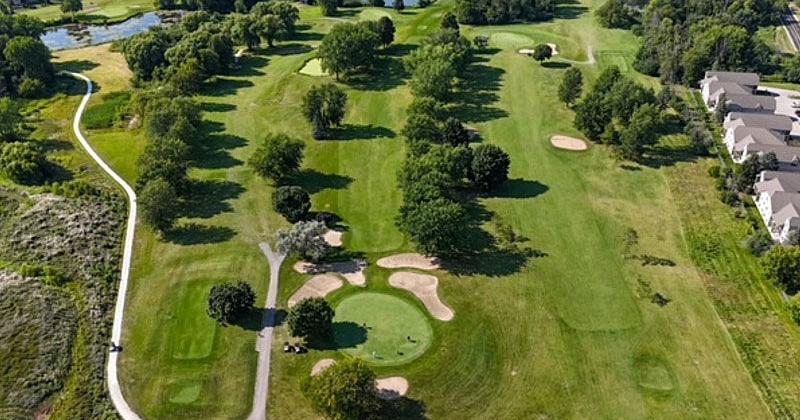
You know the feeling of pulling into a familiar parking lot, grabbing your bag and heading to the first tee. For golfers who played Foxboro Golf Club in Oregon or Lake Mills Golf Club, that routine is already gone or under serious threat. At Pewaukee Golf Club and Blackstone Creek Golf Club in Germantown, it may not be far behind.
Wisconsin golf is booming. Golfers played 11.24 million rounds in the state in 2023, participation has grown for seven consecutive years and Milwaukee County alone recorded a record 388,470 rounds in 2025. The tee sheets are full. And yet four courses in the greater Milwaukee area are facing real questions about whether they’ll be here in a few years — not because golfers have stopped playing, but because the land the courses sit on has become more valuable to developers than to golf operators.
These aren’t destination courses or private clubs. They’re the kind of places where people learn the game, join a league, bring their kids for the first time or squeeze in nine holes after work. Losing them doesn’t show up in the statewide rounds-played numbers right away, but it quietly erodes the foundation the sport is built on.
Foxboro GC, Oregon

Foxboro Golf Club
Foxboro Golf Course is confirmed open as an 18-hole course through 2026, after community pushback paused redevelopment plans earlier this year. Developer Glenn Hofer did not respond to requests for comment from Wisconsin.Golf, but issued a public statement in January: “I stated in the meeting that I am going to now take a step back and look at all the options for the golf course. I will continue to gather feedback from the neighborhood.”
Hofer has described the course as not financially sustainable, citing declining business support. That characterization has been disputed locally, with community members pointing instead to years of deferred investment as the root of the course’s struggles. Residents have been vocal in pressing village leaders for a transparent public process before any decisions are made. Hofer’s step back has bought the course another season, but the underlying questions of ownership, investment and long-term intent remain unanswered.
Lake Mills GC
Lake Mills Golf Club
Lake Mills Golf Club may represent the most complicated case of the four courses — a mix of financial strain, legal restrictions and competing visions for the property’s future.
Lake Mills Golf Club is closed. On February 4, the course posted a statement on Facebook that had been a long time coming: “At the end of last season, we had an electrical fire in our pumphouse that also spread to at least two satellite boxes. Coupled with the fact that our entire irrigation system is antiquated and needs to be replaced, we are looking at millions of dollars in upgrades. Unfortunately, we do not have the money. Sadly, we made the decision that we will not be reopening this spring.”
Co-owner Katye Chwala describes a situation that had been deteriorating for years before the fire forced the issue. The course has been on the market for five years with no viable offers — only a few land contract proposals and what Chwala describes as a low-ball bid from someone who assumed the owners were headed toward bankruptcy.
The asking price, she says, is actually less than what the owners put in: the purchase price plus nearly $2 million in building and course improvements, plus a new fleet of golf carts.
“The course has been struggling, in general, for as long as the golf industry has been struggling,” Chwala told Wisconsin.Golf. She’s not the first to say that. The two owners before her faced the same wall — one went out of business, one declared bankruptcy.
The owners twice formally approached homeowners around the course for support — and were rejected both times. In 2020, they proposed forming a golf course association that would have secured the course’s future permanently. That offer was also turned down.
“We thought the community would support us,” Chwala said, “but only about 10% of the homeowners around the course have been willing to help.”
The bottom line, she says, is straightforward: “If you want to keep a golf course in the community, you have to support it, especially in today’s economy. Even though golf play is up, the costs of running a golf course have gone through the roof since Covid.”
Developer David Werning of Loos Homes/Gremar came into the picture after the course had been on the market for five years without a golf operator stepping up. His proposal for the 144-acre site would include approximately 150 to 160 single-family home sites while preserving roughly 80 acres as green space or potential parkland — with the possibility that another group could use that acreage for a 9-hole course if someone was willing to fund the upgrades. He also plans to sell the existing clubhouse and restaurant to an experienced operator.
Before bringing the concept to the Plan Commission, Werning hired a public affairs firm to canvass 163 neighboring households and hosted a public meeting; he says the feedback led to more buffer green space being added to the plan. “Our proposal represents Plan B — an attempt to solve a problem that has gone unresolved for half a decade or longer,” Werning told Wisconsin.Golf.
The Lake Mills Golf Course Association sees it differently. President Kirk Grundahl emphasizes that the association is actively pursuing alternative buyers and exploring new ownership models, and that the public attention on the course has already generated serious interest — three investor conversations and one in-person meeting of six individuals within a single week.
The association’s mission, Grundahl says, is practical rather than sentimental: “Given the 99-year history, preserving the golf course isn’t due to nostalgia. It is a practical investment in recreation, health, environmental beauty, and the small-town quality of life that makes Lake Mills special.”
The path forward runs through the city. Any rezoning requires the Plan Commission to first approve a Future Land Use map amendment — a step that triggers a public hearing. The January 20 meeting produced no action, pushing the process to a special Plan Commission meeting March 19.
Adding further complexity is a dispute over subdivision covenants attached to the property. A 1994 Declaration of Covenants includes language stating certain outlots “shall at all times be used exclusively as a golf course or courses.” The current owners say a later amendment allows other uses with city approval, while members of the Lake Mills Golf Course Association argue the original restrictions should still protect the course.
Lake Mills is the most legally and procedurally complex of the four courses — and the one where the outcome is most genuinely uncertain. The course is closed, the developer is ready and a 99-year community asset hangs in the balance while lawyers, planners and neighbors prepare to make their cases.
Pewaukee GC
Pewaukee Golf Club
Pewaukee Golf Club (formerly Willow Run) is confirmed open for the full 2026 season, but its long-term future may be the most advanced toward resolution of the four courses profiled here.
Delafield-based Land by Label Development Co. has had an active proposal before the city of Pewaukee since 2024, already revised twice, with the latest version calling for 25 for-rent single-family homes on 19 acres north of the Meadowbrook Village Condominiums and Milkweed Lane. Emily Cialdini, VP of Development at Land by Label, declined to comment, citing a policy of not responding to media requests prior to closing on a deal.
What makes Pewaukee’s story distinct is the question of what’s driving the redevelopment.
Alyssa Schmitt, the general manager at Pewaukee GC, has given no indication the course is struggling operationally; her communications emphasize responsible stewardship and a quality experience for golfers this season. The redevelopment interest appears rooted not in financial distress but in the long-term capital investment required to keep a 142-acre championship course competitive, weighed against the underlying value of the land itself.
Schmitt describes the club’s posture in the meantime as deliberate stewardship: “Our focus remains on operating the course responsibly and providing a quality experience for golfers this coming season. Pewaukee Golf Club serves as accessible green space and a gathering place for the community.”
She also highlights the club’s role as an employer spanning students and early-career workers to older employees who value the routine, social connection and sense of purpose the job provides. This is not the first time redevelopment has been discussed for the property, she notes — and until something definitive changes, the club intends to operate as it always has.
Blackstone Creek GC, Germantown
Blackstone Creek Golf Club
Blackstone Creek Golf Club in Germantown has a reprieve for now, but its future remains an open question. Mequon-based developer The Heimat Group has proposed redeveloping the course into a residential neighborhood, a plan that has evolved over the past year. The most recent iteration involved a proposed land exchange between Heimat and the village, which came before the Germantown Village Board at its February 16 meeting as a discussion item.
No formal action was taken. According to the meeting minutes, board members discussed the land appraisal, development concepts, funding and community concerns. Several residents spoke in opposition during the public comment period, with flooding cited as a recurring worry; multiple commenters noted the course has flooded repeatedly in recent years, and they expressed concern that any development on the property would worsen an already difficult drainage situation.
Neither The Heimat Group nor the course responded to requests for comment from Wisconsin.Golf. With no action taken and no clear path forward, Blackstone Creek continues to operate for now — but the underlying redevelopment interest hasn’t gone away, and the course’s long-term future remains unresolved.
The Bigger Picture
Wisconsin golf industry veterans see these four courses not as isolated cases, but as part of a pattern that golfers across the state should pay attention to — particularly those who rely on accessible, daily-fee public courses to play the game.
According to the National Golf Foundation, Wisconsin has 528 courses — ninth-most in the country — with 88% of them public. Last year’s closures statewide amounted to less than 1% of that total supply, a figure the NGF says does not indicate a meaningful trend. The NGF notes that supply has stabilized nationally following a significant contraction after the Great Recession of 2008.
But what’s being lost isn’t evenly distributed.
David Brandenburg, President of the Golf Course Owners Association of Wisconsin and Golf Course Manager at Rolling Meadows Golf Course in Fond du Lac, has spent 41 years in the industry and puts the driving force plainly: “The courses are worth more for development than they are as a golf course. As owners want to transition into retirement, they realize their biggest payday will come by selling the course for development.”
Brandenburg points to a course in his own community — a family-owned par-3 and executive layout — where the owner wants it to stay a golf course but will likely get more selling it for development. The entry-level angle is what concerns him most. “Some of the courses we are losing are considered entry-level courses, such as the par 3 or executive courses,” he said. “This may affect how golfers enter the game. The other courses have to be cognizant of that and welcome beginning and returning players with forward tees and especially friendly and understanding staff.”
Rusty Grimm, owner of Rustic Golf Properties and operator of six public courses in Wisconsin, has a clear framework for what makes a course worth saving: “A golf course is worth saving when it has a committed local base of golfers and it has structural potential to be financially viable with proper management.”
For operators trying to turn things around, his advice is direct — “Control costs aggressively. Improve conditions first. Adjust pricing to appropriately reflect the value of the course.” And beyond the numbers, Grimm watches for something less tangible: “The culture of the property indicates whether the course is thriving. Are staff happy, are the customers enjoying their rounds, is there positive energy and talk in the community about the course.”
Both Brandenburg and Grimm point to the same underlying truth: the courses most at risk aren’t necessarily the ones struggling with participation — they’re the ones on land developers want, owned by people ready to move on. As Brandenburg puts it, the two factors converge: “The property is worth more to the current owner for development than golf, and owning and managing a daily-fee golf course is a huge undertaking.” When those two things are true at the same time, a course is vulnerable no matter how full the tee sheet is.
Looking Ahead
The stories of Foxboro, Lake Mills, Pewaukee and Blackstone Creek don’t have clean endings yet. Each is still being written — in planning commission hearings, ownership negotiations and community meetings where golfers and neighbors are showing up to fight for something they don’t want to lose.
Wisconsin golf is thriving by every measure — more rounds, more players, more diversity in who’s picking up a club. That’s worth celebrating. But it also makes the loss of accessible, community-rooted courses more consequential, not less. Every golfer who learned the game on a modest daily-fee course, every junior who practiced at a local course after school, every league player who found their people at a neighborhood nine — they got there because a course like one of these four existed and stayed open.
What Katye Chwala learned at Lake Mills cuts to the heart of it: even a course with history, community and genuine goodwill can’t survive without the tangible support of the people who say they value it.
Wisconsin golfers have shown up in remarkable numbers over the past five years. The courses that make it through the next decade will be the ones where that support extends beyond the tee sheet, where golfers treat the places they play as worth protecting, not just worth visiting.