
Yes, the technology and material quality has come on in leaps and bounds during that time, but the position of the steering wheel and dials relative to the driver’s seat, the light panel by your right knee and the centrally located air vents have remained largely the same throughout the car’s life.
It’s a shame that there aren’t as many body styles for the Golf as there used to be. The three-door hatchback disappeared while the Mk7 was still in production, and as for the estate, this did return for the eighth generation, but since the facelift, it’s only been offered in left-hand drive markets.
At least the performance models make up for the lack of variety elsewhere. The Golf GTI is still a great all-round hot hatch, and the Edition 50 builds on that with more power and a sharper focus. Or you could go all out with the Golf R for ultra-rapid thrills.
Advertisement – Article continues below
Latest Volkswagen Golf deals
Head-to-headOn the road
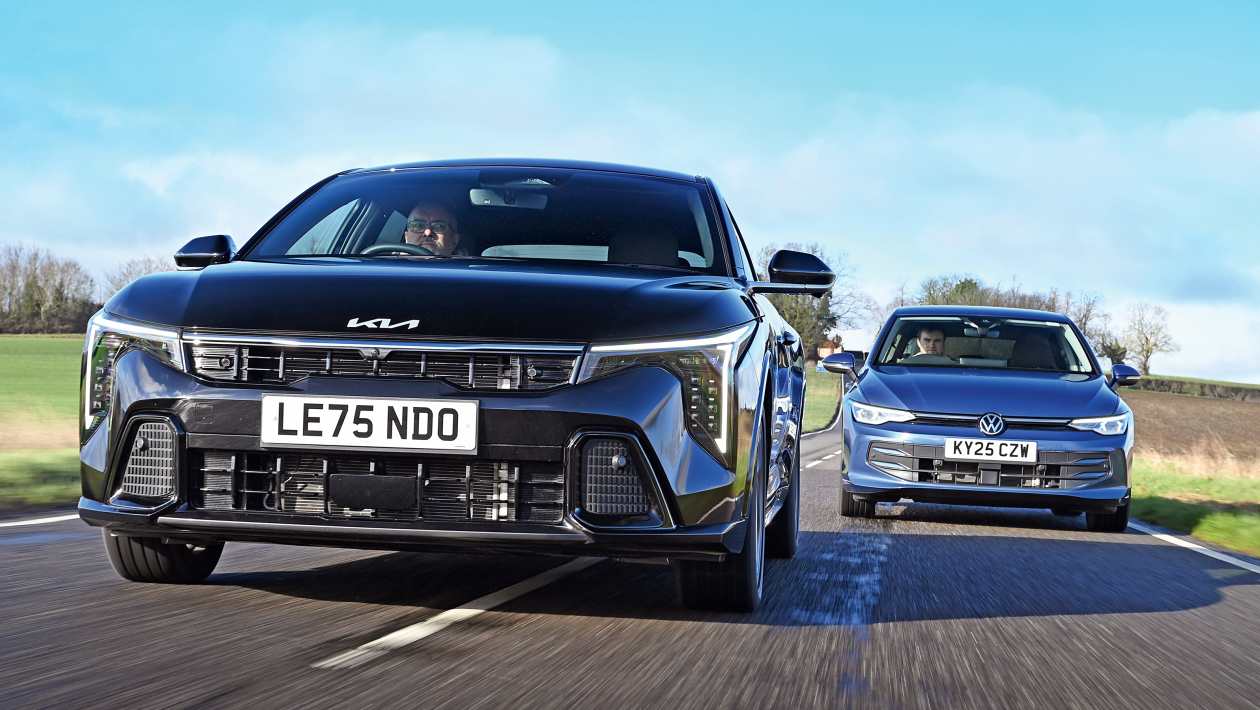
While both cars make just under 150bhp and the same 250Nm of torque at 1,500rpm, the 1.5-litre VW feels more tractable and punchier than the 1.6-litre Kia. Less weight and a more responsive automatic gearbox help it. The Golf is more enjoyable in corners, too, but without offering sacrifices in terms of overall comfort. The K4 feels soft and wallowy in comparison.
Tech highlights
Fuel-saving mild-hybrid tech is offered on both cars, although it’s only the 1.0-litre version of the Kia that comes with it, and it’s not available with a manual gearbox on the Golf. VW’s large touchscreen takes pride of place in the Golf, and it’s easy to use thanks to its size. The K4’s set-up is shared across the Kia line-up – it’s okay to use once you get used to the layout.
Price and running
The K4 has lower list prices than the Golf, but there’s less variety on offer, with the biggest engines only sold in higher GT-Line and GT-Line S specs, while options are non existent. The VW is only slightly pricier than the Kia, while it offers better everyday fuel efficiency. We managed around 47mpg during our time with the 1.5 eTSI, compared with just under 40mpg in the K4.
Practicality
Larger overall dimensions give the Kia a practical advantage. There’s more leg and shoulder space for passengers in the back, and the 438-litre boot is 57 litres larger than the Golf’s. There are some quirks, though. A low roof means access isn’t quite as easy as in the VW, plus there’s a higher boot lip and the button release for the tailgate is offset to the right of the reversing camera.
Safety
Kia has yet to submit the K4 to Euro NCAP’s tests, but it shares tech with the Kia Niro, and it comes as standard with the safety pack that car needed to earn a five-star rating. Steering-wheel buttons can deactivate the lane assist and speed-limit warning, while in the Golf it’s easy to select the safety-systems menu via a shortcut at the top of the touchscreen.
Ownership
With a seven-year warranty as standard, Kia still leads the new-car market for peace of mind. The 100,000-mile distance limit means you can cover 14,000 miles a year. VW’s three-year/60,000-mile package looks basic, but you can extend the cover to five years at extra cost. Things even out in terms of roadside assistance, with 12 months of cover from both companies.
VerdictWinner: Volkswagen Golf
While it’s not quite the class leader it once was, the Volkswagen Golf still has a lot going for it, and the most recent updates for the Mk8.5 have helped to iron out some of the issues that pegged the original car back.
Advertisement – Article continues below