
ORLANDO, FLORIDA | It is natural to feel sadness when a friend sells a place he has possessed for a long time. Especially when it’s one on which you have made some pretty special memories yourself.
And it can certainly hurt when the new owners bring in bulldozers that for all intents and purposes raze a spot you have come to know and love.
But change can also be a good thing, and I was cheered when I recently considered last spring’s sale of Pat Ruddy’s highly acclaimed European Club south of Dublin, Ireland, and the total revamping of the club’s layout that began in December.
For one thing, there was the joy in knowing that Ruddy, an amiable Irishman who has made his living as a golf journalist, publisher and course designer, is reported to have received nearly $40 million for that layout, which is arguably the best of the 20-odd tracks he has designed. That’s quite a payday for a man whose hands have been alternately stained with ink and covered with dirt throughout his working life – and who heretofore could have only dreamed of such a payoff.

I was also happy to learn that in addition to enriching the highly respected Ruddy by buying his course and club, the new owners, a father-and-son duo from County Kildare named Raymond and Nicky Conlan, were investing millions of dollars they had made from the sale of some of their car dealerships in a property that needed serious upgrading. To oversee those efforts, they engaged the course architect Kyle Phillips, who is based in northern California and best known for his work at Kingsbarns outside St Andrews, Scotland, the idea being to make what the Conlans have renamed the Brittas Bay Club, after the body of water the links borders, at least as good if not better than the original.
Work began soon after they officially closed the club in early December, with the reopening planned for May 2027.
Truth be told, there is a lot to like about those developments, and whatever concerns golf aficionados might have felt about the sale is being replaced by excitement about the reimagined course that is going to take shape on that land and the approach that the new owners are taking.
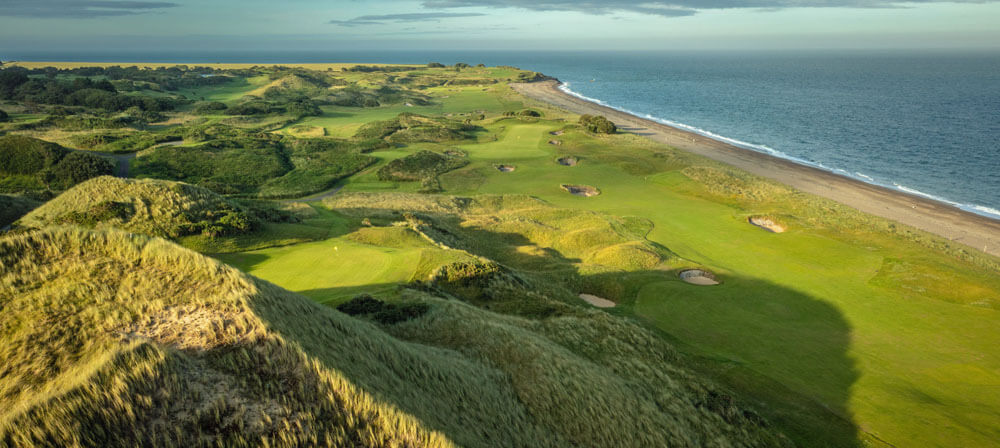
 The golf course at the Brittas Bay Club overlooks its namesake body of water. Mel Maclaine photo
“Pat is a legend, and while he is not involved with what we are doing, which is just how he wanted it, we’d like to think he is happy with our plans,” said 34-year-old Nicky Conlan, an avid golfer whose grandfather opened the family’s first auto dealership in 1965.
“There is a lot to do,” added Conlan, who attended last month’s PGA Show in this central Florida city in large part to share news about the work being done at Brittas Bay.
“We believe we are treating the site with huge respect, given Pat’s legacy. It is not easy to make big changes like these. But we believe they are the right thing to do.”
Ruddy opened the European Club in December 1992. Set on nearly 200 acres, the par-71 course was notable for its brawn, with only two par-5s, a trio of par-3s and 13 par-4s, all of which measured more than 400 yards from the tips. There was a delightful quirkiness to the track, too, with a pair of bonus holes in the form of two par-3s (Nos. 7a and 12a).
 Pat Ruddy opened the European Club, one of about 250 seaside links courses in the world, in 1992. Oisin Keniry, R&A via Getty Images
Equally beguiling was the warm and welcoming atmosphere that Ruddy established there, and he was forever mingling with his golfers, whether sharing a pint in the clubhouse bar or showing off his extensive golf library on the second floor of that building. Ruddy was also known for taking visitors around the golf course in his car, driving across tees and down fairways as he explained the design strategy of certain holes and offered suggestions as to the best ways to play them.
The European Club quickly climbed to the top of the most reputable golf course rankings and became a popular stop on the Dublin golf circuit, especially for those visiting from the U.S. If there was any knock on the layout, it had to do with its rather high degree of difficulty, especially when the wind blew and Mother Nature lashed the property with rain. But people for the most part relished their rounds there. And Ruddy delighted in having them there.
But as he approached his 80th birthday, Ruddy realized it was time to sell. Given the high esteem in which the European Club was held by golfers and the fact that there are only some 250 seaside links in a worldwide course universe of 38,000 layouts, he rightly figured his place could fetch a very good price. According to news reports of the sale, it certainly did.
In making the purchase, the Conlans appreciated that they also needed to pour more money into a club that felt a bit frayed in places. And they began doing so almost immediately.
“We needed a new irrigation system,” said Nicky. “The tees, fairways and greens all needed to be regrassed and the bunkers rebuilt. We also needed to look at the actual course design itself, which is why we hired Kyle after interviewing several architects. We liked his vision for the property and loved the work he had done at places like Kingsbarns.”
 Course designer Kyle Phillips says golfers will be able to see the waters of Brittas Bay from most of the holes on the course. Courtesy Kyle Phillips
“It is an amazing site for links golf,” said Phillips, a former associate of Robert Trent Jones Jr. whose portfolio of roughly 60 projects also includes renovations of such notable places as the Cal Club in South San Francisco, Morfontaine outside Paris and Valderrama in the south of Spain as well as original designs in Morocco, Sicily, Scotland, South Korea and the U.S. “And among the other changes we are making are widening the fairways that were quite narrow in places, expanding some of the green surrounds.”
Conlan says that drawings for a revamped course were completed by the end of December and that when all is said and done, the layout will be 18 holes – and will not include any bonus holes. Par will be 72, and the mix will include four par-5s, four par-3s and 10 par-4s of varying lengths, with at least one of those being drivable.
“By and large, it will be a completely new course,” Conlan added. “And one that we hope will be more accessible to the 20-handicapper while remaining a true challenge for the tour professional or elite amateur. There will be sea views from every hole, and we will get people to the water much quicker than in the past, bringing them there by the fifth hole and not making them wait until the 12th, as was the case in the past.”
At the same time, the Conlans plan to redo the clubhouse and entrance to the new Brittas Bay Club, which will feature a tern as its logo due to the seabirds’ presence along the beach of the 13th hole.
“And we will certainly look at the possibility of lodging down the road,” Nicky added.
Top: The site of the new Brittas Bay Club is classic linksland. Mel Maclaine photo
© 2026 Global Golf Post LLC