

In an era of swing labs, launch data, and aesthetic perfection, Scottie Scheffler has built dominance on fundamentals, feel, and doing things his own way. The World No.1’s approach is refreshingly simple – and surprisingly transferable.
No one is rushing to put him on the level of golf’s two greatest ever players yet – but the numbers are starting to make the debate a genuine one.
With his most recent victory at the American Express, Scottie Scheffler became the fastest player to 20 PGA Tour wins since Tiger Woods and Jack Nicklaus.
Only the three of them have reached 20 PGA Tour titles and four majors before turning 30.
He owns the longest active made-cut streak on the PGA Tour, with 68, chasing down – you guessed it – Tiger Woods and the longest ever streak of 142.
Scheffler’s 67.99 scoring average last season was almost a full shot clear of the next best player and within touching distance of Woods’ all-time PGA Tour record of 67.79.
“I never thought in my lifetime I’d see a player as close to Tiger as this man is,” said veteran tour caddie Jim ‘Bones’ Mackay.
You might think there’s little to be gained from comparing the world’s best player to your own game, but there is plenty we mere mortals can learn from Scheffler to become better golfers.
In an era obsessed with swing aesthetics, launch data, and endless technical tweaks, Scheffler has built his dominance on fundamentals, simplicity, and a handful of personal quirks most players either ignore or outsource.
Here are four things he does differently to almost everyone else on Tour – and what they can teach the rest of us.
Like this article? See more TG content in your feed! Click here to add Today’s Golfer as a preferred source on Google.
 1. He obsesses over his grip
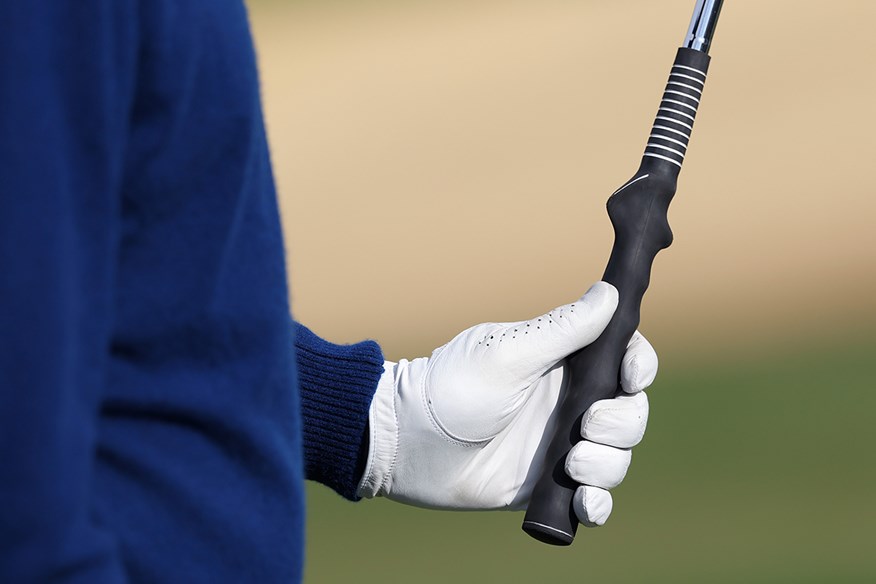
Spend five minutes watching Scheffler practise and you’ll see something that would have been laughed off a tour range a decade ago: a moulded grip trainer attached to one of his spare clubs.
It’s a $10 training aid most amateurs buy, use once, and abandon.
Scheffler uses it every day.
Former US Open champion Geoff Ogilvy summed it up perfectly on a recent episode of the Subpar podcast with Colt Knost.
“He keeps it so simple. Did we ever think we would see a moulded grip on Tour? We’d have been laughed off the range. But it’s so smart. He gets his alignment right and his grip right every morning, so he’s starting in the same place every single day. The magic is that it’s the same every day. Because your grip drifts.”
The golf grip is like watering a plant – neglect it and it won’t suffer immediately, but leave it too long and it will slowly wilt until one day you’re left wondering what went wrong.
Scheffler knows the importance of getting the small details right.
In an age dominated by ground reaction forces and 3D swing analysis, Scheffler is guarding the most basic fundamental in the game.
And it shows.
“What impresses me most is his clubface control,” says three-time major winner Jordan Spieth. “He’s maybe the best there’s ever been in terms of clubface control.”
That clubface control is rooted in the grip.
“It’s too obvious,” adds Ogilvy. “We thought it was too simple, but it’s genius. He’s cracked the code.”
What you can learn
Before you chase a new move in transition or try to shallow the shaft like a YouTube tip says you should, check your grip.
If it’s too weak, too strong, or worse, inconsistent, you’re building a swing on unstable foundations.
The grip has quietly gone out of fashion in some coaching circles. Some argue that there are so many different grips working on tour that trying to force everyone into a textbook one does more harm than good. But ask any of the all-time greats and they’ll hammer home the importance of getting the fundamentals right. Nicklaus famously said that the three most important parts of the golf swing were “Setup, setup, and setup.”
Getting the basics right might not feel exciting. But the world No.1 is proving it’s still the most reliable way to build elite consistency.
A simple moulded grip ensures proper hand and finger placement for golfers, aiding consistent grip alignment during swing practice.
If you don’t have a spare golf club to use the moulded grip trainer with, here’s an alternative designed to clip over the top of any grip.
2. He plays golf, not golf swing
Scheffler’s unorthodox swing and footwork have been dissected endlessly. His foot slides. His lower body looks chaotic. It’s miles from textbook.
He doesn’t care.
“When I first came out on the PGA Tour, I think my footwork was kind of how I was known to people,” says Scheffler. “I think a lot of people may have viewed it as not that good of a trait in my golf swing. Some people said that it would be hard for me to be consistent, hard for me to play under pressure with that much action going on in my swing.”
Scheffler, thankfully, didn’t listen to any naysayers.
“I’ve had the same coach since I was seven years old, and he’s taught me for 20 years now how to swing a golf club. He hadn’t wanted to change it yet, so I don’t think we’re going to change it anytime soon.”
Ogilvy believes that Scheffler’s focus on results over aesthetics is central to his dominance.
“He’s just hitting the golf ball at the target, and he seems to do that better than anyone I’ve ever seen,” he says. “He’s more target-conscious than anyone since maybe peak Tiger. Scottie doesn’t care how he’s swinging it – he just cares where the ball goes. We all are a little bit vain about how it looks, but he doesn’t care at all – he just wants the ball to go where he wants it to go so he can beat you.”
That’s rare in modern golf. With slow-motion cameras in every pocket and millions of swing videos online, golfers at every level are hyper-aware of how their motion looks. Aesthetic perfection has become confused with athletic effectiveness.
Jim Furyk built a Hall of Fame career with a swing once described as resembling “a one-armed golfer using an axe to kill a snake in a telephone booth”. Furyk later revealed that he didn’t see much footage of it until he was already established on Tour – and by then it was too late to care.
Scheffler falls into the same category. It may not be pretty. It’s certainly not textbook. But it is brutally effective.
What you can learn
Not every swing quirk needs fixing.
If the ball flight is predictable, the strike is solid, and you can repeat it under pressure, cosmetic changes may do more harm than good.
Improvement isn’t about chasing positions. It’s about producing outcomes.
Focus more on where the ball goes than how your swing looks on camera.
The point isn’t to never try improving your swing – just be careful who you listen to, what you try to do with your natural motion, and why.
 3. He doesn’t lean on a launch monitor like everyone else
Walk down a PGA Tour range and you’ll see a launch monitor behind every player.
Except one.
“He is the only one that doesn’t have the drama box, aka the TrackMan, Thursday through Sunday before his round,” says former PGA Tour player Colt Knost.
While others scroll through spin rates and launch angles, Scheffler warms up by watching ball flight.
“He literally just goes out there to warm up and hit shots,” adds Knost. “Everybody else is paying attention to what’s going on with all the numbers and everything. And he’s like, dude, I’m here to play golf.”
Technology isn’t the enemy. Launch monitors are extraordinary tools, and Scheffler uses them when it suits him. But his refusal to lean on one during competition week is striking.
“That’s what Jack [Nicklaus] always said – the range wasn’t to find your golf swing, it was just to find a rhythm for the day,” Ogilvy explained. “That’s what Scottie does.”
Others have taken similar approaches. Recent LIV winner Anthony Kim has openly said he doesn’t own or regularly use a TrackMan, while Nelly Korda resisted getting one for years because she is such a feel-based player.
Most of golf’s greats built legendary careers without ever seeing a spin rate.
“I love that Scottie has pared it down to the simplest point, and usually everybody ends up copying the best players,” adds Ogilvy. “I can’t imagine Tiger would have had the TrackMan out there much.”
Scheffler’s approach is a reminder that information is only useful if you don’t become dependent on it.
What you can learn
Launch monitors are more affordable and accessible than ever. That’s a good thing.
But don’t let them replace your own feedback.
Learn to watch your ball flight. Learn to feel strike quality and impact location. Learn to self-correct without a screen telling you what just happened.
Under pressure, on the course, you won’t have a data readout. You’ll have your eyes, ears, and instincts. Being able to self-correct during a round is what separates golfers who let the course beat them up until they can get back to the range and refind their swing from those who can turn a bad day into one that helps them win a tournament.
 4. He plays a ball unlike anyone else
This one sounds trivial. It isn’t.
Many golfers are superstitious about the number on the golf ball they use. Some will only use a ‘one’, others avoid odd numbers, and some refuse to use a ‘three’ as they think it will encourage three-putts. But few take Scheffler’s approach.
He’ll only use balls numbered five, six, seven, or eight.
Scheffler’s Ryder Cup teammate Justin Thomas clocked it first.
“Does anyone else think it’s weird that Scottie uses high numbers?” he asked during a broadcast of the 2024 RBC Heritage. “I don’t know if I’ve ever seen an elite player use high [numbered] golf balls.”
“Weird” is something Scheffler isn’t afraid of, and, like with everything he does, there’s a reason.
During college, Scheffler twice played the wrong ball in competition. So he eliminated the possibility. He switched to numbers hardly anyone else uses.
Problem identified. Problem removed. That’s it.
Playing a number eight ball didn’t make him world No.1. But it tells you something about how he thinks. He systematically removes avoidable errors, however small.
He’s comfortable doing things differently if it gives him clarity.
What you can learn
Choosing a golf ball isn’t about playing what your mate plays or even the world No.1.
It’s about what works best for you.
Spin profile. Feel. Trajectory. Confidence.
And if a small tweak – even something as simple as an unusual number or how you mark it – gives you clarity and confidence, it’s worth doing.
Golf improvement isn’t always about huge swing overhauls. Often it’s about eliminating small sources of doubt.
The bigger lesson
Scheffler is the most dominant player in the world right now.
But you don’t need his swing speed or talent to copy what makes him so great.
You don’t need to start only playing high-numbered balls or doing the Scottie shuffle with your feet on every shot to borrow a bit of what makes him so special.
Scheffler’s foundation is built on fundamentals, self-trust, and doing things his own way.
He guards his fundamentals.
He prioritises outcomes over aesthetics.
He trusts his eyes over numbers.
He eliminates small errors that others ignore.
“Scottie is refreshing in this day and age,” says Ogilvy. “He probably sits back and laughs because everyone’s making it harder than it needs to be.”
And that might be the biggest lesson of all.