
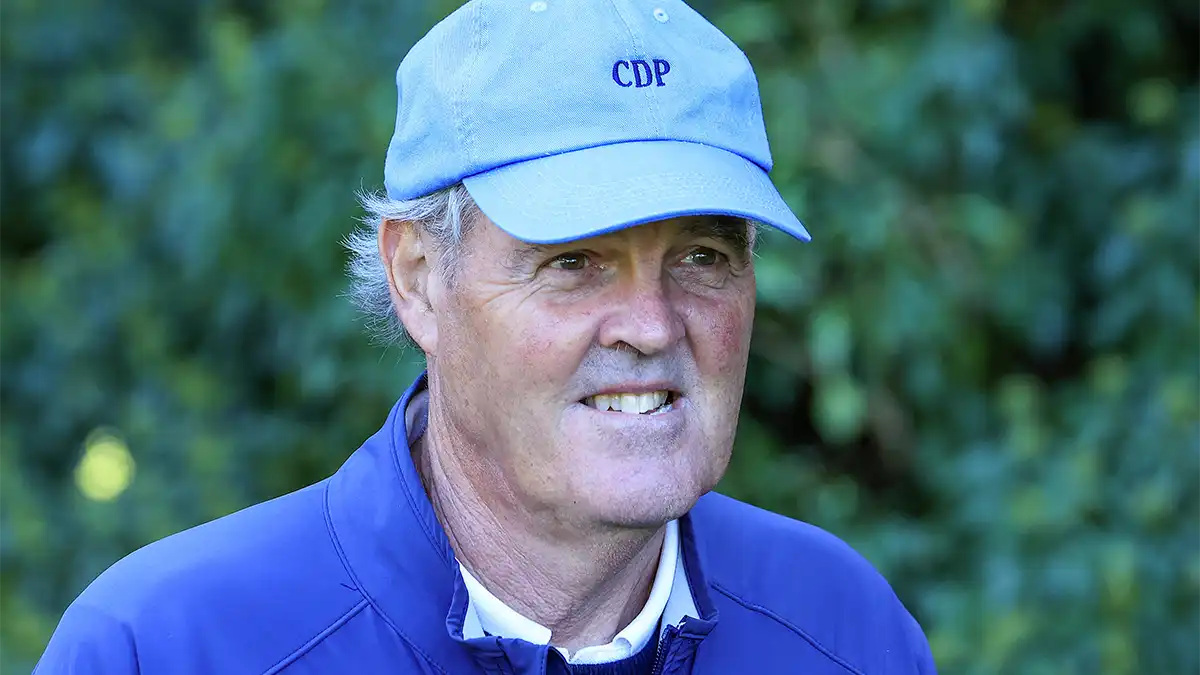
Australia’s Mike Clayton has worn just about every hat in the game. A former European Tour professional, he’s since become one of the world’s most respected golf course architects, an occasional tour caddie, sharp-eyed writer and forthright pundit. This is his take on the game.
It is difficult to ask Mike Clayton a question he hasn’t fielded from members of the media before, during a career that spans decades, continents and includes victories on the European Tour, Asian Tour and PGA Tour of Australasia. His playing days preceded a second chapter as a course designer, where he has worked on needle-moving new layouts and restorations. In other words, he’s heard most of the questions.
In the media and online, Clayton’s thought-provoking takes on a variety of corners of the golf world draw plenty of admiration and, occasionally, criticism. He takes it all in his stride because – like his work for the Clayton, DeVries & Pont (CDP) course design firm – his mission is to make golf more interesting. Why? Well, it originates from Clayton reading Dr Alister MacKenzie’s 13 Principles of Golf Course Design, an index featured in two of the Scot’s published books. MacKenzie urged the need for interesting shots and courses to sustain the future of the game. It’s only fair, then, that we attempt to ask Clayton interesting questions.
Including this one: “Do you think, in today’s age, that the Melbourne Sandbelt, as a collection of courses, is as important for Australia’s golf credentials around the world as any current tour player?”
“Post-Greg Norman, it probably is… interesting question,” Clayton replies. “You’ve got to throw Tasmania in there, too. The fact that Tasmania [will probably have] four courses in the top 10 in Australia is pretty amazing, which was inconceivable even 30 years ago. Yeah, I think Australia’s reputation for world-class golf-course architecture is really important. Lots of people come down now to play in Australia. But 40 years ago, Royal Melbourne was the only course that was really going to impress an architecture buff.”
For the rest of the interview, the man who is adamant that golf needs to be intriguing did not disappoint.
▶ ▶ ▶
I’ve always been interested in golf courses. When I saw Royal Melbourne for the first time in 1972 at the World Cup of Golf, and then I played it in 1974, I instinctively understood how great it was. Everyone back then thought everything in American golf was great; better than everything in Australia. Maybe I didn’t understand right away that Royal Melbourne was arguably the best course in the world, or in the top three, but I knew it was an amazing course.
▶ ▶ ▶
I’ll tell you this, and this will be a bit controversial. We (CDP) work at Green Acres Golf Club now. [When I was growing up], the seventh was a 90-degree [dogleg] around a pond. I couldn’t get to the corner. So, I’d hit 4-wood, then I’d chip up to the corner like 30 metres. Then I could get to the green, because it was around a pond lined with big trees. As a 12-year-old, I instinctively understood that was a bad hole.
▶ ▶ ▶
I was always interested in course design and the history of golf. The more I played, the more I became interested in architecture, really.
▶ ▶ ▶
We lived on the back of Eastern Golf Club [which back then was located] in Doncaster. I’d jump the fence and play golf every day, really. I just loved to play. I thought it was such a cool game. Of course, Jack Nicklaus and Arnold Palmer and Gary Player would come down to Australia to compete, so you would watch them regularly. Bruce Devlin was a massive star when I was a kid. Peter Thomson was the older guy; he was 40 when I was 12, so he wasn’t that old, and he was always great to watch.
▶ ▶ ▶
Then you start competing, playing schoolboy golf and amateur golf. I won the Australian Amateur in 1978 and the Victorian Amateur in 1977 and 1981. There was a vibrant amateur scene in the ’70s in Melbourne, where all the best golfers played most of the tournaments. There were lots of tournaments to play in; way more than there are now.
▶ ▶ ▶
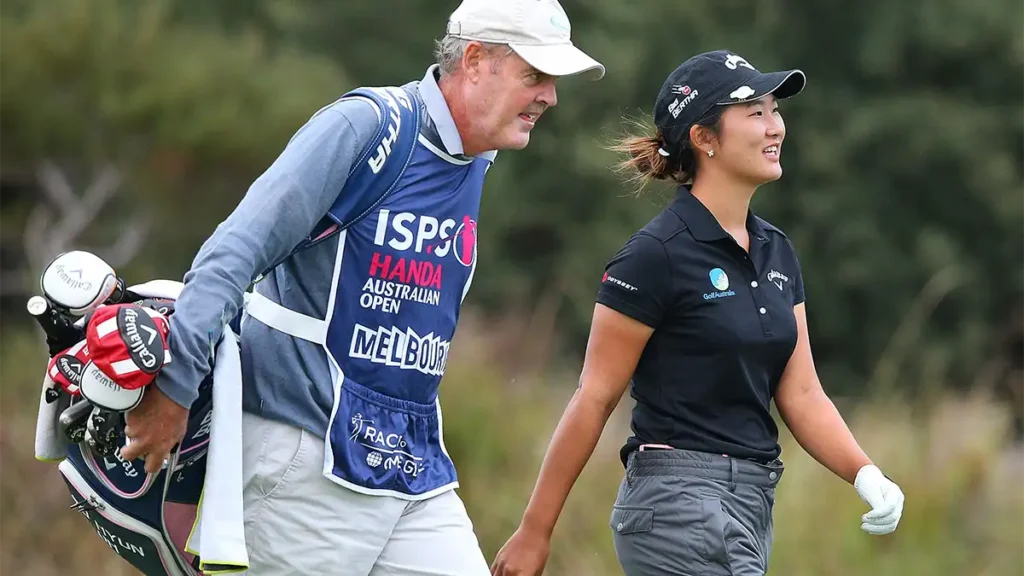
In 1984, the great Steve Williams worked for me, and in our first tournament together, I won my only European Tour title – the Timex Open at Biarritz Golf Club in France. How he came to caddie for me was a funny story: we were playing a practice round at the Tournament Players Championship at St Mellion in Cornwall in England. My caddie at the time bet that he could jump over a ditch with the bag on his back. We were playing a practice round with Sir Bob Charles and Frank Nobilo, if I remember correctly. My caddie tried to jump, and he almost made it, but didn’t and smashed his leg and couldn’t work the next week. Steve Williams was able to fill in.
▶ ▶ ▶
As we were leaving the range at Biarritz Golf Club, Steve said to me, “I’ve just watched you play a bit, and your concentration’s horrendous on the golf course. All I want you to do is concentrate on every shot. I don’t care how you play, just put full attention into every shot.” I won the tournament.
▶ ▶ ▶
The regular caddie fee on the European Tour was £120. I said to my wife, “I want this guy to caddie for me regularly. How about I offer him £200 a week?” So, he left a player called Michael King and worked for me the rest of the year, which was great. He was a fantastic caddie. Very insightful.
▶ ▶ ▶
That 1984 season on the European Tour was really enjoyable, because I had Steve working for me and I had some good results. About six weeks into 1985, Steve left me to work for Eduardo Romero, who was a tremendous Argentinian player. Then he caddied for Ian-Baker Finch. He would go on to caddie for Greg Norman, and then of course, Tiger Woods.
▶ ▶ ▶
If I could revive any tournament around the world? That’s an interesting question. Probably the World Match Play when it was eight players, 36-hole matches, but the best eight golfers in the world played in it. That was a great tournament, and it was at Wentworth in England. It was run by IMG, so Nicklaus, Palmer and Player played it. Peter Thomson, too. The guys who played well that year got invited but Nicklaus, Palmer and Player were the backbone of it for years. It was a mystical tournament to me; we used to watch it on TV and that was an amazing time in golf.
▶ ▶ ▶
In Australia, we had the Dunlop International and it was a great tournament. The backbone of the Australian tour, when I started out playing, were the three big tournaments: the Dunlop International, the Wills Masters and the Australian Open, and they were three great, end-of-year tournaments in November. I watched Gary Player in the 1970 Australian Open and I couldn’t believe it. You could watch one of the best players in the world with no ropes, walking on the fairway. That was incredible. That would be one thing I would love to revive: no gallery ropes at tournaments. So, in answer to your question, I would revive the Australian Open like it was in 1970 with no ropes.
▶ ▶ ▶
Which golf courses left an impression on me as a tour player that I came back to as a designer? Well, all the great Heathland courses in London, of which we played Wentworth and Sunningdale. Sunningdale was probably the best of them. We used to play the French Open at Golf de Chantilly, which was a terrific course, and I played the 1980 French International Amateur Championship at Chantilly. [Acclaimed Australian amateur] Tony Gresham beat me in the second round. I caddied for him and then he won the tournament. Later, we played a match against the French amateur national team at Morfontaine, which was also outside Paris. As a pro, every year we went back to Chantilly for the French Open, and I would go across to Morfontaine and play at least twice a week there. Even though I never played in a tournament there, Morfontaine left a great impression on me. It was such a beautiful place to play. It’s incredibly secluded. Amazing clubhouse. It has some really cool holes and Tom Simpson was a great course architect. It’s simple, great architecture with beautiful greens, great bunkers, interesting holes, it’s easy to walk, not a difficult course but still a fantastic course. It is the sort of course you could play every day for the rest of your life… with the forest, you didn’t see any of the surrounding world. It wasn’t like it was in the suburbs. It was in a forest. It’s a special place to play golf. Falsterbo Golfklubb, in the south of Sweden, is a wonderful classic links course. Real Club Puerta de Hierro in Madrid was a Harry Colt design I liked. The Open Championship courses were terrific. Moortown Golf Club in Leeds was a great course, which we played a little bit on the European Tour. The European Tour would find a fantastic commercial reason to go to a less-than-good golf course because it meant [the tour pros] played for more money. So, most guys thought that was a good thing. But I didn’t.
▶ ▶ ▶
We started the golf-course design business in 1995. I was reading more about architecture, so I was interested in it. I was also writing about course architecture and occasionally I was critical. And then 1996 coincided with me playing s–tty golf, losing my card, and we were 18 months into the design business. I was 39 years old, so it was perfect timing, really. I came home and started working on course design.
▶ ▶ ▶
If I look at our portfolio of golf-course designs or restorations, they’re all different and unique in their own way. But in our restoration of Victoria Golf Club, there is a lot of how I think the Melbourne Sandbelt should play. Recutting the greens back to the original shapes, restoring bunkers, restoring heathland, taking trees out that had been planted illogically in the 1950s because people thought you should plant trees. I don’t know why, but people had this reverence for tree planting.
▶ ▶ ▶
In terms of our vegetation philosophy, the North course at Peninsula Kingswood is super-important because it’s the best conditioning – if the definition of the condition of a golf course is everything inside the boundary fences and not just the health of the turf. The best conditioned course on the Australian mainland is probably the North course at “PK”, because it’s the only one with purely indigenous heathland and Coastal Merri gums.
▶ ▶ ▶
The Melbourne Sandbelt, overall, is much better now than 50 years ago. Royal Melbourne was always great, but Graeme Grant transformed Kingston Heath. The Kingston Heath I grew up on playing, the greens were mush and Graeme hadn’t yet restored the bunkers at Nos.12 and 15. The trees hadn’t been managed properly, the heathland wasn’t there. So, it’s a far better golf course now than it was then. We did a great job at Victoria Golf Club and Peninsula. Tom Doak and Renaissance Golf Design did a great job at Yarra Yarra and Commonwealth. The Melbourne Sandbelt has never been better. Now there are 12 courses worth playing on the Sandbelt.
▶ ▶ ▶
Over the past few decades, there have been some world-class additions to Australian golf course architecture, including – but certainly not limited to – Peninsula Kingswood North course, 7 Mile Beach in Hobart, and obviously Barnbougle Dunes and Lost Farm and St Andrews Beach. The question for the future of Australian golf-course architecture is, Where do the second and third-tier courses go? Do they make the same jump that almost all the first-tier courses – aside from Royal Melbourne, which was always great – have after undergoing significant work in the past 30 years? Do members of golf clubs want to play more interesting golf? If you don’t, that’s fine. But it’s not the long-term future of the game. MacKenzie wrote that the future of golf is reliant upon creating interesting golf courses. That’s still true today.
Photographs by getty images/david cannon, michael dodge