

Getty
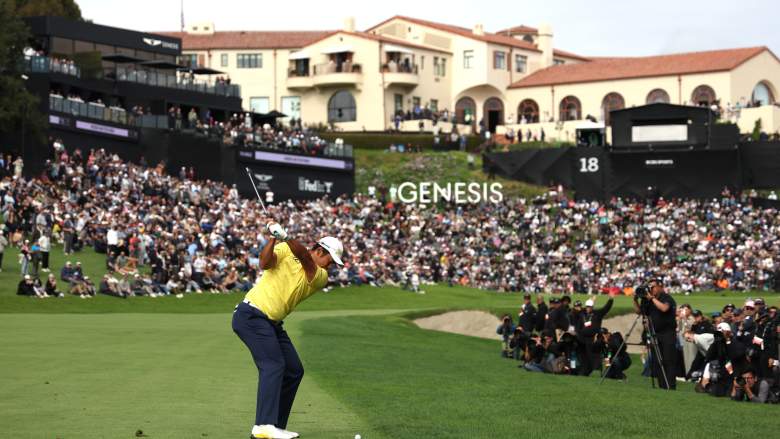
Hideki Matsuyama of Japan hits a second shot on the 18th hole, finishing a round of 62, to win the tournament during the final round of The Genesis Invitational at Riviera Country Club on February 18, 2024.
As the Genesis Invitational returns to Riviera Country Club in 2026, the golf world is also celebrating a landmark: 100 years of Riviera Country Club. Since its opening in 1926, Riviera has become much more than a golf course; it’s a cultural and architectural touchstone that has helped define the sport on the West Coast and beyond. This anniversary isn’t just about longevity; it’s about legacy.
Nestled quietly at the intersection of Sunset Boulevard and Capri Drive in Pacific Palisades, Riviera’s modest entrance belies the history, drama, and architectural brilliance that lie within. While Beverly Hills and Bel-Air golf clubs might catch your eye with ornate gates and grand facades, Riviera’s understatement is almost part of its mystique – a golf course that lets its design and its champions do the talking.
A Humble Entrance with a Storied Past
The club’s rise to prominence began with a desire for something extraordinary. Members of the Los Angeles Athletic Club (known as The Uplifters) sought to add a world-class golf course to their offerings in the early 1920s. After extensive searching across the Santa Monica area, they found a tucked-away parcel of land hidden in a valley just over a mile from the Pacific Ocean. Upon seeing the site, Frank Garbutt, one of the leaders of the push, famously declared, “This is it!” and the journey toward Riviera’s creation began.
The land was purchased for $264,500, and then developed at a cost nearly quadruple that of the average course at the time. Beyond the golf course, a Spanish Revival-style clubhouse was erected, and remarkably, it remains close in appearance to its original form. From the outset, Riviera was intended to be a place of distinction, a home not just to golf but to community and character.
Architectural Brilliance in Every Fairway
Riviera’s layout was the work of architect George C. Thomas Jr., whose design would later be called his “masterpiece.” Thomas was initially skeptical of the property, but he was eventually convinced by the club’s ambitions and investment. During construction, famed architect Alister MacKenzie visited the site and pronounced it as fine as any he had seen, praising the routing as close to perfect as possible.
Riviera stretches to just under 7,400 yards for the Genesis Invitational (Par 71) but retains a strategic complexity that predates length. Its Poa annua greens, kikuyu rough, subtle elevation changes, and classic bunker work demand precision off the tee and thoughtful iron play. Holes such as the par-3 fourth and the donut-green par-3 sixth are regularly cited as among the most interesting and challenging on Tour, blending historical design principles with creative strategy.
A Century of Legendary Moments
Just two years after opening, Riviera hosted its first Los Angeles Open in 1929, won by Scotsman Macdonald Smith. The course would host sporadically until securing a permanent place on the PGA Tour in 1973. Since then, Riviera has been a consistent stage for elite competition, producing memorable champions and historic moments.
The mid-20th century brought some of golf’s most dramatic Riviera chapters. Sam Snead, fresh from WWII service, won in 1945, while Byron Nelson claimed victory in 1946 and later said he considered the event “as important as a major.” Ben Hogan’s back-to-back victories in 1947 and 1948, followed by his 1948 U.S. Open win at Riviera, solidified the course’s reputation as “Hogan’s Alley.” These performances helped position Riviera not just as a local treasure, but as a national benchmark of excellence.
Later decades brought champions such as Arnold Palmer, Tom Watson, Fred Couples, Phil Mickelson and more. In the modern era, names like Adam Scott, Max Homa and Hideki Matsuyama have etched their own Riviera legacies, each victory adding another layer to the tournament’s rich history.
Cultural Significance Beyond the Scoreboard
Riviera’s allure hasn’t been limited to its competitive pedigree. From Hollywood royalty to today’s celebrities, the club has long been a magnet for famous faces. In its early years, personalities like Douglas Fairbanks, Mary Pickford and Walt Disney were known to frequent the grounds. In recent decades, members have included figures like Mel Gibson and comedian Larry David.
The clubhouse, timeless in its Spanish Revival architecture, serves as a cultural hub as much as a golf facility. Its design recalls Riviera’s origins while providing a backdrop for decades of social and sporting tradition. In a region known for glamour and spectacle, Riviera stands out not for flashiness but for character.
Evolution, Restoration and Modern Identity
While Riviera’s routing has remained largely unchanged since 1927, the course has seen thoughtful restoration that reinforces its Golden Age DNA. After the club was acquired by the Watanabe family in 1988, architects Bill Coore and Ben Crenshaw were brought in to restore greens and bunkering to Thomas’ original intent. In the last two decades, Tom Fazio has also contributed refinements that respect tradition while accommodating the modern game.
Golf journalist Bradley S. Klein has noted that Riviera’s reputation has only grown as course photography and architectural awareness have risen. In the 1990s and beyond, West Coast courses began to be appreciated on par with their East Coast and Midwest counterparts, and Riviera has stood at the forefront of that recognition.
More Heavy on Golf
Loading more stories