
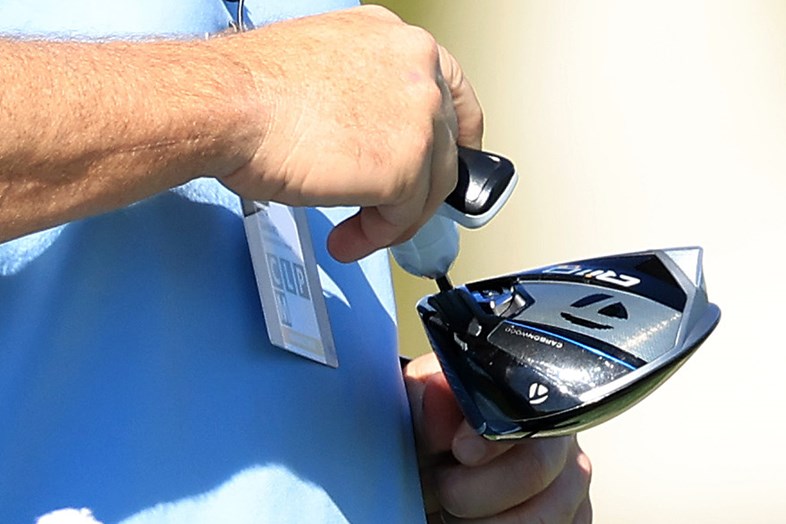
Our latest testing shows that moving two small weights on your driver could add up to eight yards of carry distance – or tighten your dispersion – without changing your swing.
Most golfers never touch the settings on their driver after taking it out of the wrapper.
That might be costing them serious distance – and could be causing them to miss fairways.
How so?
Most modern drivers come with adjustability. Some feature sliding tracks to fine-tune shot shape, while many use two interchangeable weights – one positioned towards the front of the head and one at the back. One of those weights is heavier than the other, and swapping their positions fundamentally alters how the club performs.
But by how much?
In our 2026 drivers test, we tested every adjustable model in both the ‘weight back’ and ‘weight forward’ settings to see how the different configurations altered performance.
The results were eye-opening.
In some cases, carry distance changed by more than eight yards – using the exact same head, the same shaft, the same tester, and the same clubhead speed.
How much difference can it really make?
The biggest jump came from the PXG Lightning Max-10K+ driver. With the heavier weight at the back of the head, it carried 272 yards. Move that weight forward and carry jumped to 280.2 yards – a gain of 8.2 yards.
We saw similarly meaningful shifts elsewhere:
Srixon ZXi LS: +8.1 yards (weight forward longer)
PXG Lightning Tour: +7.2 yards (weight forward longer)
TaylorMade Qi4D LS: +6.3 yards (weight back longer)
That last example is important.
Because in some cases, the so-called distance-maximizing weight-forward setting was actually shorter.
This isn’t a simple case of weight forward equals bombs – at least not every time.
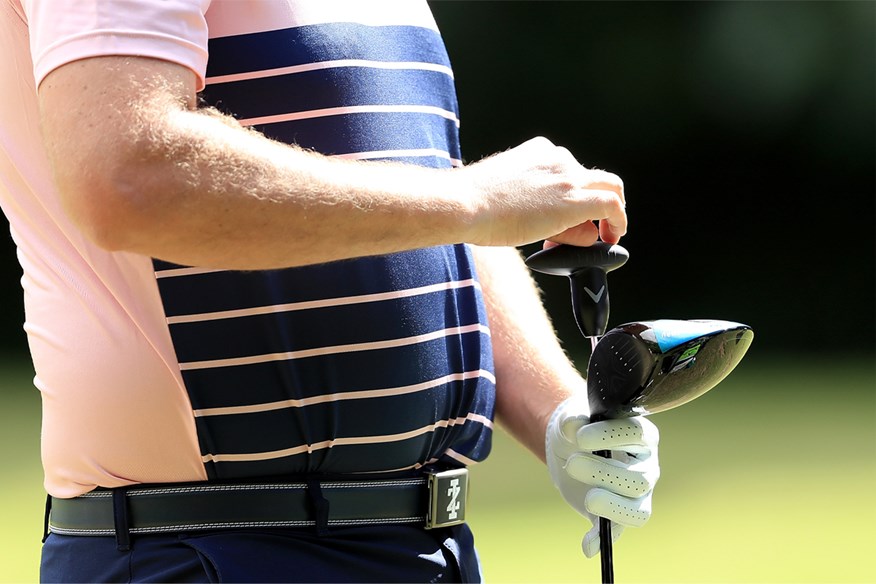 What actually changes when you move the weight?
Putting the heavier weight forward shifts the center of gravity towards the front of the clubhead. That typically:
Reduces spin – often by 200–600rpm
Lowers launch slightly
Flattens peak height and descent angle
Increases ball speed on centered strikes
Reduces forgiveness on mishits
Putting the heavier weight at the back does the opposite:
Raises MOI
Increases spin
Launches the ball higher
Produces steeper descent angles
Tightens dispersion in many cases
Across the dataset, the forward setting frequently dropped spin by several hundred rpm. But lower spin didn’t automatically mean longer carry.
In some heads, the extra launch and spin from the weight back setting actually created a better flight – and more carry distance.
Like this article? See more TG content in your feed! Click here to add Today’s Golfer as a preferred source on Google.
The surprise: why the “forgiveness” setting is sometimes longer
This is where the story gets interesting.
With the TaylorMade Qi4D LS, the weight back setting was 6.3 yards longer than the forward setup.
The standard TaylorMade Qi4D and the Titleist GT4 were also longer with the heavier weight at the back.
Why?
Because optimized spin beats simply chasing the lowest spin possible.
If the forward setting drops spin too much, or punishes your mishits too severely, you lose peak height. The ball flies flatter and you can lose carry distance.
The general trend still holds – weight forward will usually mean more distance and less forgiveness, while weight back should do the opposite – but the only way to find the best setup for your swing is a good custom fitting or testing session.
 Dispersion: the trade-off most golfers ignore
Extra distance is great, but it’s no use if you’re constantly chipping out sideways from trouble.
In a number of models, forward settings increased left-right dispersion by several yards. That’s the MOI trade-off in action – pushing mass forward means less stability.
For a highly consistent ball striker chasing spin reduction, that’s manageable.
For a mid-handicapper who frequently misses the middle of the face, it might not be worth the gamble.
And that’s another reason the back setting – billed as the more forgiving setup – can sometimes produce tighter dispersion and longer carry distance.
Which setting should you use?
If you:
Generate high spin (north of 2,800rpm)
Deliver plenty of dynamic loft
Strike it consistently out of the middle
… the forward setting could unlock meaningful distance.
But if you:
Sit in the 2,200–2,400rpm window already
Need help launching it higher
Miss the center occasionally
… the back setting may actually be the better play.
The bigger takeaway
The real lesson here isn’t just that you can gain eight yards by adjusting your driver.
It’s that your stock setting probably isn’t optimal.
Unless you went through a detailed custom fitting that explored weight placement, there’s a good chance you haven’t unlocked everything your driver can offer.
Most modern drivers are effectively two heads in one. Move the weight and you alter spin profile, peak height, descent angle, and forgiveness – sometimes dramatically.
Ignoring that adjustability means you’re paying for a feature you’re not utilising – and potentially missing out on significantly better performance.