
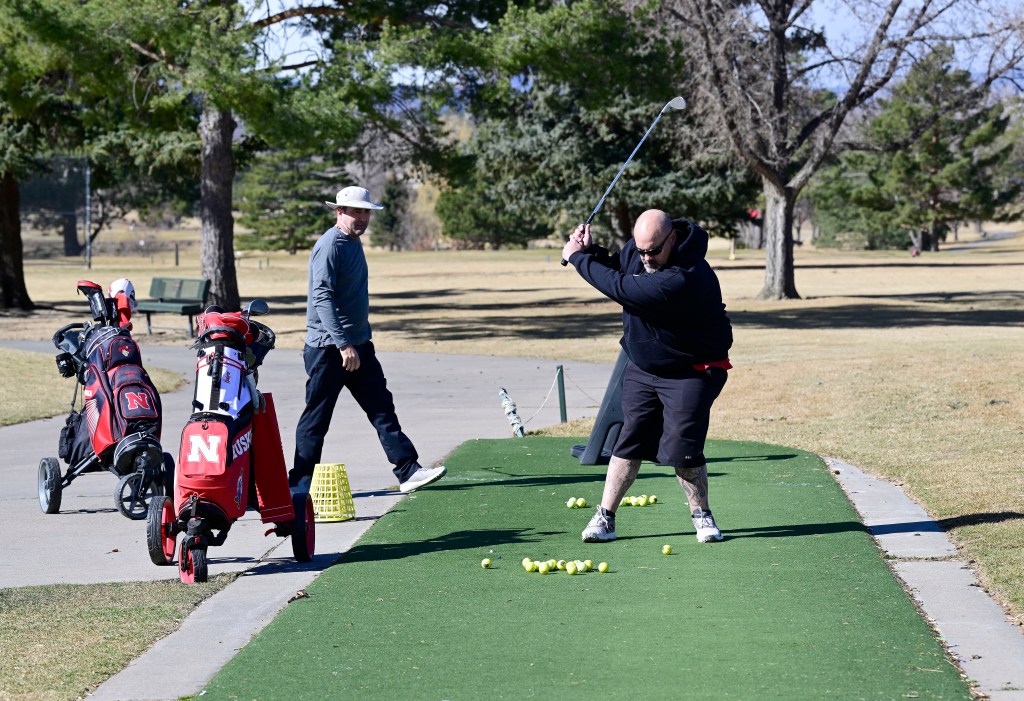
An unseasonably warm and dry winter has been a boon to Loveland golfers like Rocky Stough and Logan Campbell, who were hitting range balls at Loveland’s Olde Course on Tuesday.
“I’m standing here in shorts on Feb. 17 and we’re playing golf,” Stough said with a laugh. “It’s crazy.”
The pair have taken advantage of the unusual conditions to hit the local links about once a week over the winter, but wear and tear from the prolonged dry spell is starting to become noticeable.
“There’s dead grass and a little fairway cracking,” Stough said.
To prevent more of the same for the drought-stressed turf, Golf Loveland is making a rare move. Beginning Friday, the use of golf carts will be suspended at all three municipal courses until further notice.
“We’ve held on as long as we could,” said Golf Operations Director Mark Esoda. “It’s a revenue stream for us, so it was a hard decision, but it had to be made.”
The decision came after Course Superintendent Dennis Kling sounded the alarm following a technical assessment of the turf at the Olde Course last week showed it was holding almost no moisture. He had also noticed that at “pinch points” where golfers enter and exit fairways, much of the grass has been worn away.
“We’re at a critical stage,” Kling said. “And when you’ve got carts driving repetitively over the turf, you get to the point where you don’t have anything left. It’s just down to dirt.”
Kling, who has worked on Loveland’s municipal courses for 35 years, said he has never seen winter conditions quite like this.
“This is the worst,” he said. “Especially knowing what we don’t have up in the hills. It would be one thing if it were dry down here and they were getting a foot of snow every weekend, but that’s not happening. It’s pretty scary.”
The cart suspension applies to both players and course staff, including range operations. Maintenance crews will avoid taking vehicles onto the turf as well.
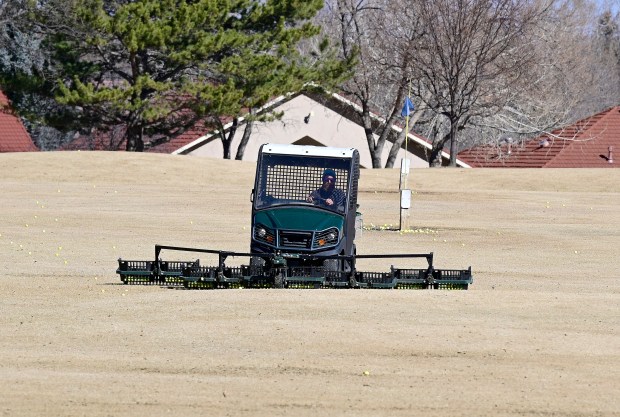 Mike Connelly, an Olde Course employee, drives a range picker to up balls on the driving range Tuesday at the golf course in Loveland. After Thursday all golf carts will be banned from the course including the range picker because of the dry conditions on the course. (Jenny Sparks/Loveland Reporter-Herald)
It is unclear when carts will be allowed back onto the courses, Esoda said, because the answer depends in part on how much water will be released to the courses this year. Final allocations are not expected until late March or early April, once mountain snowpack levels and runoff forecasts become clearer.
In past dry years, the courses have received as little as 50% of their water shares, Kling said.
“With that, you’re good to about midseason,” he said. “Then we’d be looking at leasing water.”
Irrigation ponds are currently about 85% full — typically they would be near capacity this time of year — adding to Kling’s concerns about how long supplies will last if conditions do not improve.
“It could bleed into next year,” he said. “There are a lot of uncertainties, and I’d rather be the doomsday guy than assume we’ll get all the water we need.”
Kling said that if water supplies are limited, protecting greens — “where the money’s at,” as he put it — would take priority, potentially leaving some fairway areas to struggle.
“It’d be unfortunate if we had to let fairways go,” he said. “But we have to make sure we still have a good golf course when we get out of this drought.”
In anticipation of continued dry conditions, staff this week activated the courses’ irrigation systems roughly a month earlier than usual, charging main lines and laterals so they can water if necessary. The move carries some risk if freezing temperatures return, Esoda acknowledged, saying it was a calculated decision.
Despite the uncertainty, Esoda said he and his team are hopeful the restrictions will be temporary.
“We’re not trying to stop everything,” he said. “We’re just trying to slow it down.”