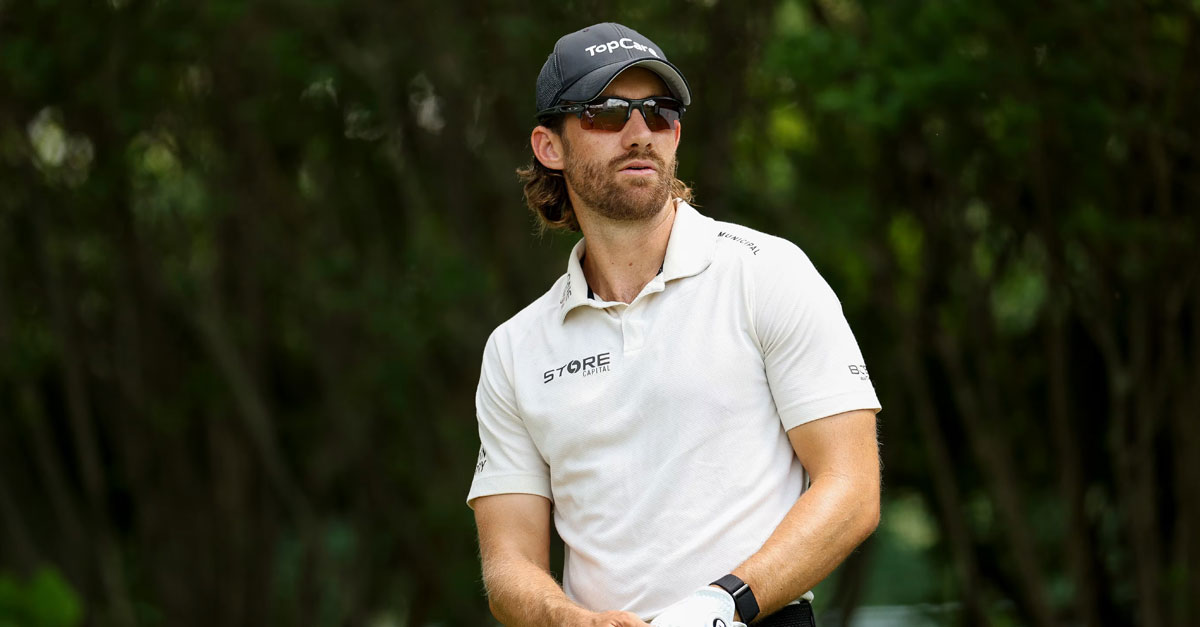
Patrick Rodgers turned professional in the summer of 2014 after an exceptional amateur career that included appearances on two successful Walker Cup teams (2011, 2013) and 11 collegiate wins in three seasons at Stanford, tying Tiger Woods’ school record. Now entering his 12th season on the PGA Tour at age 33, Rodgers is playing some of the best golf of his career. He has made the cut in each of the first three tournaments of the season, highlighted by a solo third-place finish at the Sony Open, and currently ranks eighth in the FedEx Cup standings.
Ahead of last week’s Farmers Insurance Open at Torrey Pines, I caught up with Rodgers to discuss unplugging from technology, the state of his game, the shifting collegiate athletics landscape, amateur golf development, the future of the PGA Tour, and much more.
After Christmas, you posted about how you’ve historically wasted downtime scrolling on your phone. You wrote, “In 2026, one of my main priorities is to use dead time to do something meaningful. Read, reflect, think.” What motivated that post and how has that initiative been going?
Being at home for seven weeks in the offseason, out of the routines of the typical Tour season, spending time with my kids and realizing that I – along with everyone else – we’re all addicted to our phones. Often I find myself waiting in line somewhere or sitting around at an airport on my phone. The scary thing is sometimes even when you’re at home with your kids, you have an urge to pull out your phone.
At the start of every year, I want to prioritize things that are productive, that push me forward in the right direction of accomplishing my goals. That felt like an important one to me.
And just trying to balance life. I have two young kids, a five-year-old and a two-year-old, and I’m still trying to be the best player in the world. I can’t afford to be wasting time. There are so many things that I could learn if I was reading instead. I just felt like it was important to make a change, and it’s something that’s already had a big impact on my year. It’s amazing the amount of time that I feel like I’ve gained back since the apps have been just deleted on my phone. It’s been great.
What are you reading right now?
I’ve already finished a couple of books this year, which is a nice positive trend. I love reading and it makes me happy, but it’s crazy how often that gets lost in the fray.
I reread “Atomic Habits,” an impactful book that came out five or ten years ago. I felt like it kind of set me on the right course to start the year, building positive habits that compound over time. Doing the little things that make you feel like you’re productive during your day, kind of stacking small wins on top of one another.
And then I just finished one called “The Courage to Be Disliked.” It was originally written in Japanese, and it’s basically a dialogue between a Japanese philosopher and a student who’s really skeptical of him. It’s a lot of really powerful, simple life lessons.
MORE Q&A’s: From Patrick Reed and Frank Nobilo to Mike Clayton and Edoardo Molinari
We’re recording this right before the Farmers. You’ve had a solid start to the season and you’ve also played well stretching back to the fall. Where do you feel like your game is right now and how does that compare to how you’ve felt in previous seasons?
The middle of last year was a little bit frustrating. I felt like I was on a nice, continuous, positive path for the two to three years building up to that point, starting to play some of the most consistent golf of my career.
And just like anything, golf kind of slaps you in the face sometimes. I had just worked into a really funky technical pattern in my swing without trying to make a ton of adjustments. It was difficult because I had to play a lot of last year while I was uncomfortable with my swing technically, trying to get back into a spot that I was familiar with, but it just felt really, really funky.
Like anything in the game, you work through it and it feels great in practice and it just doesn’t show up in competition right away. You sort of revert to what’s comfortable.
Then finally, towards the end of the year, I felt like a lot of the work that I had put in during the late summer was starting to show up and I was giving myself more opportunities to score and succeed. But I’m most pleased now that I was able to build upon that through an offseason and have it show up a couple months later to start the new year.
Through two tournaments this season, you’ve hit your irons very well, which hasn’t always been your strength. Is that something you’ve been working on?
Yeah, my coach and I really put our heads together late last summer and into the early fall. The place that I need to get to in my game is that if I can become an elite iron player, opportunities really change for me.
I’ve always been a really good driver of the golf ball. I’m fortunate to still hit it a long way, even in the modern game. And my putter has always been a huge asset. I think that’s kind of the reason that I’ve had longevity playing the Tour.
But all of the best players in the game throughout history, and definitely all the best players in the game now, are the best iron players. It’s kind of a non-negotiable. And I’ve never been an elite iron player in my career on the Tour, so we’re trying to figure out the best way to navigate the problem.
I tend to play golf sort of towards my back foot, pretty heavily rotated. It makes me hit a driver really far and up in the air, but it also makes short irons and wedges more difficult. The challenge has been: how do I blend the two? How do I maintain elite driving while putting myself in a position to hit my wedges better?
We feel like we finally approached it from a little different angle, some different feels and thoughts that started to show up in practice and pretty immediately in competition. It’s been nice to see that continue, and yes, quality iron play has been the reason I’ve started off the season so nicely.
In assessing your own skill set since you’ve been on Tour, have your statistics aligned with your expectations? Is iron play something that you knew you needed to improve when you turned professional or is that something you had to learn?
It’s actually a really interesting question. When I started on Tour, I kind of had the belief that I was elite in every area and really backed myself and had a lot of confidence. One of the things I struggled with early in my career was that I have always been a massive golf fan, have watched a ton of golf, and I really revered the best players in the world.
Then when I was competing against them and seeing their skill sets up close, a lot of times I was incredibly impressed. I think to my detriment, it made me feel like I had some serious flaws in my golf game.
I’d watch Dustin Johnson and Rory McIlroy hit a driver and feel like I didn’t have the gear that they had. I would watch Justin Rose’s iron play and feel like I’m not as precise as he is. Or Luke Donald’s short game, he had so many different shots that I felt like I needed to have.
You kind of go down the list and all of a sudden, you feel like your game has a lot of holes in it. So I spent the early few years of my career trying to kind of piece together a game that wasn’t my own.
Through that process, I feel like I started to understand that I need to maximize my skill set to the best of my ability and understand my strengths and weaknesses. Plus, by that point, I had four or five years of data on my game.
Now going into year 12, I’m so much more comfortable in my own skin. I feel like there’s a best version of me that’s very capable of having a lot of success on the Tour.
And, fortunately, as many changes as I’ve had in my life, I feel quite motivated and enthusiastic about my pursuit of where I can get to in the game, maybe more than ever. I love it. I’m addicted to it. I love showing up to work. And I’m excited about what the future holds.
Have you set any specific goals for the remainder of your career or do you focus more on taking things day by day and focusing on what you can control?
Yeah, I know it can sound cliché. When I was young, I had tons of external goals that drove me forward. I had checkpoints along my junior career and my college career and into my professional career. Kind of a little road map.
When you’re young and when you’re growing every year, you see progress in golf in a very simple, linear form. That makes it easy to chip away at a lot of those external goals. But eventually you reach a point in golf as a professional where the margins are really tiny. Sometimes the progress can be quite a bit harder to see.
Through being a Tour player, I have found that the best goals I can set for myself are the day-to-day stuff, the things that are really within my control. At the end of the day, I can’t control how anybody else plays. I can’t control if somebody has a hot Sunday. I have no control over what the cutline is for a week or the wave split that I get. But I do know that if I do the things I’m capable of doing really well, I’m going to have a lot of chances to win.
I’ve kind of evolved to where my goal-setting is much more with my daily systems than how many events I want to win or what place I want to be in the FedEx Cup or on the money list. I’ve learned those lessons maybe the hard way through some disappointing years. But I think the place I am now is healthier.
I want to get into the shifting college landscape. You posted on X, “There’s a lot to say about the current situation in collegiate athletics but my take is that kids and athletes in general could be better at handling adversity – that is where the growth lies.” What motivated that post?
I was watching the College Football Playoff. I’ve been fortunate now to be back around the Stanford football program a little bit more.
College sports have changed massively. I can’t really relate to it. I don’t know what it’s like to be a college kid and getting paid through NIL money. I don’t know the mentality of transferring to four different schools in four different years or watching a college football program and it’s full of 23-year-old seniors.
It makes me feel old and sort of disassociated from the current situation. But from the outside looking in, it’s pretty clear to me that the best way forward to get the most out of yourself is to delay gratification – to be working hard now for something that you’re seeking to have in the future. That has served me well over the course of my career.
I hate what I see now with kids who are making decisions for the short-term gain at the cost of long-term growth and development. Maybe they’re signing a $50,000 NIL deal and switching schools at the cost of their development as a player.
I can’t sit here and say I know what I would do if I was in their shoes at that age. I mean, I thought I was rich if I was getting guac on my burrito at Chipotle at that age. Who knows how I would handle it?
But I worry about kids nowadays with access to so many things in the short term and what the cost of that is as they grow up.
It’s a completely different landscape today compared to when you were in school. Not just the prevalence of NIL, but PGA Tour U didn’t exist back then. We also have LIV Golf, which just signed the NCAA individual champion. As a highly decorated collegiate player, how do you reflect on your decision to turn professional when you did? And what do you think the key considerations should be for a golfer today who is trying to decide when they should turn pro?
The PGA Tour University situation is amazing now, and I would have loved to have that opportunity when I was coming out. Probably the most stressful part of my entire career was trying to get my Tour card. I put a lot of pressure on myself. I had a lot of expectation internally of getting to where I wanted to go, and it felt like a really steep mountain to climb.
The reason why I turned pro when I did was I felt like I had the longest opportunity and the biggest window of chances to play. At the time, you could take seven sponsor invites, and I got those in successive seasons. I felt like those 14 starts were going to give me a runway to have a chance to earn my card.
I was fortunate that I played well enough in a few of them to earn my status and get some Tour status without going to Q-School. I’m really grateful. I hope I never have to go to Q-School.
But I can tell you that the nine to 12 months of trying to earn status was incredibly stressful. It felt like massive ups and downs that I had never experienced in golf before. With PGA Tour U now, giving the top college players an 18-month runway to get their feet underneath them as professionals is hugely, hugely helpful.
The opportunity with LIV is a little bit like an exaggerated version of the college NIL situation. It’s been an unbelievable sociology experiment with golf. What does your competitive integrity mean to you? What price do you pay for it? It’s given a lot of professionals really interesting philosophy questions.
I feel like as a young player, you want to give yourself the simplest ladder to the top of the game if you really back yourself. And I don’t believe that’s on LIV. I believe the structure through the Tour gives you the best chance to win majors and become the number one player in the world. I wouldn’t trade that for anything when I was young, because that’s where I wanted to go.
The best golf in the world is being played almost exclusively by players aged 27 to about 36, with a few exceptions. As the PGA Tour is currently constructed, do players aged 22-27 have enough of a platform and safety net to develop?
My biggest critique of the current system is that I think it delays the opportunity for the best players of the next generation to become the stars. Right now we’re maybe a little bit stuck in a situation where we’re kind of rerunning the same play with the same stars and the same top players for nearly a decade now.
Of course, there is some turnover, but it takes some really exceptional golf to break through from the rookie or the Korn Ferry category into the elite area of the game. When I started on Tour, I felt like everyone with a PGA Tour card was kind of starting at zero each year. If you played the best golf, you were going to be the top player that year.
It definitely still is that way, but I’d be lying if I said that rookies didn’t have a higher mountain to climb than some of the better players at the moment. I think that just delays the turnover and the opportunities for a younger player. It’s harder than ever in the current system.
Despite the PGA Tour U being incredibly positive, it’s only a Tour card for one player each year. Or if somebody earns their Tour card early through the Accelerated system, there might be a few. But if you’re the fourth-best player in college golf, you’re a heck of a player. In my opinion, we want those guys on the Tour as quickly as possible with an equal opportunity.
The fall was a perfect example, in my eyes. You had Michael Brennan playing on a sponsor invite in Utah. He played incredible golf, won the event, and everyone is blown away by his skill set. He’s a phenomenal player, he hits it a mile, and his game is really refined.
Had it not been for that sponsor invite, he’d have been playing this year on the Korn Ferry Tour. And now he’s ranked nearly 30th in the world and one of the premier young players in the game.
I hate that it took kind of a chance event for him to have access to the Tour because people like him with his game deserve as much of a chance as anyone.
You mentioned the expectations you had to deal with. For somebody like Jackson Koivun or another top amateur in the world, what advice would you give for dealing with that level of expectation when turning pro?
I would tell somebody like Jackson to take a lot of confidence from the résumé that he already has and that the best version of their golf is good enough. That’s not to say that you won’t grow and refine and change your mind and opinion about a lot of different things.
I think the thing I struggled with the most early in my career was the comparison piece. But at the same time, college players now have more evidence that their best is really good. I felt like when I was an amateur, making a cut and being kind of in the mix on the weekend at a pro event was kind of the validation and the experience that I needed to feel confident turning pro.
Now these guys are trying to win events when they’re an amateur and in college. Honestly, I don’t even think that was on my radar at that young of an age. So it’s definitely sped up that process.
I hope that the guys come out with the confidence that their best is good enough to have a lot of success on this Tour.
Shifting gears, much will be made of the USGA’s return to Shinnecock Hills for the U.S. Open this summer. You played the 2018 U.S. Open at Shinnecock. The Saturday round was a wild day that ended up being controversial. What are your core memories from how the golf course played that day? Did they go over the line with the setup?
I have kind of a bitter relationship with that day, to be honest.
I think I was in 10th place through two rounds, so I had a late tee time on Saturday. I was obviously playing some really nice golf to be in that position.
On Saturday, I hit 12-of-14 fairways and shot a 13-over-par 83. I think I had over 40 putts. Rickie Fowler played behind me and shot 84. It was crazy.
I’ve played some big-time USGA events, a lot of U.S. Opens, and I had never seen a golf course get like that. Then they watered the crap out of the course the next day. I shot 67 and didn’t really go anywhere because the course was soft and gettable.
The shame was that Shinnecock, you could go host a U.S. Open there on a random Wednesday for member play, it’s that good of a track.
It’s a shame. I think anybody from the USGA would tell you that event was mismanaged, but it gives massive props to Brooks because he played like an hour behind me on Saturday and shot like +1 or +2 and won the U.S. Open.
It’s easy to be bitter and disappointed when it doesn’t go your way, but that was one of the most frustrating moments of my major championship career because I felt like I was finally on the cusp of getting to where I wanted to be and playing the golf that I wanted to be playing.
And yeah, I ran up against a pretty impossible test that day.
{{inline-course}}
Do you believe there’s a distance problem in professional golf? What’s your opinion on the equipment rollback? If there is a problem, would it be better to address the driver head or the golf ball?
I think broadly in the game, there is not a distance problem. I play with people in pro-ams every week and I don’t think I’ve ever played with somebody who hits it too far or feels like there’s not enough golf course for them.
The professional game has changed a lot. Data has basically made clear that hitting it as far and as hard as you possibly can is the ultimate advantage.
Like we were playing the North Course at Torrey today, and there’s a really simple little 320-yard hole, No. 7. We were talking about how even just at the beginning of my career, which was 12 years ago, that was a hole where the majority of guys hit an iron and a wedge. They laid back. There weren’t ShotLink analytics that said it was a great play to send it up by the green.
I feel like if I was to hit driver on that hole, you were almost looked at by your peers as being reckless back then. Now hardly anyone lays up. Everyone just hits driver by the green and lives with wherever it goes.
When you see that week in and week out, it permeates the way you practice. It flows through every young player. College systems and the whole system of the professional game has shifted in a major way towards speed.
I don’t personally think there is a distance problem. I think the game has changed in a massive way. If you want to make distance less of a factor, then shrinking the driver head would be a great idea.
At this point in my career, I’ve played for long enough under the current system of rules that I think any adjustment would be really inconvenient. You’re not going to get a ton of professionals who support massive changes to the equipment.
I’ve always thought it would be a shame to make sweeping changes to the entirety of the game to try to curb 300 professionals. I think that would be a shame.
If you had to vote, would you support or oppose shrinking the driver head just specifically for professionals?
I’d probably vote against shrinking the driver head, but it would be an incredibly selfish vote.
I don’t know if that’s for the betterment of the game or the betterment of myself, but I wouldn’t want to shift to a smaller driver.
Reports indicate that the PGA Tour schedule may look a lot different in 2027 than it does today. Between field sizes and the number of events on the schedule, what is the ideal structure for the PGA Tour in your mind?
I’m a bit of a traditionalist. Change is hard for anyone, and I understand that. And I definitely want to grow the PGA Tour into something that is more suited to the modern entertainment industry.
But it would make me really sad to throw away decades of history with amazing events just for the sake of trying to make the PGA Tour more elite. I have always really enjoyed the PGA Tour the way it’s been.
Like I said, I’m a traditionalist. I respect the history of the game and I’ve always been a massive golf fan. I’m a fan of every event we have. I feel lucky that we go to almost all of the stops on the Tour, and I think each one of them has an amazing thing to offer each week to that community, to the players that go and play, and to the fans that come and support.
So personally, I wouldn’t like shrinking the schedule. That wouldn’t be something that I would be super supportive of, but I’ve learned that I’m not the one making the decisions. I’m just the one playing.
With as much change as we’ve had the last five years, it’s been very easy to get wrapped up in it. I have learned that the best thing to do is try to play the best golf I can and not get too stuck in it.
Brooks Koepka returned to the PGA Tour this week. It was also announced that Patrick Reed can return to the PGA Tour in the fall. What is your stance on LIV golfers returning to the PGA Tour?
I’ve always wanted to play the Tour because I’ve wanted to be competitive against all of the best players. Especially at the beginning of LIV, it was kind of strange to have a group of clearly some of the best players in the world playing somewhere else.
I think it’s proven that the competitive structure of the Tour allows us to create new stars very quickly because the competition is great. That’s an advantage the Tour has always held over LIV.
So, of course, as a competitor, I want to play against all of those guys. I want to play against the best players in the world. It has been interesting to me how the cost of returning to the Tour is more financial than there being competitive penalties. There seems to be a dollar amount and a loss of future income that they have structured to feel fair towards bringing these guys back.
For me, the thing that hurts a player making that decision more than anything is if there was some sort of competitive penalty – playing opportunities. It’s just been interesting how quickly everyone is kind of welcomed back into the competitive fold.
Yeah, I think it’s going to rub some players the wrong way because the Tour has become a lot more cutthroat and the Tour is very much shrinking. Spots in fields are more competitive than ever. They’re harder to earn than ever before.
So to bring guys back that have actively been advocating for the thing that nearly cost the Tour what it is, it’s just interesting how quickly and easily they’re back into the competitive fold.
What is the most underrated golf course on the PGA Tour schedule?
The most underrated architecture on the Tour is Detroit Golf Club. A classic Donald Ross and it’s about to get a lot better with the renovation. We just don’t play those types of golf courses very often.
I know that it doesn’t play very difficult because the tournament is in the middle of the summer and it’s soft and warm and the ball goes forever. But Detroit Golf Club has some amazingly interesting greens. Great sets of bunkers. From an architecture perspective, I think the bunkers are going to be more in play this next trip around after the renovations.
It’s a very cool old-school course. And obviously I’m biased because I love the Midwest.
Do you have a favorite architect?
Yeah, I’m super into architecture. I love it. I find it fascinating. There are tons of people right now that are doing great work.
Gil Hanse is obviously getting a majority of the really top-quality golf courses, and he does awesome stuff. It’s easy for me to fall in love with his work. I think he has some really cool original ideas.
I’ve also really enjoyed Kyle Phillips’ stuff. I play Cal Club in San Francisco quite a bit, and that’s just as good as it gets. I play at a place in Los Angeles called Hillcrest Country Club, which was one of the best renovations/transformations I think I’ve ever seen. He’s also done some cool work overseas.
Again, really easily accessible for everyone. As in, his designs aren’t going to beat you up. But even for the top player, hazards are in the right place and they’re fun designs to play.
If you could only play one golf course anywhere for the rest of your life, where would it be?
Ooh, if you would have asked me that question like eight years ago, I probably would have said somewhere in Northern California, but I’ve become a bit of a weather wimp. Living in South Florida and chasing the nice weather with the Tour for my whole career, I definitely appreciate some nice weather.
In its current form, I’m going to go with a place like The Park in West Palm Beach. It couldn’t be more pleasant. Just an incredible place. Anyone can play. It’s super accessible. You see kids to elderly people out there playing.
It’s an amazing design. Super fun. I’d love to play there.