
As golf continues to evolve to meet changing climate patterns and year-round participation demands, a new project is pushing the sport into architectural territory few have explored: a full-scale indoor golf course designed under massive, climate-controlled domes. Set for construction in Oswego, Illinois, a community southwest of Chicago, Megalodome Golf aspires to be a landmark in sports architecture and indoor recreation.
A Dome-Driven Golf Landscape

World’s First Full-Scale Indoor Golf Course
The Megalodome concept envisions large structural domes enclosing a real, navigable golf layout. Designed by Huxham Golf Design, a Montreal-based golf architecture firm responsible for course routing and play strategy, the planned facility will house a nine-hole executive course under three connected domes rising roughly 110 feet high.
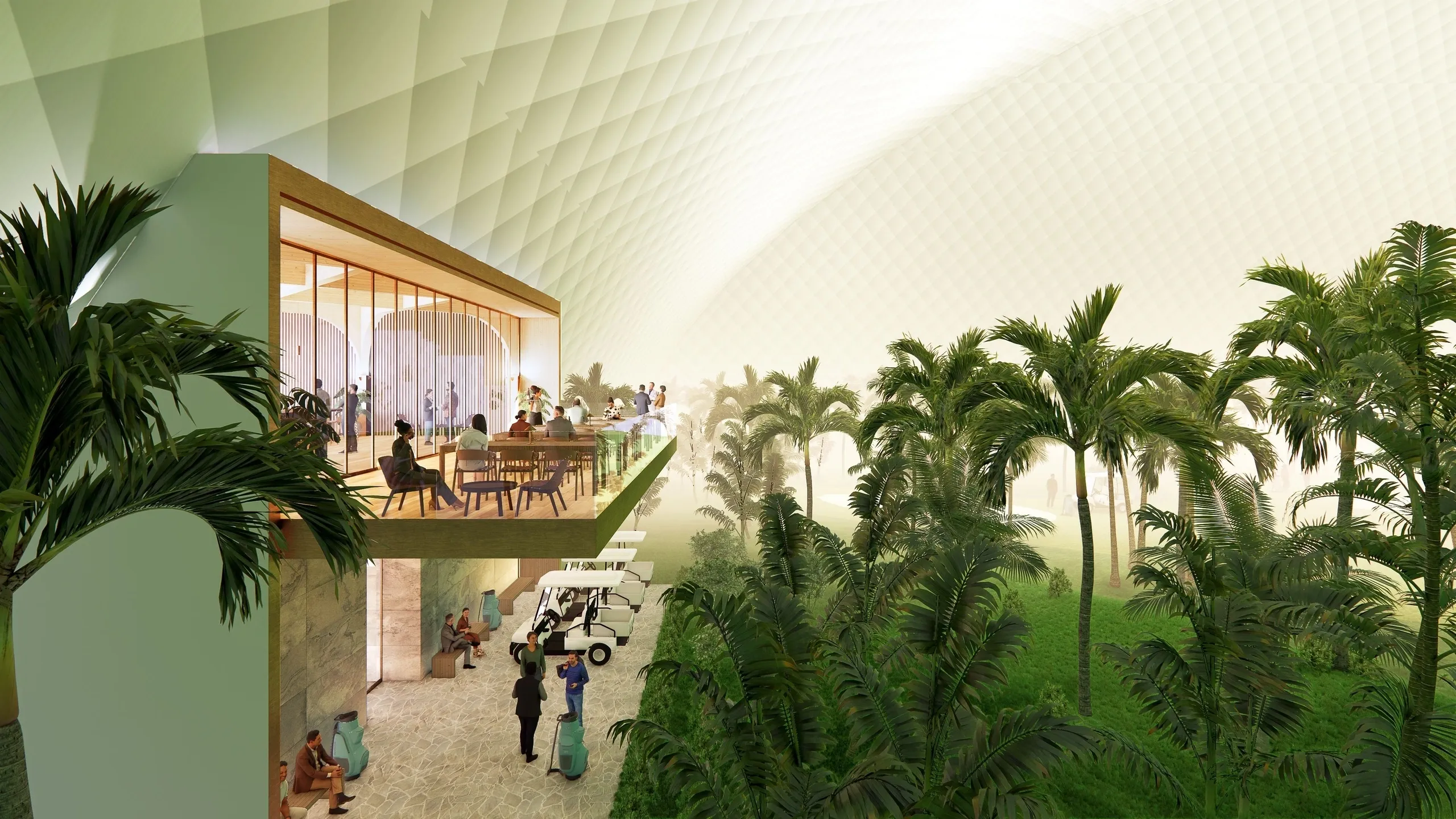
The domes themselves are not merely screens or netted enclosures but architected structures meant to create a climate-controlled environment where elements like wind, snow, or heat no longer govern seasonality. This approach aims to allow golfers full swing play, including realistic ball flight, in a space as large as 300 by 900 feet per dome.
Indoor Golf Course Architectural Features

The club’s executive layout will total a par-30 course featuring six par-3s and three par-4s. The architecture of the golf experience pays careful attention to space efficiency while preserving strategic play, a challenge unique to indoor golf design, where ceiling height and spatial sequencing influence hole layout more strongly than in traditional outdoor courses.

Artificial turf designed to mimic real grass will be paired with real sand bunkers, water hazards, and desert-style landscaping to evoke an outdoor feel inside the structures. This choice reflects a broader trend in experiential recreational architecture, incorporating authentic sensory experience with controlled environments.
Supporting Facilities Under One Roof

In addition to the playing domes, a fourth dome will serve as a comprehensive practice facility, offering a 275-yard driving range, 50 practice stalls, and integrated short-game areas with chipping and putting greens. This dedicated practice environment expands the architectural program beyond the course itself, incorporating teaching, training, and community space into the design.

Plans also include a clubhouse with extended views into both the main course and practice areas, bridging leisure, social, and athletic functions. While specific architectural firms beyond the golf course designers haven’t been publicly credited yet, these program elements suggest a mixed-use recreational design approach that may integrate hospitality design principles alongside sports architecture.
Design Challenges and Innovation

Crafting indoor environments for a sport like golf, traditionally tied to natural landscapes, presents unique architectural challenges. Designers must balance structural span, climate control, natural lighting simulation, and acoustic considerations to create an environment that feels open rather than enclosed. The planned domes’ height and volume seek to give players a sense of vertical space usually afforded by sky and open air.

Unlike golf simulators or smaller indoor training spaces, this project is both architectural and recreational, replicating the mechanics of golf as well as its spatial experience within a built environment.
With target openings projected for fall 2027, the Megalodome Golf facility aims to reshape perceptions of indoor golf and expand the architectural vocabulary of sports facilities. As climate change continues to affect outdoor seasons, facilities like this could pave the way for new hybrid recreational typologies that integrate indoor comfort with outdoor-like play.