
A plan to renovate the Sandpiper Golf Club and restore the landmark Barnsdall Rio Grande filling station to create a western “gateway” into Goleta has received preliminary approval from the city’s Design Review Board with members heaping praise on the ambitious project.
The clubhouse at the golf course, a blockish brown structure built in the early 1970s, would be razed and replaced with a new one built into the earth and topped with an undulating earth berm. Drawings show a design that would make it appear somewhat like a green wave or sand dune on the sloped side and an expanse of glass on the vertical side.
Members recently said they were thrilled by the inventiveness of the design while addressing potential environmental concerns. They said it’s a transformative project that will attract droves of visitors, not just golfers.
“I don’t think Goleta has seen or will see something akin to this design,” said member Dennis Whelan. His overall reaction was an enthusiastic “wow.”
Chair Scott Branch called the proposal “creative” while member James van Order said the design was “very inspiring.”
The clubhouse would include a restaurant and lounge open to the public. The property would be laced with bike and hiking trails and would convert 63 acres of turf to more drought-resistant native vegetation that will both beautify and save water. What remains of the Barnsdall filling station, the iconic tower at the city’s western edge, would be restored to its 1929 grandeur. In place of gas pumps would be charging stations for ebikes.
The proposal includes provisions for monarch butterfly foraging, “naturalizing” portions of Devereaux Creek and preserving five acres of Bell Canyon. Utility poles along Hollister Avenue would be replaced with underground lines.
As far as the proposal has come, it still has a long way to go. Back by the design board’s endorsement, next stop is the Goleta Planning Commission and then the City Council. The Barnsdall element will be reviewed by the Historic Preservation Commission on Feb. 26. The project also needs a coastal development permit. And it eventually will have to come back to the design board for final approval.
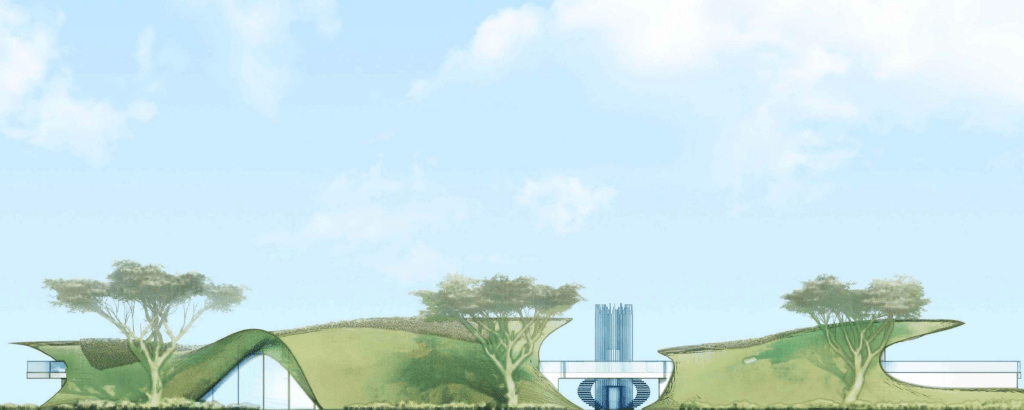 A rendering of the proposed design for the Sandpiper Golf Course.
The site has a unique history tinged by World War II. Oil was discovered in 1927 and the field eventually was home to 25 wells, according to Sandpiper’s website. On Feb. 23, 1942, Japanese submarine I-17 surfaced offshore and lobbed shells into the oil refinery on the site,sparking fears across the West Coast of an impending Japanese military invasion amid the unsettling knowledge that the war had come to American soil.
Oil production ended in 1965 and seven years later the site became a golf course. In 2003, the site was purchased by Ty Warner, the Beanie Babies tycoon who acquired a string of luxury area hotels and resorts.
As designed, much of the clubhouse and parking is out of sight, said Santa Barbara architect Barry Winick in its presentation to the board. “We are trying to put as much as we possibly can underground” with the goal of having the buildings blend into the land and preserving views.
To further beautify the course, a total of 116 trees would be planted.
“For us, it’s all about honoring the landscape that it is here, improving all the public amenities and making it really accessible,” Winick said.
Even with the board’s unanimous endorsement, concerns were raised on some of the details. Most concerned plans for a glass-paned elevator that members criticized as being out of character with the design. The elevator tower “feels a little foreign,” van Order said.
The board also wanted attention to be paid as to whether the glass front to the clubhouse could invite bird strikes. It was pointed out, however, that some buildings have thwarted the problem around the world by using a special type of glass.
A couple members wondered whether the clubhouse might encounter trouble from people trudging across the turf topping it. As such, Branch said safety comes into play.
Members of the public echoed some of the same concerns, but overall, were supportive as well.
As for plans around the Barnsdall filling station, Ronald Nye, chair of the Santa Barbara County Historic Landmarks Advisory Commission, told the board he’s all in favor.
“I like what I’m hearing,” he said. “I have nothing but praise.”